The Open Group Related Exams
OG0-023 Exam
Scenario
Please read this scenario prior to answering the question
The ArchiSuranceTo Go mobile consumer solution is increasingly important to ArchiSurance, which uses it to sell and renew insurance products, provide customer service, enable accurate and convenient home recordkeeping, and capture and process claims. The solution consists of three components. The Consultant lets customers review their existing coverage, and update it based on common life events, such as getting a new car, moving into a new home, or having a family member move in or out. If necessary, they can speak or chat with a customer service representative. The Home Manager helps customers photograph and catalogue their valuable possessions in order to support the filing of accurate claims in case of loss or damage. The Claim Manager enables customers to quickly file a claim for loss or damage to an insured auto, home or possession. It enables customers to describe the incident by referencing information captured with the Consultant and the Home Manager applications. In addition, it allows the customer to add photographs, audio, video and text to support a claim, submit the claim, and monitor its progress.
The ArchiSurancetoGo components rely on a number of application services hosted by ArchiSurance. The first is an Auto Identification and Description (AID) service that the Consultant uses to validate and complete auto information entered by customers. The second service, Home Identification and Description (HID) performs the same function for home information, and is used by the Home Manager. The Consultant also uses the Virtual Agent service to guide customers as they select coverage options, the Payment Processor service to arrange premium payments, and the Coverage Activator service to generate policies and put them in force.
ArchiSurance to Go also relies on a number of infrastructure services. The Home Manager uses a Multimedia Repository service to store and retrieve information about insured homes. The Claim Manager also uses this service for claim information entered by customers. All three components of ArchiSuranceTo Go use a Personal Security service to register and authenticate customers, and to manage their profiles.
Each application service is realized by an application component with the same name. Also, each infrastructure service is realized by a system software environment with the same name. ArchiSurance hosts both the application components and system software environments in a virtual ized server pool within its data center. Each service has its own virtual server. Each server is connected to a data center network (DCN) which in turn connects to a commercial wide area network (WAN).
Refer to the Scenario
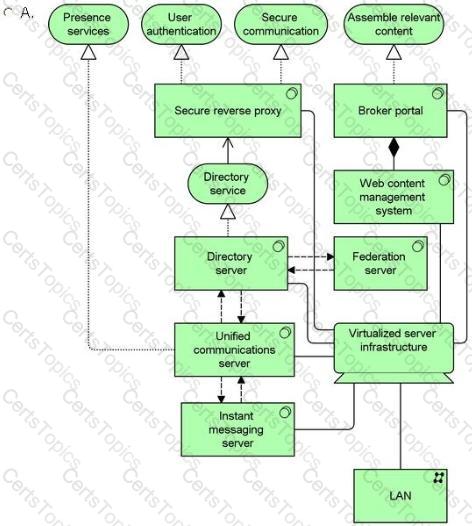
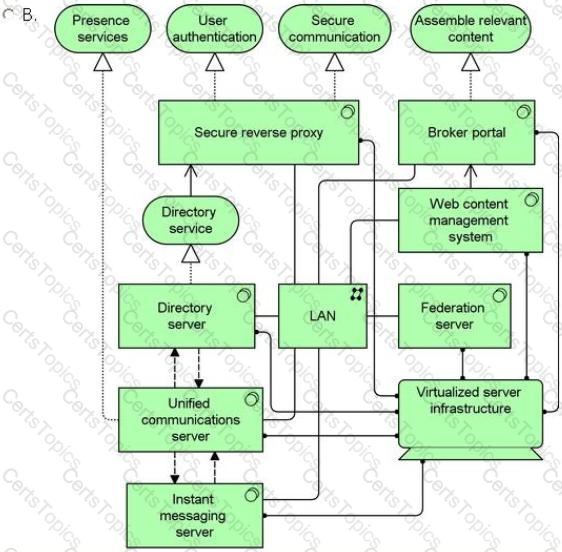
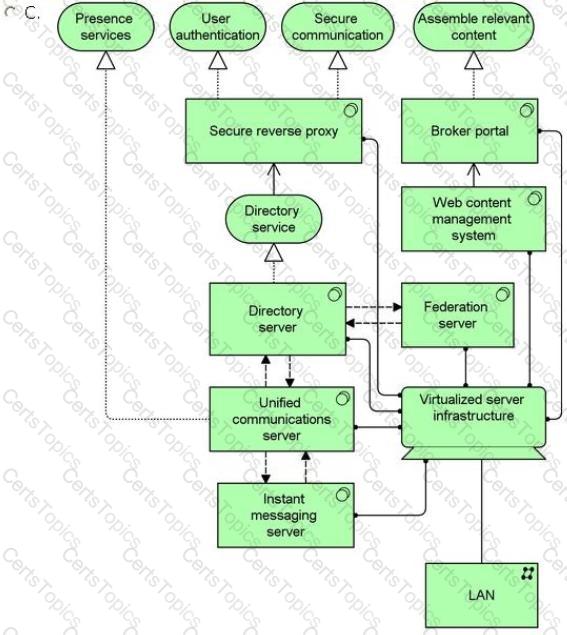
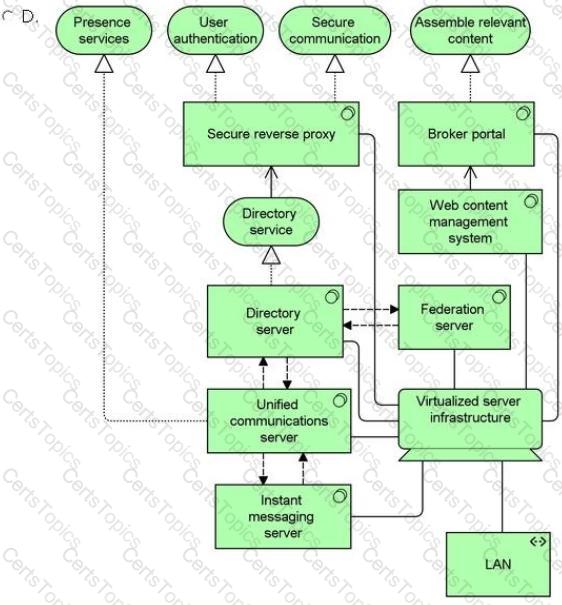
The new head of IT infrastructure would like a better understanding of the applications used by ArchiSurance to Go mobile solution and the hosting infrastructure that supports these applications.
Which answer provides the best description of the applications and their underlying infrastructure? (Please note that it is not necessary to model the networks).


Scenario
Please read this scenario prior to answering the question
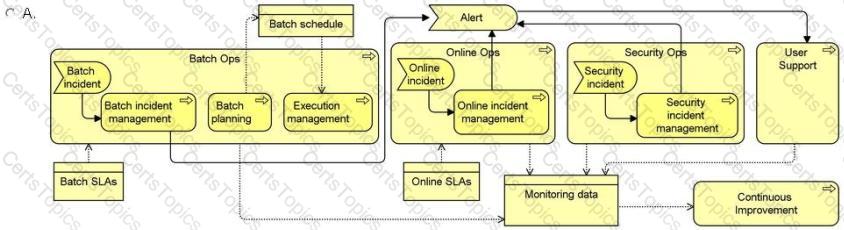
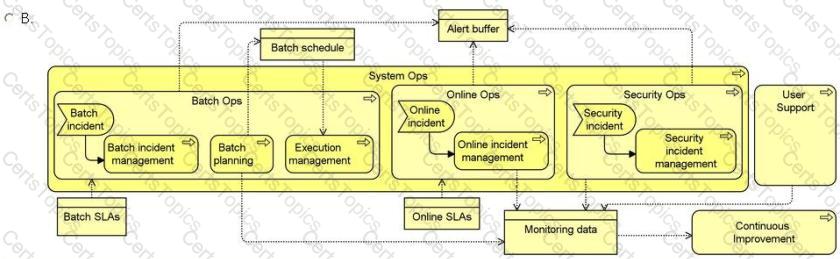
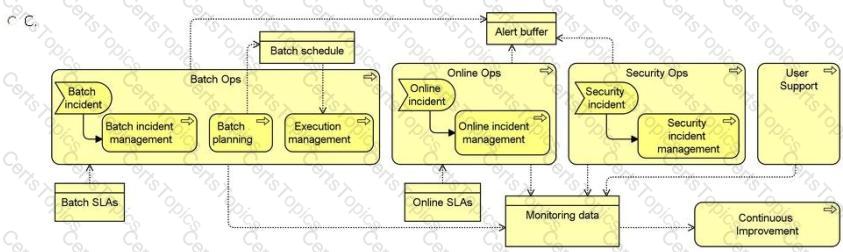
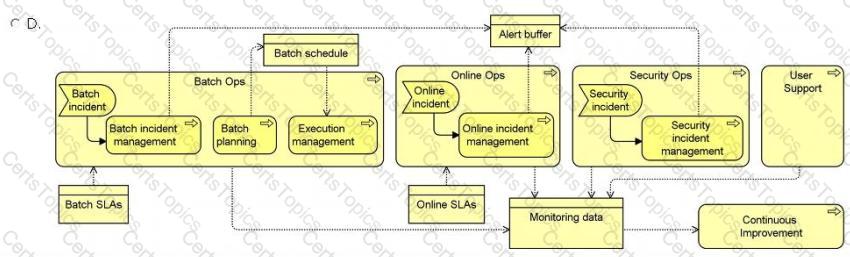
The ArchiSurance IT Operations (IT Ops) department has five core responsibilities, and continuously executes a core business process for each responsibility. (1) The Batch Ops process makes sure that batch jobs execute completely, successfully, and on time, consistent with their service level agreements (SLAs). (2) The Online Ops process makes sure that all web applications and content delivery services are available and performing according to their SLAs. (3) The Security Ops process protects ArchiSurance IT operations from being damaged by malicious or careless incidents. (4)The User Support process assists users of ArchiSurance systems with problems or requests. (5) The Continuous Improvement process monitors and measures the performance of each of the other processes and works to solve problems and optimize use of ArchiSurance resources. In order to enable monitoring, each of the other processes generates monitoring data that is read by the Continuous Improvement process.
The processes in the System Ops category, which are Batch Ops, Online Ops and Security Qds, each have a separate sub-process for incident management. These sub-processes are triggered, respectively, by Batch, Online and Security Incidents. One of the first steps in each incident management sub-process, is to pass an Incident Alert to each of the other System Ops processes. This is accomplished by posting the alert to the Alert Buffer.
The Batch Ops process uses a schedule that lists all batch jobs and their dependencies. The schedule is used by two Batch Ops sub-processes. The Batch Planning sub-process updates this schedule for use by the Execution Management sub-process.
The Batch Ops process uses a number of applications that interact with each other. The Batch Scheduler application enables users to manage a database of jobs, job schedules and dependencies, and launches batch jobs according to the database. The Batch Monitor application uses the job schedules as a reference to monitor job execution, and reports all exceptional conditions to the both the Batch Scheduler and the Incident Handler applications via the Alert Buffer described earlier in the scenario. The Incident Handlerrefers to a set of business rules to determine the systems and individuals that must be notified of each incident. Based on these determinations, the Incident Handler produces appropriate notifications.
Due to their criticality, the Batch Scheduler, Batch Monitor and Incident Handler applications are hosted redundantly in multiple geographically distributed data centers. In each data center, the three applications are hosted on a fully redundant virtual server cluster. Each cluster is connected to two site local area networks, each of which connects to a separate physical storage array.
Refer to the scenario
As part of an IT service management initiative, you have been asked to model the operations management business processes and sub-processes, including their relationships, the events that trigger them and the information they exchange.
Which answer provides the most complete and accurate model?

Consider the following symbol that represents information about a major systems and process transformation project:

What concept does this symbol represent?