Comprehensive and Detailed Explanation
HPE Press guide context | PDF page 999 | HPE Press, Aruba Certified Associate – Campus Access Official Certification Study Guide
Technical Deep Dive — Original Chat Wording
A high-level network design describes the architecture required to meet an organization's business, connectivity, capacity, and security requirements.
Estimating the number of users at each site is particularly important because the user population directly influences network sizing.
For example, a corporate network may have three sites supporting 100, 500, and 1,500 users respectively.
Although the sites belong to the same organization, their infrastructure requirements will differ significantly.
The number of users affects the required access-switch port density, wireless access-point capacity, IP addressing, authentication infrastructure, and uplink bandwidth.
The estimate should also account for users connecting multiple devices, including laptops, smartphones, tablets, and other wireless endpoints.
HPE Aruba Networking's campus design guidance emphasizes evaluating device density, application requirements, and wireless capacity.
This is especially important for conference rooms, auditoriums, and other high-density environments.
Building counts and installed switch counts provide useful physical-infrastructure information, but they do not directly establish the demand generated by users.
Remote-worker estimates can help determine VPN or remote-access capacity, but they do not describe the complete user population at each campus site.
A reliable high-level design uses site-specific user estimates to support appropriate infrastructure sizing and future expansion.
Therefore, Option D (Estimate of total users by site) is correct.
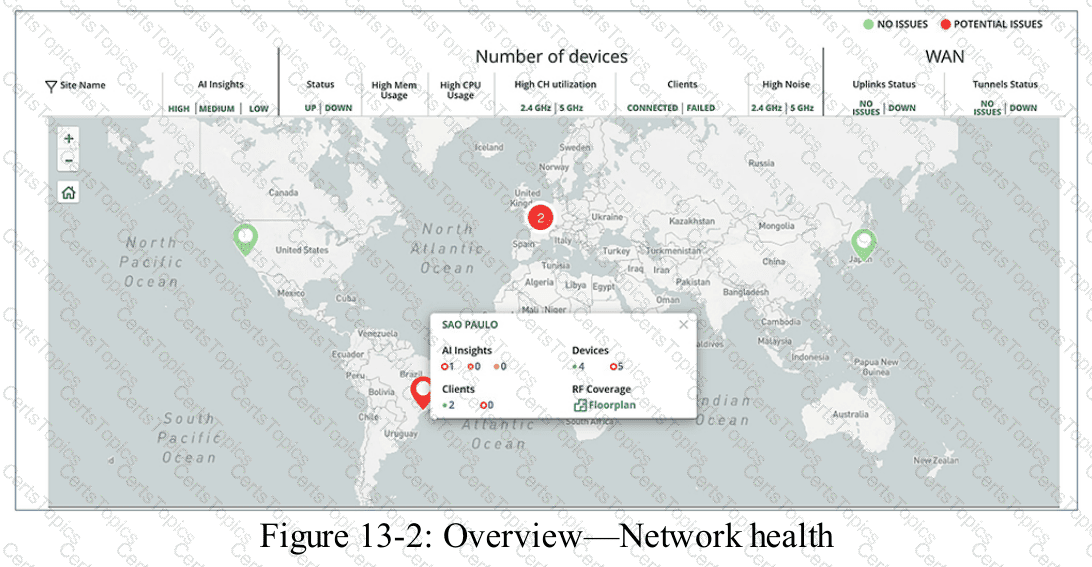
HPE Press study-guide figure / related learning illustration · Q201 Fig 13 2 Network Sites







 Burundi
 China
 Zambia
 Belarus
 Finland