
An AI developer team wants to fine-tune an open-weight model to have exceptional performance on a code generation use case. They are trying to choose the best model to start with. They want to minimize model hosting costs and are using Hugging Face model cards and spaces to explore models. Which TWO model attributes and metrics should the team focus on to make their selection?
A Generative AI Engineer I using the code below to test setting up a vector store:
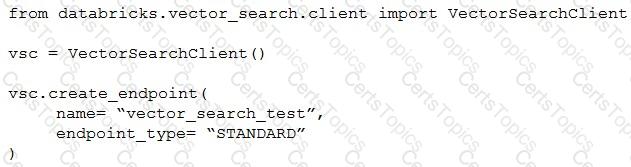
Assuming they intend to use Databricks managed embeddings with the default embedding model, what should be the next logical function call?
Databricks offers a number of built-in AI judges that provide metrics and rationale for different types of quality issues a Generative AI application may have.
Which of the following pairs of judges both require a ground-truth label in the evaluation dataset field expected_response to execute?
A Generative AI Engineer is building an interactive catalog for a company’s inventory system that allows users to search for any item using a plain-text description. There are currently about 17,000 items, and new items are not frequently added. They need a solution that will be the most cost-effective and easy for the company to maintain.
Which solution should the engineer choose?
A small and cost-conscious startup in the cancer research field wants to build a RAG application using Foundation Model APIs.
Which strategy would allow the startup to build a good-quality RAG application while being cost-conscious and able to cater to customer needs?
A Generative AI Engineer is building a compound AI system for an organization. The goal is to automate the processing of incoming customer event reports against a coding system and corporate-guidelines documentation. The system must handle three distinct user-request types: answering questions from guidelines documents, extracting specific event codes from reviewers’ notes, and routing ambiguous requests to the appropriate specialized handler. All three capabilities must operate under a single entry point that interprets user intent and delegates accordingly.
Which Agent Brick should serve as the top-level orchestrator in this architecture?
A Generative AI Engineer is deploying a customer-facing, fine-tuned LLM on their public website. Given the large investment the company put into fine-tuning this model, and the proprietary nature of the tuning data, they are concerned about model inversion attacks. Which of the following Databricks AI Security Framework (DASF) risk mitigation strategies are most relevant to this use case?
A company selling gourmet mushroom-growing supplies has a script that runs once per day to scrape various social media platforms for posts that mention its name. The scraped text data is loaded into a Delta table each night for a downstream processing task that summarizes each post and its sentiment for internal use. Given the small size of the company, it only receives a couple hundred posts per day.
Which solution best optimizes for cost and ease of implementation?
A Generative Al Engineer is helping a cinema extend its website ' s chat bot to be able to respond to questions about specific showtimes for movies currently playing at their local theater. They already have the location of the user provided by location services to their agent, and a Delta table which is continually updated with the latest showtime information by location. They want to implement this new capability In their RAG application.
Which option will do this with the least effort and in the most performant way?
A Generative AI Engineer is tasked with deploying an application that takes advantage of a custom MLflow Pyfunc model to return some interim results.
How should they configure the endpoint to pass the secrets and credentials?
A Generative AI Engineer is deploying an agent using Mosaic AI Model Serving. The agent needs to access various Databricks resources, including Vector Search, Databricks SQL, and Functions. They need to find the easiest and best-practice way to authenticate the deployed agent to access these resources.
What approach should they choose?
What is an effective method to preprocess prompts using custom code before sending them to an LLM?
A Generative AI Engineer is developing an agent system using a popular agent-authoring library. The agent comprises multiple parallel and sequential chains. The engineer encounters challenges as the agent fails at one of the steps, making it difficult to debug the root cause. They need to find an appropriate approach to research this issue and discover the cause of failure. Which approach do they choose?
A Generative AI Engineer wants to build an LLM-based solution to help a restaurant improve its online customer experience with bookings by automatically handling common customer inquiries. The goal of the solution is to minimize escalations to human intervention and phone calls while maintaining a personalized interaction. To design the solution, the Generative AI Engineer needs to define the input data to the LLM and the task it should perform.
Which input/output pair will support their goal?
A Generative Al Engineer has developed an LLM application to answer questions about internal company policies. The Generative AI Engineer must ensure that the application doesn’t hallucinate or leak confidential data.
Which approach should NOT be used to mitigate hallucination or confidential data leakage?
A Generative Al Engineer needs to design an LLM pipeline to conduct multi-stage reasoning that leverages external tools. To be effective at this, the LLM will need to plan and adapt actions while performing complex reasoning tasks.
Which approach will do this?
A Generative AI Engineer received the following business requirements for an external chatbot.
The chatbot needs to know what types of questions the user asks and routes to appropriate models to answer the questions. For example, the user might ask about upcoming event details. Another user might ask about purchasing tickets for a particular event.
What is an ideal workflow for such a chatbot?
A Generative Al Engineer is tasked with improving the RAG quality by addressing its inflammatory outputs.
Which action would be most effective in mitigating the problem of offensive text outputs?
A Generative AI Engineer is building a RAG application that will rely on context retrieved from source documents that are currently in PDF format. These PDFs can contain both text and images. They want to develop a solution using the least amount of lines of code.
Which Python package should be used to extract the text from the source documents?
A Generative AI Engineer at a legal firm is designing a RAG system to analyze historical legal cases. The system needs to process millions of court opinions and legal documents, already organized by time and topic, to track how interpretations of specific laws have evolved over time. All of these documents are in plain-text. The engineer needs to choose a chunking method that would most effectively preserve continuity and the temporal nature of the cases. Which method do they choose?
A Generative Al Engineer interfaces with an LLM with prompt/response behavior that has been trained on customer calls inquiring about product availability. The LLM is designed to output “In Stock” if the product is available or only the term “Out of Stock” if not.
Which prompt will work to allow the engineer to respond to call classification labels correctly?
Generative AI Engineer at an electronics company just deployed a RAG application for customers to ask questions about products that the company carries. However, they received feedback that the RAG response often returns information about an irrelevant product.
What can the engineer do to improve the relevance of the RAG’s response?
A Generative AI Engineer has been asked to design an LLM-based application that accomplishes the following business objective: answer employee HR questions using HR PDF documentation.
Which set of high level tasks should the Generative AI Engineer ' s system perform?
A Generative AI Engineer is integrating Mosaic AI Vector Search into a Retrieval-Augmented Generation (RAG) system. The source data, comprising simple text entries, is stored in a Delta table. To simplify the workflow, the engineer plans to use an embedding model served via a Mosaic AI Model Serving endpoint to automatically compute embeddings during data synchronization from the Delta table to the vector search index.
Which method should the engineer use to achieve this integration?
A Generative AI Engineer has deployed a customer-support agent in production that retrieves product documentation and generates responses. SMEs have been reviewing agent responses and providing feedback through a web interface that captures ratings of 1–5 stars and written comments. The engineer needs to systematically collect this feedback and use it to create an evaluation dataset that can be used to compare future agent versions against the current baseline performance.
Which approach should the engineer use to accomplish this task?
A Generative AI Engineer is developing a patient-facing healthcare-focused chatbot. If the patient’s question is not a medical emergency, the chatbot should solicit more information from the patient to pass to the doctor’s office and suggest a few relevant pre-approved medical articles for reading. If the patient’s question is urgent, direct the patient to calling their local emergency services.
Given the following user input:
“I have been experiencing severe headaches and dizziness for the past two days.”
Which response is most appropriate for the chatbot to generate?
A Generative AI Engineer is developing an LLM application that users can use to generate personalized birthday poems based on their names.
Which technique would be most effective in safeguarding the application, given the potential for malicious user inputs?
Copyright © 2021-2026 CertsTopics. All Rights Reserved
