
Power Up Your Study Prep: Black Friday 75% Discount! Use coupon code below to save! - Ends in 0d 00h 00m 00s - Coupon code: big75certs

Cisco 300-610 Exam With Confidence Using Practice Dumps

Exam Code:
300-610
Exam Name:
Designing Cisco Data Center Infrastructure for Traditional and AI Workloads v1.2 (DCID 300-610)
Certification:
Vendor:
Questions:
299
Last Updated:
Nov 21, 2026
Exam Status:
Stable
Cisco 300-610

300-610: CCNP Data Center Exam 2025 Study Guide Pdf and Test Engine

Are you worried about passing the Cisco 300-610 (Designing Cisco Data Center Infrastructure for Traditional and AI Workloads v1.2 (DCID 300-610)) exam? Download the most recent Cisco 300-610 braindumps with answers that are 100% real. After downloading the Cisco 300-610 exam dumps training , you can receive 99 days of free updates, making this website one of the best options to save additional money. In order to help you prepare for the Cisco 300-610 exam questions and verified answers by IT certified experts, CertsTopics has put together a complete collection of dumps questions and answers. To help you prepare and pass the Cisco 300-610 exam on your first attempt, we have compiled actual exam questions and their answers. 

Our (Designing Cisco Data Center Infrastructure for Traditional and AI Workloads v1.2 (DCID 300-610)) Study Materials are designed to meet the needs of thousands of candidates globally. A free sample of the CompTIA 300-610 test is available at CertsTopics. Before purchasing it, you can also see the Cisco 300-610 practice exam demo.

Designing Cisco Data Center Infrastructure for Traditional and AI Workloads v1.2 (DCID 300-610) Questions and Answers

Question 1

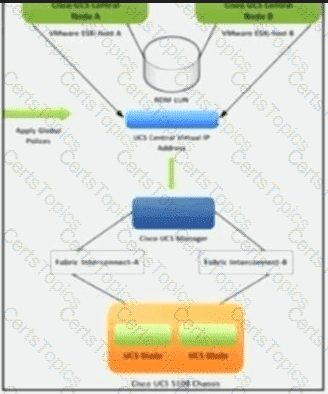
Refer to the exhibit. A network engineer must improve high availability within the given UCS infrastructure The engineer configured central nodes A and B in cluster mode to ensure that traffic fails over in the case of a network outage. Which type of redundancy will the cluster configuration provide?

Options:

A.

redundancy for the management plane only

B.

redundancy via a single fabric interconnect

C.

redundancy for the management, control, and data planes

D.

link-level redundancy via one management port

Buy Now
Question 2

A large financial institution hosts all customer data in a critical data center with a single physical location Top management is concerned about the risk of a single-site failure. Dot budget is also an issue, so the network engineering team is working to implement a cost-effective redundancy strategy with a second data center. The new data center must use a three-tier design Identical to the existing data center. Business requirements dictate that all data must always be accessible from anywhere in the world, even It a single site fails. The team purchased two Cisco Nexus 7700 Series Switches and four Catalyst 8000 Series Routers. Which action must the team take to accomplish the goal?

Options:

A.

Implement NVGRE on the Catalyst 8000 routers to create a DCI communication channel between the data centers and provide Layer 2 extension capabilities.

B.

Implement OTV with the Nexus 7700 Series devices to extend Layer 2 connectivity between the two data centers and provide disaster-recovery capabilities.

C.

Implement FabricPath on the Catalyst 8000 routers in both data centers to provide full redundancy in the event of a disaster. D. Implement HSRP with the Nexus 7700 Series devices to provide gateway redundancy to ensure seamless failover between the Nexus switches.

Question 3

A network administrator must simplify and optimize the VRF architecture in a Cisco ACI fabric. The current deployment contains multiple tenants, each with its own network stack, and uses VRF leaking for inter-tenant communication. The large number of tenants and leaked routes is causing the switches to approach their prefix-capacity limits. Which solution should the engineer recommend?

Options:

A.

Collapse all VRFs into a single VRF in the management tenant.

B.

Collapse all VRFs into multiple VRFs in the management tenant and continue using VRF leaking.

C.

Collapse all VRFs into multiple VRFs in the common tenant and continue using VRF leaking.

D.

Collapse all VRFs into a single VRF in the common tenant.