
Power Up Your Study Prep: Black Friday 75% Discount! Use coupon code below to save! - Ends in 0d 00h 00m 00s - Coupon code: big75certs

Free and Premium Snowflake ADA-C02 Dumps Questions Answers

Page: 1 / 5
Total 60 questions

SnowPro Advanced: Administrator Questions and Answers

Question 1

A Snowflake account uses SCIM provisioning for user accounts and has bidirectional synchronization of user identities. An Administrator with access to SECURITYADMIN creates a user in the Snowflake UI by issuing these commands:

The new user, PTORRES, logs in successfully but sees PUBLIC as the default role in the web UI. The following command fails when attempted:

USE DEVELOPER_ROLE;

Why does this command fail?

Options:

A.

The DEVELOPER_ROLE needs to be granted to SYSADMIN before user PTORRES will be able to use the role.

B.

The new role can only take effect after USERADMIN has logged out.

C.

USERADMIN needs to explicitly grant the DEVELOPER_ROLE to the new USER.

D.

The new role will only take effect once the identity provider has synchronized by way of SCIM with the Snowflake account.

Buy Now
Question 2

A user with the appropriate role runs the following commands to configure and activate network policies:
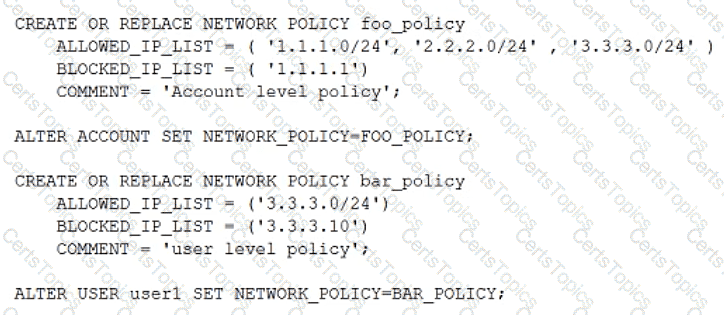
Options:

A.

fterward, user1 tries to sign in to Snowflake from IP address 3.3.3.10. Will the login succeed?

B.

Yes, because 3.3.3.10 is found in the ALLOWED_IP_LIST of bar_policy.

C.

No, because 3.3.3.10 is found in the BLOCKED_IP_LIST of bar_policy.

D.

Yes, because 3.3.3.10 is found in the ALLOWED_IP_LIST of foo_policy.

E.

No, because 3.3.3.10 is not found in the ALLOWED_IP_LIST of foo_policy.

Question 3

An Administrator receives data from a Snowflake partner. The partner shares a dataset containing multiple secure views. The Administrator wants to configure access so that only specific roles can view specific secure views.

How can this be achieved?

Options:

A.

Apply RBAC directly onto the partner's shared secure views.

B.

Individually grant imported privileges onto the schema in the share.

C.

Clone the data and insert it into a company-owned share and apply the desired RBAC on the new tables.

D.

Create views over the incoming shared database and apply the desired RBAC onto these views.

Question 4

Which roles may be used to create network policies in Snowflake accounts?

Choose three

Options:

A.

SYSADMIN

B.

SECURITYADMIN

C.

ACCOUNTADMIN

D.

ORGADMIN

E.

Any role with the global permission of CREATE NETWORK POLICY

F.

Any rote that owns the database where the network policy is created

Question 5

MY_TABLE is a table that has not been updated or changed for several days. On 01 January 2021 at 07:01, a user ran a query that updated this table. The query ID is '8e5d0ca9-005e-44e6-b858-a8f5b37c5726'. It is now 07:30 on the same day.

Which queries allow the user to view the historical data that was in the table before this query ran?

Choose three

Options:

A.

SELECT * FROM my_table WITH TIME_TRAVEL(OFFSET = > -60*30);

B.

SELECT * FROM my_table AT(TIMESTAMP = > '2021-01-01 07:00:00'::timestamp);

C.

SELECT * FROM TIME_TRAVEL('MY_TABLE', 2021-01-01 07:00:00);

D.

SELECT * FROM my_table PRIOR TO STATEMENT '8e5d0ca9-005e-44e6-b858-a8f5b37c5726';

E.

SELECT * FROM my_table AT(OFFSET = > -60*30);

F.

SELECT * FROM my_table BEFORE(STATEMENT = > '8e5d0ca9-005e-44e6-b858-a8f5b37c5726');

Question 6

Which Snowflake objects can be managed through SCIM integration?

Choose two

Options:

A.

Stages

B.

Users

C.

Warehouses

D.

Roles

E.

Shares

Question 7

An Administrator must configure a Snowflake virtual warehouse for a new use case with these details:

B. etween 50 and 100 concurrent users will run reports.

C. osts must be minimized according to the number of users active at a particular time.

The virtual warehouse must automatically suspend and resume based on user activity.

Which configuration meets these requirements?

Options:

A.

CREATE OR REPLACE WAREHOUSE reporting_wh

WAREHOUSE_SIZE = MEDIUM

AUTO_SUSPEND = 600

AUTO_RESUME = TRUE;

B.

CREATE OR REPLACE WAREHOUSE reporting_wh

WAREHOUSE_SIZE = XXXLARGE

MAX_CLUSTER_COUNT = 10

SCALING_POLICY = STANDARD

AUTO_SUSPEND = 600

AUTO_RESUME = FALSE;

C.

CREATE OR REPLACE WAREHOUSE reporting_wh

WAREHOUSE_SIZE = XXXLARGE

AUTO_SUSPEND = 60

AUTO_RESUME = TRUE;

D.

CREATE OR REPLACE WAREHOUSE reporting_wh

WAREHOUSE_SIZE = MEDIUM

MAX_CLUSTER_COUNT = 10

SCALING_POLICY = STANDARD

AUTO_SUSPEND = 600

AUTO_RESUME = TRUE;

Question 8

A large multinational company with numerous operating regions needs data to be shared bidirectionally among all offices: from the head office to regional offices and among regional offices themselves. The company holds a Snowflake account, with its European operations deployed in Microsoft Azure in a single region, while North American regional offices use AWS in a single region as their deployment cloud. This configuration is required to comply with Personal Identifiable Information (PII) regulations in certain European countries. The corporate head office is located in Europe.

How can the data be shared bidirectionally while MINIMIZING costs?

Options:

A.

Use data replication everywhere to reduce costs associated with same-region sharing.

B.

Use the PUT command to move files to an Amazon S3 bucket and Azure Blobs, and use an external file management application to move files within the corporate VPC.

C.

Move all the Snowflake accounts to a single region, and implement data sharing.

D.

Use bi-directional data sharing among offices in the same region and replication among offices across the continents.

Question 9

Which information must be obtained from the Identity Provider (IdP) to enable federated authentication in Snowflake?

Choose two

Options:

A.

IdP account details

B.

URL endpoint for SAML requests

C.

SAML response format

D.

Authentication certificate

E.

IdP encryption key

Question 10

A company has configured Snowflake replication between two Snowflake accounts, both running Snowflake Enterprise Edition. Replication applies to database APP_DB, which contains only one schema, APP_SCHEMA. The company’s Time Travel retention policy is currently 30 days in both accounts. An Administrator must extend the Time Travel retention policy to 60 days on the secondary database only.

How can this requirement be fulfilled?

Options:

A.

Set the data retention policy on the secondary database to 60 days.

B.

Set the data retention policy on the schemas in the secondary database to 60 days.

C.

Set the data retention policy on the primary database to 30 days and the schemas to 60 days.

D.

Set the data retention policy on the primary database to 60 days.

Question 11

Which role or roles should be used to correctly create the object needed to configure an OAuth 2.0 integration?

Options:

A.

Any role with GRANT USAGE on SECURITY INTEGRATION

B.

ACCOUNTADMIN and SYSADMIN

C.

ACCOUNTADMIN and SECURITYADMIN

D.

ACCOUNTADMIN only

Question 12

Which steps are needed to configure OKTAAPI token integration in Snowflake?

Options:

A.

See original SQL exhibit above.

grant role okta_provisioner to role ACCOUNTADMIN;2. create or replace security integration okta_provisioningtype = scimscim_client = 'okta'run_as_role = 'OKTA_PROVISIONER';3. Update these steps every 12 months.

B.

See original SQL exhibit above.

use role ACCOUNTADMIN;2. select system$ generate_scim_access_token ('OKTA_PROVISIONING');3. Update these steps every 12 months.

C.

See original SQL exhibit above.

create or replace security integration okta_provisioningtype = scimscim client = 'okta'run_as_role = 'OKTA_PROVISIONER';2. Update this step every 6 months.

D.

See original SQL exhibit above.

use role ACCOUNTADMIN;2. select system$ generate_scim_access_token ('OKTA_PROVISIONING');3. Update these steps every 6 months.

Question 13

When adding secure views to a share in Snowflake, which function is required to authorize users from another account to access rows in a base table?

Options:

A.

CURRENT_ROLE

B.

CURRENT_ACCOUNT

C.

CURRENT_USER

D.

CURRENT_CLIENT

Question 14

A user has enrolled in multi-factor authentication (MFA) to connect to Snowflake. The user tells the Snowflake Administrator that they lost their mobile phone the prior evening.

Which action should the Administrator take to enable the user to sign in to the system without revoking the user’s MFA enrollment?

Options:

A.

Alter the user and set MINS_TO_BYPASS_MFA to a value that will disable MFA long enough for the user to log in.

B.

Alter the user and set DISABLE_MFA to true, which will suspend the MFA requirement for 24 hours.

C.

Instruct the user to connect to Snowflake using SnowSQL, which does not support MFA authentication.

D.

Instruct the user to append the normal URL with /?mode=mfa_bypass & code= to log on.

Question 15

Which commands can a user with the ORGADMIN role, but without the ACCOUNTADMIN role, perform?

Choose two

Options:

A.

SHOW REGIONS;

B.

SHOW USERS;

C.

SHOW ORGANIZATION ACCOUNTS;

D.

GRANT ROLE ORGADMIN TO USER < username > ;

E.

SELECT SYSTEM$GLOBAL_ACCOUNT_SET_PARAMETER(

'ACCOUNT_LOCATOR',

'ENABLE_ACCOUNT_DATABASE_REPLICATION',

'true'

);

Question 16

What is the default data-retention period for transient databases, schemas, and tables in Snowflake Enterprise Edition and higher?

Options:

A.

1 day

B.

14 days

C.

30 days

D.

90 days

Question 17

What is one characteristic of Snowflake’s transaction locking and concurrency model?

Options:

A.

A deadlock cannot occur in Snowflake, since concurrently executed queries and DML statements do not block one another.

B.

If two queries are concurrently executed against the same table, one of the two queries will be blocked until the other query completes.

C.

Transaction locking in Snowflake is enforced exclusively at the row and table levels.

D.

Queries executed within a given transaction see that transaction's uncommitted changes.

Question 18

A company has many users assigned to the ANALYST role who regularly query Snowflake through a reporting tool. The Administrator observes that the ANALYST users continuously keep two small clusters busy and occasionally require three or four clusters of that same size.

B. ased on this scenario, how should the Administrator configure a virtual warehouse to MOST efficiently support this user group?

Options:

A.

Create a multi-cluster warehouse with MIN_CLUSTERS set to 1. Give MANAGE privileges to the ANALYST role so this group can start and stop the warehouse, and increase the number of clusters as needed.

B.

Create a multi-cluster warehouse with MIN_CLUSTERS set to 2. Set the warehouse to auto-resume and auto-suspend, and give USAGE privileges to the ANALYST role. Allow the warehouse to auto-scale.

C.

Create a standard X-Large warehouse, which is equivalent to four small clusters. Set the warehouse to auto-resume and auto-suspend, and give USAGE privileges to the ANALYST role.

D.

Create four virtual warehouses (sized Small through XL) and set them to auto-suspend and auto-resume. Have users in the ANALYST role select the appropriate warehouse based on how many queries are being run.

Page: 1 / 5
Total 60 questions
