
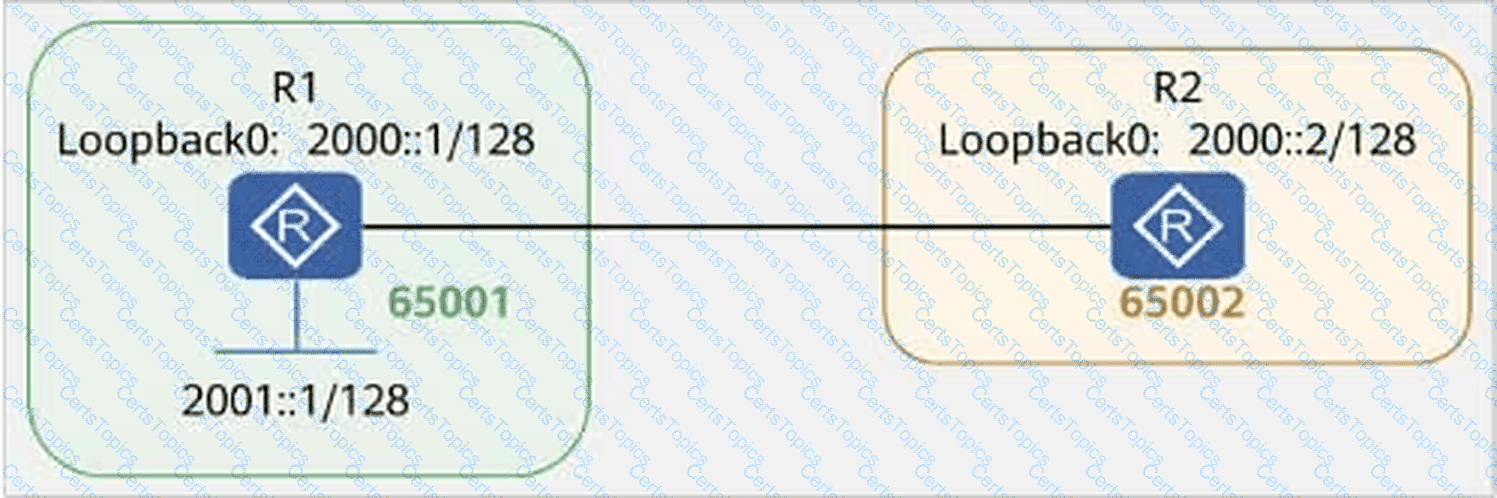
On the network shown in the figure, R1 and R2 have established an EBGP peer relationship through Loopback0. R1 imports the route 2001::1/128 to BGP. In Update messages sent by R1, the value of the Next Hop field in the MP_REACH_NLRI attribute is 2000::1.
Network administrators can run the clock timezone command to set the time zone of a device. If two network devices have different time zone settings, they cannot establish a neighbor relationship using a dynamic routing protocol.
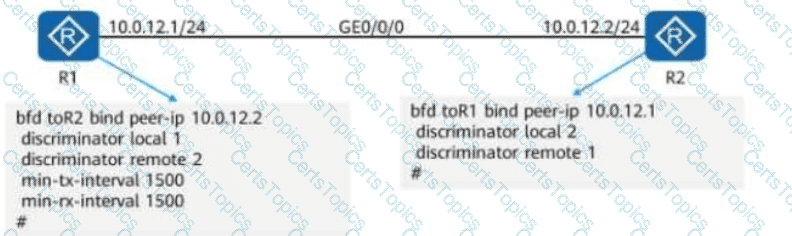
On the network shown in the figure, single-hop BFD is configured on R1 and R2.
A network engineer finds that the BFD session goes down. To locate the fault, the network engineer queries the BFD configurations on R1 and R2.
According to the configuration information marked in the figure, it can be determined that mismatched time parameter settings on R1 and R2 cause the BFD session to go down.
Is this statement TRUE or FALSE?
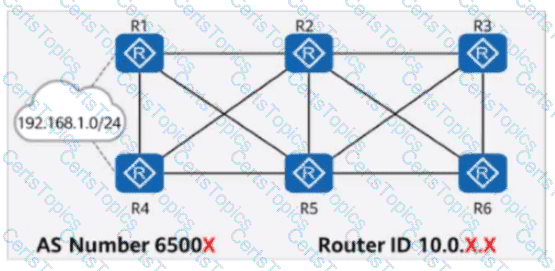
On the network shown in the figure, EBGP peer relationships are established between neighboring routers through directly connected interfaces. The router ID of each router is 10.0.X.X, and the AS number is 6500X, where X is the number of the router. Both Rl and R4 have static routes to 192.168.1.0/24, which are imported to BGP through the import-route command. R3 is configured with the peer y.y.y.y as-path-filter 1 import command for all peers. Which of the following sets of commands enables R3 to select the route with the longest AS_Path to 192.168.1.0/24?
Copyright © 2021-2026 CertsTopics. All Rights Reserved
