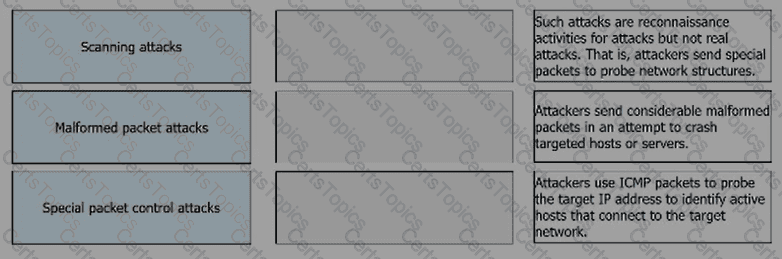
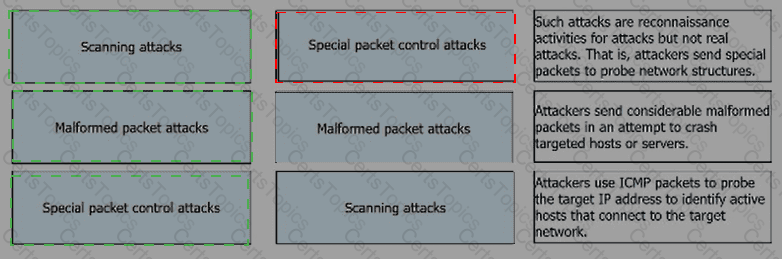
A. Scanning attacks → Attackers use ICMP packets to probe the target IP address to identify active hosts that connect to the target network.
B. Malformed packet attacks → Attackers send considerable malformed packets in an attempt to crash targeted hosts or servers.
C. Special packet control attacks → Such attacks are reconnaissance activities for attacks but not real attacks. That is, attackers send special packets to probe network structures.
In HCIA-Security, single-packet attacks are commonly categorized by the purpose and structure of the packets being sent. Scanning attacks are mainly used to discover targets and collect information before a real attack begins. A common example is using ICMP probe packets to identify whether hosts are alive and reachable on a network. This makes the ICMP host-discovery description the correct match for scanning attacks.
Malformed packet attacks involve sending packets with abnormal, invalid, or deliberately corrupted structures. Their purpose is to exploit weaknesses in protocol handling or operating system processing so that the target host, device, or server becomes unstable, crashes, or stops responding. Therefore, the description about sending many malformed packets to crash targets clearly matches this category.
Special packet control attacks are also more related to probing than direct destruction. In this case, attackers send specially crafted control or probe packets to learn network structure, device behavior, or service characteristics. These activities are considered reconnaissance rather than full attacks. That is why the description about probing network structures with special packets belongs to special packet control attacks.