
Refer to the exhibit.
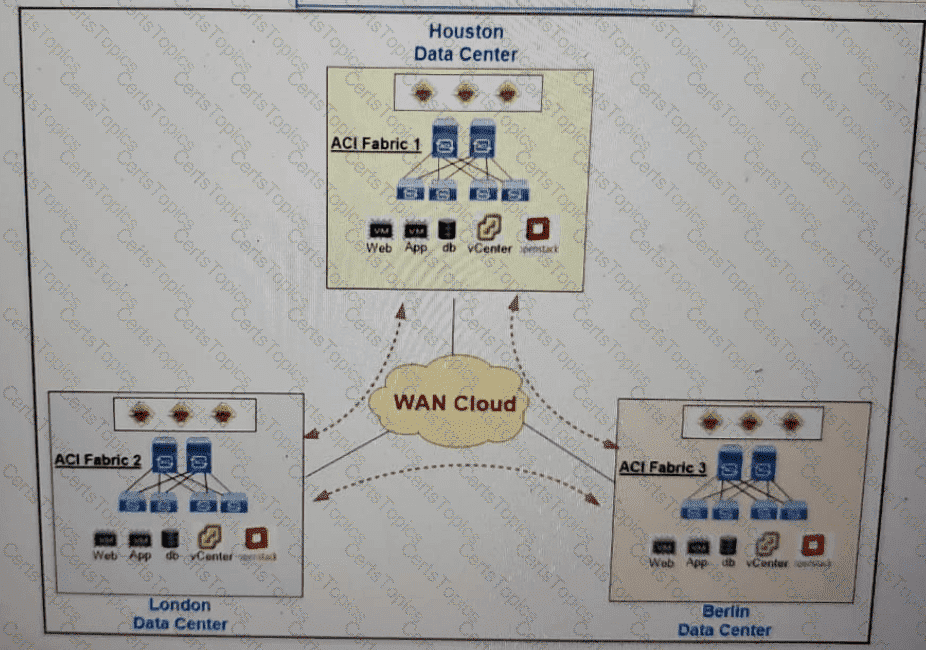
A cloud provider service provider deployed three geographically separated Cisco ACI data centers. One of the customers needs to host a clustered application that is spread across the three data centers. The cluster nodes that host the application need a layer 2 topology to communicate with each other. Which Cisco ACI topology design meets these requirements?
After experiencing traffic disruptions from the failure of a single router, a customer asks an engineer to design a solution that will prevent this from occurring in the future. While examining the customer’s environment, the engineer discovers that the routers are manufactured by a variety of different vendors, and they have varying amounts of CPU and memory resources. Additionally, several of the customer’s applications require the ability to fine-tune the load-balancing parameters between multiple routers. Which solution should be used to meet these requirements?
Refer to the exhibit.
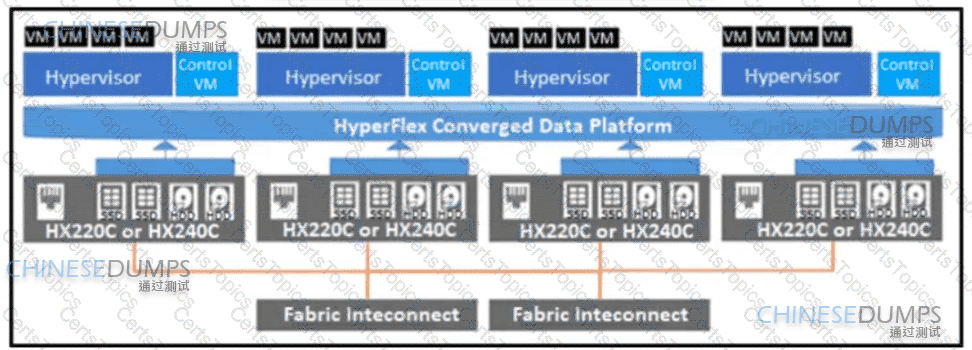
A Cisco engineer is configuring a next-generation Cisco HyperFlex HX data platform with 2 x Cisco UCS 6248UP fabric interconnects. 8 x Cisco HX-Series HX240c-M4SX servers, plus 8 x Cisco UCS B200-M4 blade servers Cisco UCS 5108 blade chassis, and Cisco UCS 2204XP fabric extenders The solution is configured with HX Release 4 5(2a) using VMware ESXi 7 0 U2 After the engineer migrates all customer VMs to the new solution platform, the engineer decides to create HX Native snapshots for all the VMs The engineer performs the operation and notices that some of the VMs are not creating snapshots. What is the most probable reason that the HX Native snapshots are not created?
An end user is experiencing network latency when accessing a database in a disaster recovery site. The monitoring team concluded that the database was writing simultaneously to the storage arrays on the primary and disaster recovery sites.
Which design resolves this issue?
Copyright © 2021-2026 CertsTopics. All Rights Reserved
