New Year Sale 70% Discount Offer - Ends in 0d 00h 00m 00s - Coupon code: save70

PRINCE2 Prince2-Practitioner Exam With Confidence Using Practice Dumps

Exam Code:
Prince2-Practitioner
Exam Name:
PRINCE2 7 Practitioner (7th Edition) Exam
Certification:
Vendor:
Questions:
263
Last Updated:
Jan 17, 2026
Exam Status:
Stable
PRINCE2 Prince2-Practitioner

Prince2-Practitioner: PRINCE2 Certification Exam 2025 Study Guide Pdf and Test Engine

Are you worried about passing the PRINCE2 Prince2-Practitioner (PRINCE2 7 Practitioner (7th Edition) Exam) exam? Download the most recent PRINCE2 Prince2-Practitioner braindumps with answers that are 100% real. After downloading the PRINCE2 Prince2-Practitioner exam dumps training , you can receive 99 days of free updates, making this website one of the best options to save additional money. In order to help you prepare for the PRINCE2 Prince2-Practitioner exam questions and verified answers by IT certified experts, CertsTopics has put together a complete collection of dumps questions and answers. To help you prepare and pass the PRINCE2 Prince2-Practitioner exam on your first attempt, we have compiled actual exam questions and their answers. 

Our (PRINCE2 7 Practitioner (7th Edition) Exam) Study Materials are designed to meet the needs of thousands of candidates globally. A free sample of the CompTIA Prince2-Practitioner test is available at CertsTopics. Before purchasing it, you can also see the PRINCE2 Prince2-Practitioner practice exam demo.
PRINCE2 7 Practitioner (7th Edition) Exam Questions and Answers

Question 1

Project Scenario – Health and Safety Training Project:

ABC Company is a well-established training company that uses a standard model to develop training materials and deliver courses to customers.

ABC Company has commissioned a project in response to recent changes in government legislation relating to health and safety on construction sites. The project will deliver “capability to provide health and safety training”, including the materials needed for classroom-based training and e-learning. The expected benefits for construction companies include a reduction in lost days and legal costs due to accidents.

The e-learning course will be developed by a specialist external consultancy. The materials for classroom-based training will be delivered by ABC Company’s development team. All course materials will be piloted before they are used. ABC Company will deliver training to its customers and also hopes to sell the course materials to other training companies as part of their operational business. ABC Company will use their own sales and marketing departments to promote the courses.

The legislation requires construction companies to comply with the new legislation within two years. The course materials and trainers have to be accredited by a government agency before courses can be delivered. ABC Company is planning to deliver pilot courses within five months of starting the project.

The ABC Company standard development model for new courses recommends the following stages:

End of the Project scenario.

Additional Information:

The Chief Executive Officer (CEO) founded the company five years ago. Under her leadership, ABC Company has grown quickly into a successful training company. It delivers a range of accredited professional training.

The Finance Director is also a founder member of ABC Company and is responsible for authorizing budgets for the Operations and Development Teams. She authorizes all large contracts personally.

The Purchasing Manager reports to the Finance Director and is responsible for managing and monitoring supplier contracts.

The Operations Director is responsible for the delivery off all training and for the training development budget. His department organizes courses, venues and trainers. They work with the Product and the Sales teams to provide a comprehensive training schedule. ABC Company’s IT manager reports to the Operations Director.

The Business Development Director has recently been appointed to identify new training needs and propose new products. She will work with the Operations. Director to ensure a cost-conscious approach and that appropriate development technologies are used for the health and safety course.

The Training Development Manager reports to the Business Development Director and is responsible for developing training materials and gaining accreditation, in accordance with the standard course development model. Course developers in his team have skills in a range of development technologies and are allocated to projects as needed.

The Training Delivery Manager, who reports to the Operations Director, is responsible for ensuring that internal and external trainers deliver ABC Company training courses to the required standard. He also checks course materials to ensure they are fit for purpose and of the required quality.

The Central Services Director has responsibility for corporate communications, facilities management and configuration management. He recently led a project to consolidate all company quality systems into one quality management system and set up a corporate quality department, now managed by the Corporate Quality Manager.

The Corporate Document Manager reports to the Central Services Director. She helped establish the company’s document management system and now operates it across the business. She manages a team of administrators and contracts staff when workload is high.

The Sales Director joined ABC Company two months ago and is keen to establish himself by suggesting new markets for the courses and material. All account managers and the marketing team report to him. They promote existing training courses to other training companies and existing customers.

End of the additional information.

The project board has asked for highlight reports every six weeks during stage 3. As a result, the project manager has asked each team manager for checkpoint reports every six weeks, in order to collate these into the highlight report. The team manager for the ‘marketed courses’ is new to team management.

Is this an appropriate action as part of the ‘controlling a stage’ process, and why?

Options:

A.

Yes, because the project board will need to be updated with the progress of every team.

B.

Yes, because checkpoint reports are a time-driven control providing progress information.

C.

No, because the frequency of reporting should reflect the level of control required for the work package.

D.

No, because the project board should decide on the frequency and content of progress reporting.

Buy Now
Question 2

Scenario

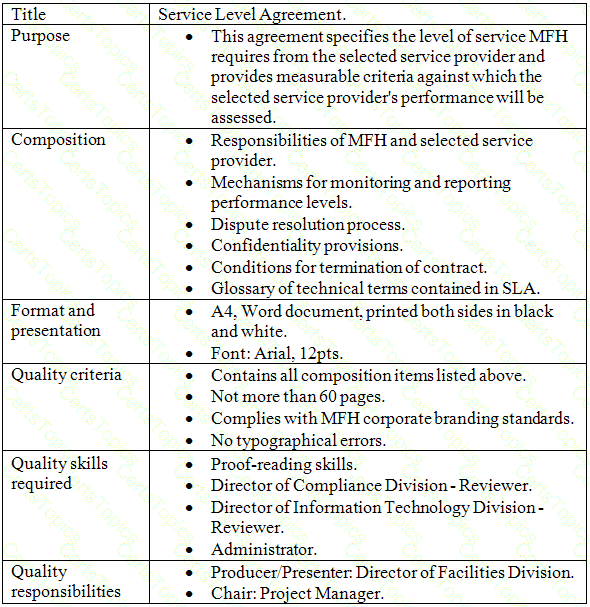
A central government department, the Ministry of Food Hygiene (MFH), faces increasing pressure to cut costs, better manage suppliers’ performance and reduce the confusion caused by inadequate internal controls, outdated standards and outdated technology. External consultants were employed to conduct a feasibility study to identify options to address the problems, and the likely costs and benefits. The following options were considered:

● Do nothing.

● Re-engineer selected business functions.

● Outsource selected business functions.

The feasibility study concluded that there was a case for outsourcing the MFH Information Technology Division and the Facilities Division (maintenance of buildings and grounds). The recommendations were:

● One service provider should be contracted to provide the services currently provided by the Information Technology Division and the Facilities Division.

● A 10-year service contract should be agreed with the selected service provider.

The feasibility study developed high-level designs of the current organization, processes, systems and operating models, plus an outline Business Case for the required project. The external consultants also made the following recommendations for the management of the project:

● Use PRINCE2.

● Set up the project with 4 management stages:

Stage 1. Standard PRINCE2 initiation activities.

Stage 2. Create detailed designs (future organization, processes, systems and operating models) and the service level agreement between MFH and the future service

provider.

Stage 3. Request and evaluate proposals, select service provider and agree contract.

Stage 4. Transfer equipment and staff, transfer responsibility for service provision and run trial period.

Initial estimates indicated that the project would cost £2.5m and take two years to complete.

MFH senior management agreed that there was a case for outsourcing, and accepted the recommendations as a basis for the project. There is an expected saving of £20m over 10 years.

The Outsourcing project has completed the Starting up a Project process and is now in the initiation stage. Because of the strategic importance of the project, the MFH Chief Executive Officer has taken the role of Executive. A PRINCE2-experienced Project Manager has been appointed from within MFH. Staff within the business functions being outsourced will work with the external consultants who conducted the feasibility study to define the detailed designs.

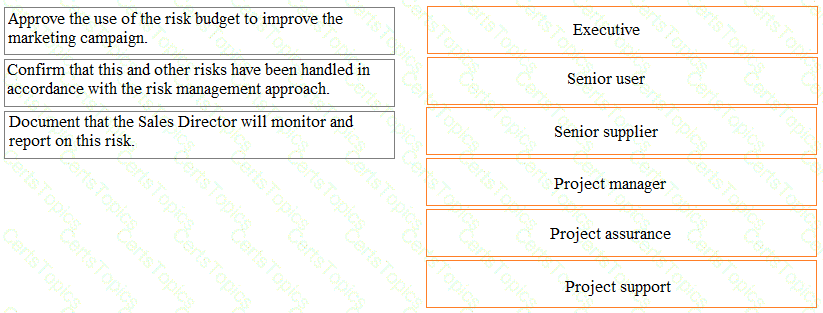
Lines 1 to 6 in the table below consist of an assertion statement and a reason statement. For each line identify the appropriate option, from options A to E, that applies. Each option can be used once, more than once or not at all.

Options:

Question 3

Scenario

A photographer from Portraits Ltd, a professional photographic company, has taken on the role of Team Manager after taking some time to understand the requirements of the project. A contract for their services has been set up and is being monitored by the Purchasing Manager and a Work Package has been agreed. This contract specifies that the photographer must arrange a meeting with the Engineering Manager to establish a schedule for the photo sessions to minimize the impact on the Engineering staff. This meeting should have occurred by now.

The Engineering Manager was made aware of this requirement but when asked he reported that he has received no communication from the photographer. The Project Manager has tried to call the photographer and has had no response. The Project Manager believes there is a risk that Portraits Ltd are overbooking work and prioritizing other clients' work. If Portraits ltd do not deliver on schedule the project will be delayed and the expected benefits will be reduced.

The contract is to be reviewed and Portraits Ltd reminded of their agreement.

The project is now in stage 2. The Project Manager has heard about the possibility of a competitor also producing a calendar to be delivered earlier than the target date for this project. There is a threat that the early release of a competitor's calendar may weaken the impact of the MNO Manufacturing Company calendar, thereby reducing the anticipated benefits of the Calendar project.

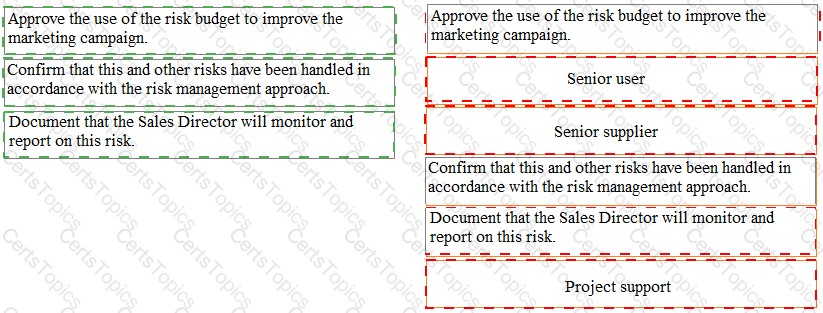
Which 2 statements should be recorded under the Timing of risk management activities heading?

Options:

A.

During stage 4, the selected service provider will manage any risks to their Business Case and report these to the Project Manager on a weekly basis.

B.

The Project Board should hold monthly meetings to review project progress.

C.

When closing a project, the follow-on action recommendations should be updated with any risks relating to the realization of benefits after the outsourced services go live.

D.

Any new risks identified during product development should be reported to the Project Manager by the Team Manager when delivering the completed Work Package.

E.

When authorizing a stage, the Project Board will check that the exposure to risk is still acceptable.