Summer Certification Sale 70% Discount Offer - Ends in 0d 00h 00m 00s - Coupon code: save70

Free and Premium Netskope NSK200 Dumps Questions Answers

Page: 1 / 7
Total 96 questions

Netskope Certified Cloud Security Integrator (NCCSI) Questions and Answers

Question 1

A customer wants to deploy the Netskope client on all their employee laptops to protect all Web traffic when users are working from home. However, users are required to work from their local offices at least one day per week. Management requests that users returning to the office be able to transparently leverage the local security stack without any user intervention.

Which two statements are correct in this scenario? (Choose two.)

Options:

A.

You must enable On-premises Detection in the client configuration.

B.

You must allow users to unenroll In the client configuration.

C.

You must disable Dynamic Steering in the traffic steering profile.

D.

You must configure IPsec/GRE tunnels on the local network to steer traffic to Netskope.

Buy Now
Question 2

The risk team at your company has determined that traffic from the sales team to a custom Web application should not be inspected by Netskope. All other traffic to the Web application should continue to be inspected. In this scenario, how would you accomplish this task?

Options:

A.

Create a Do Not Decrypt Policy using User Group and Domain in the policy page.

B.

Create a Do Not Decrypt Policy using Application in the policy page and a Steering Exception for Group

C.

Create a Do Not Decrypt Policy using Destination IP and Application in the policy page.

D.

Create a Do Not Decrypt Policy using Source IP and Application in the policy page.

Question 3

The director of IT asks for confirmation If your organization ' s Web traffic would be blocked when the Netskope client fails. In this situation, what would confirm the fail close status?

Options:

A.

Perform a right-click on the Netskope client icon using your mouse.

B.

Review the nsdebuglog.log.

C.

View Application events.

D.

Review user settings.

Question 4

You want to provision users and groups to a Netskope tenant. You have Microsoft Active Directory servers hosted in two different forests. Which statement is true about this scenario?

Options:

A.

You can use the Netskope Adapter Tool for user provisioning.

B.

You can use the Netskope virtual appliance for user provisioning

C.

You cannot provision users until you migrate to Azure AD or Okta.

D.

You can use SCIM version 2 for user provisioning.

Question 5

Your customer is migrating all of their applications over to Microsoft 365 and Azure. They have good practices and policies in place (or their inline traffic, but they want to continuously detect reconfigurations and enforce compliance standards.

Which two solutions would satisfy their requirements? (Choose two.)

Options:

A.

Netskope SaaS Security Posture Management

B.

Netskope Cloud Confidence Index

C.

Netskope Risk Insights

D.

Netskope Continuous Security Assessment

Question 6

Your company is using on-premises QRadar as a SIEM solution. They are replacing it with Rapid7 in the cloud. The legacy on-premises QRadar will eventually be decommissioned. Your IT department does not want to use the same token that QRadar uses.

Options:

A.

Netskope does not support multiple REST API tokens.

B.

You must use Netskope REST API v1 to support multiple tokens to share events.

C.

You must use Netskope REST API v2 to support multiple tokens to share events.

D.

You must use an Advanced Threat Protection license to support multiple tokens to share events.

Question 7

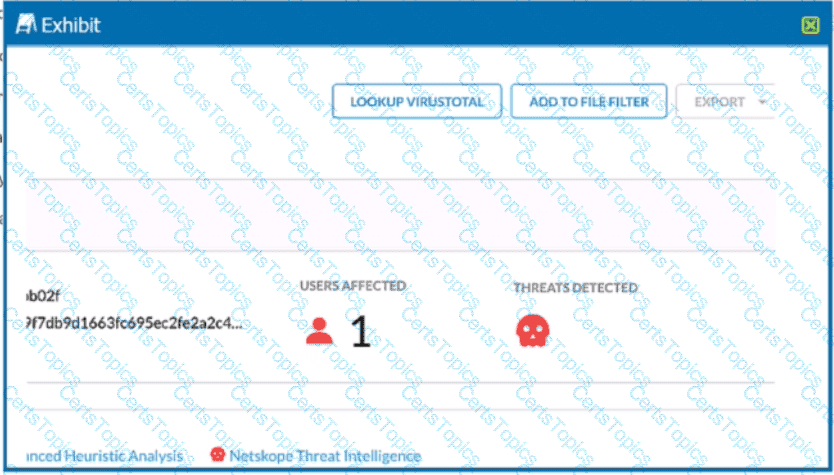
Review the exhibit.

You are at the Malware Incident page. A virus was detected by the Netskope Heuristics Engine. Your security team has confirmed that the virus was a test data file You want to allow the security team to use this file

Referring to the exhibit, which two statements are correct? (Choose two.)

Options:

A.

Click the " Add To File Filter button to add the IOC to a file list.

B.

Contact the CrowdStrike administrator to have the file marked as safe.

C.

Click the ' ' Lookup VirusTotal " button to verify if this IOC is a false positive.

D.

Create a malware detection profile and update the file hash list with the IOC.

Question 8

Your learn is asked to Investigate which of the Netskope DLP policies are creating the most incidents. In this scenario, which two statements are true? (Choose two.)

Options:

A.

The Skope IT Applications tab will list the top five DLP policies.

B.

You can see the top Ave DLP policies triggered using the Analyze feature

C.

You can create a report using Reporting or Advanced Analytics.

D.

The Skope IT Alerts tab will list the top five DLP policies.

Question 9

A city uses many types of forms, including permit applications. These forms contain personal and financial information of citizens. Remote employees download these forms and work directly with the citizens to complete them. The city wants to be able to identify and monitor the specific forms and block the employees from downloading completed forms.

Which feature would you use to accomplish this task?

Options:

A.

exact data match (EDM)

B.

regular expressions (regex)

C.

document fingerprinting

D.

optical character recognition (OCR)

Question 10

Your company asks you to use Netskope to integrate with Endpoint Detection and Response (EDR) vendors such as CrowdStrike. In this scenario, what is a requirement for a successful Integration and sharing of threat data?

Options:

A.

API Client ID

B.

device classification

C.

custom log parser

D.

user endpoint

Question 11

Your company asks you to use Netskope to integrate with Endpoint Detection and Response (EDR) vendors such as Crowdstrike.

Which two requirements are needed for a successful integration and sharing of threat data? (Choose two.)

Options:

A.

Remediation profile

B.

Device classification

C.

API Client ID

D.

Custom log parser

Question 12

Your customer is using a virtual desktop infrastructure (VDI) for their support engineers. Multiple users will be logging into the same device, and they want to detect activities for each user.

Options:

A.

Install Netskope client in default mode and enable DTLS.

B.

Install Netskope client and create a separate steering configuration for each user.

C.

Install Netskope client in peruserconfig mode.

D.

Install Netskope client and create a separate device configuration for each user.

Question 13

You are an administrator writing Netskope Real-time Protection policies and must determine proper policy ordering.

Which two statements are true in this scenario? (Choose two.)

Options:

A.

You must place Netskope private access malware policies in the middle.

B.

You do not need to create an " allow all " Web Access policy at the bottom.

C.

You must place DLP policies at the bottom.

D.

You must place high-risk block policies at the top.

Question 14

Deploying the Netskope Client using IdP requires which two prerequisites? (Choose two.)

Options:

A.

The user must be authenticated using IdP.

B.

The Home POP Domain must be preconfigured using the client CLI parameters.

C.

The tenant name will be automatically determined during IdP authentication.

D.

The IdP mode parameter must be specified when installing the client.

Question 15

You want to provide malware protection for all cloud storage applications.

In this scenario, which action would accomplish this task?

Options:

A.

Create a real-time threat protection policy with a category of Cloud Storage.

B.

Apply a data protection profile.

C.

Apply a CTEP profile.

D.

Create an API threat protection policy with a category of Cloud Storage.

Question 16

You are testing policies using the DLP predefined identifier " Card Numbers (Major Networks; all). " No DLP policy hits are observed.

Options:

A.

You must use Netskope API protection.

B.

Your data must have valid credit card numbers.

C.

You must normalize credit card numbers to 16-digit consecutive numbers.

D.

You must use the Netskope client to perform advanced DLP and optical character recognition.

Question 17

You are deploying a Netskope client in your corporate office network. You are aware of firewall or proxy rules that need to be modified to allow traffic.

Which two statements are true in this scenario? (Choose two.)

Options:

A.

You need to allow TLS 1.1 traffic to pass through the firewalls from the users ' IP to all destinations.

B.

You must enable SSL decryption in the proxy to inspect the Netskope tunnel.

C.

It is recommended to allow UDP port 443 to the Netskope IP ranges to allow DTLS.

D.

You need to allow TCP port 443 to the Netskope IP ranges or domains.

Question 18

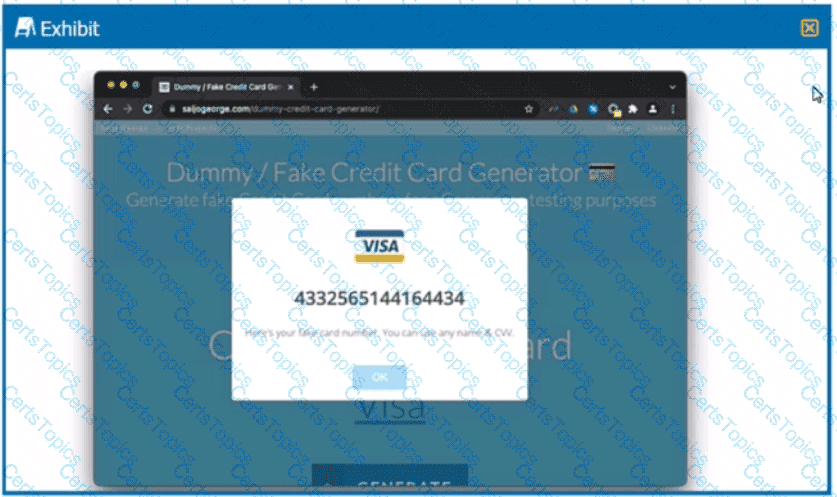
Review the exhibit.

You are asked to create a DLP profile that will ensure that the data shown in the exhibit cannot be uploaded to a user ' s personal Google Drive.

What must be used to accomplish this task?

Options:

A.

document fingerprinting

B.

ML image classifier

C.

optical character recognition

D.

INTL-PAN-Name rule

Question 19

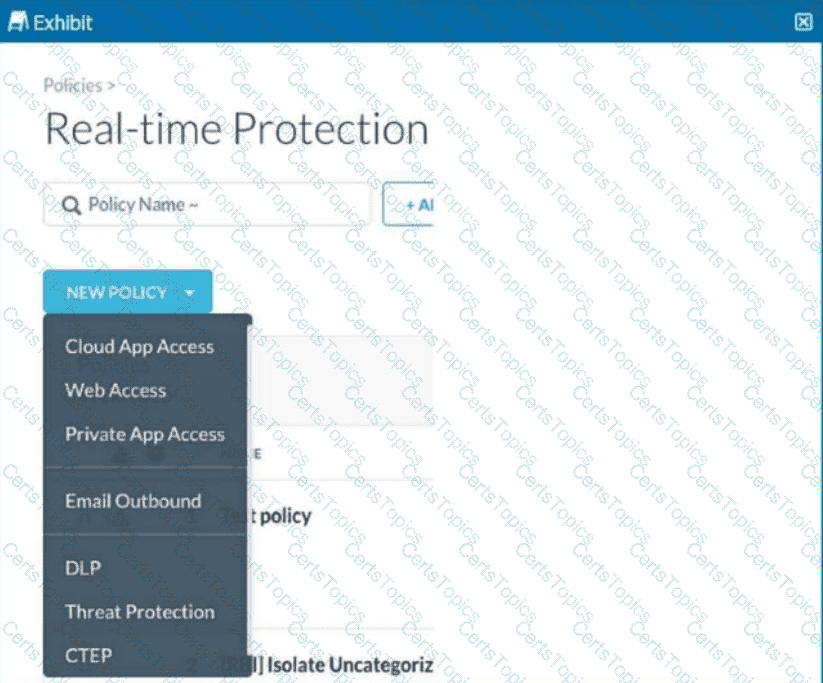
Review the exhibit.

You are asked to create a new Real-time Protection policy to scan SMTP emails using data loss prevention (DLP) for personal health information (PHI). The scope is limited to only emails being sent from Microsoft Exchange Online to outside recipients.

Options:

A.

Web Access policy

B.

Email Outbound policy

C.

CTEP policy

D.

DLP policy

Question 20

You are currently migrating users away from a legacy proxy to the Netskope client in the company’s corporate offices. You have deployed the client to a pilot group; however, when the client attempts to connect to Netskope, it fails to establish a tunnel.

In this scenario, what would cause this problem?

Options:

A.

The legacy proxy is intercepting SSL/TLS traffic to Netskope.

B.

The corporate firewall is blocking UDP port 443 to Netskope.

C.

The corporate firewall is blocking the Netskope EPoT address.

D.

The client cannot reach dns.google for EDNS resolution.

Question 21

You notice that your Netskope client icon has a red dot and see " Disabled due to error " when hovering the mouse over the icon. What are two reasons for this message? (Choose two.)

Options:

A.

The client service is manually stopped.

B.

The steering exceptions are incorrect.

C.

The client health check has failed.

D.

The client traffic is directed over iPsec.

Question 22

With Netskope DLP, which feature would be used to detect keywords such as " Confidential " or " Access key " ?

Options:

A.

Regular Expression

B.

Exact Match

C.

Fingerprint Classification

D.

Dictionary

Question 23

To which three event types does Netskope ' s REST API v2 provide access? (Choose three.)

Options:

A.

application

B.

alert

C.

client

D.

infrastructure

E.

user

Question 24

Recently your company implemented Zoom for collaboration purposes and you are attempting to inspect the traffic with Netskope. Your initial attempt reveals that you are not seeing traffic from the Zoom client that is used by all users. You must ensure that this traffic is visible to Netskope.

In this scenario, which two steps must be completed to satisfy this requirement? (Choose two.)

Options:

A.

Create a steering exception for Zoom to ensure traffic is reaching Netskope.

B.

Create a Do Not Decrypt SSL policy for the Zoom application suite.

C.

Remove the Zoom certificate-pinned application from the default steering configuration.

D.

Remove the default steering exception for the Web Conferencing Category.

Question 25

You are using Skope IT to analyze and correlate a security incident. You are seeing too many events generated by API policies. You want to filter for logs generated by the Netskope client only.

Options:

A.

Use the access_method filter and select Client from the dropdown menu.

B.

Use the access_method filter and select Tunnel from the dropdown menu.

C.

Use the access_method filter and select Logs from the dropdown menu.

D.

Use query mode and use access_method neq Client.

Question 26

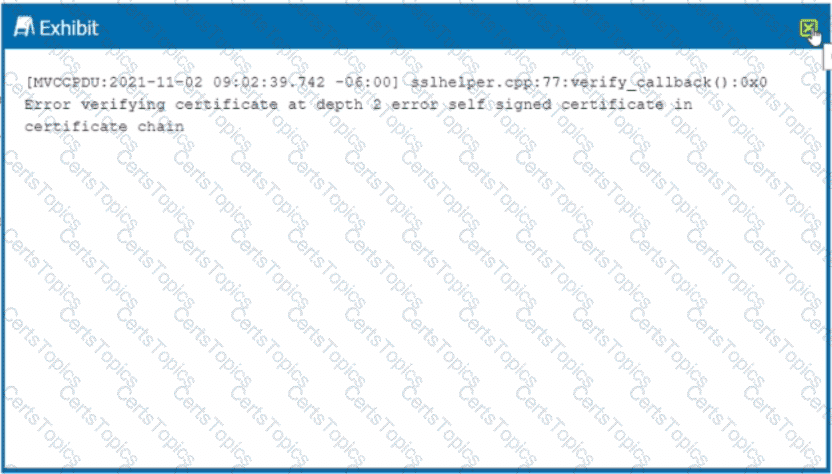
Review the exhibit.

While diagnosing an NPA connectivity issue, you notice an error message in the Netskope client logs.

Referring to the exhibit, what does this error represent?

Options:

A.

The Netskope client has been load-balanced to a different data center.

B.

The primary publisher is unavailable or cannot be reached.

C.

There Is an EDNS or LDNS resolution error.

D.

There Is an upstream device trying to intercept the NPA TLS connection.

Question 27

You are configuring GRE tunnels from a Palo Alto Networks firewall to a Netskope tenant with the Netskope for Web license enabled. Your tunnel is up as seen from the Netskope dashboard. You are unable to ping hosts behind the Netskope gateway.

Which two statements are true about this scenario? (Choose two.)

Options:

A.

You need to call support to enable the GRE POP selection feature.

B.

Netskope only supports Web traffic through the tunnel.

C.

You can only ping the probe IP provided by Netskope.

D.

There is no client installed on the source hosts in your network.

Question 28

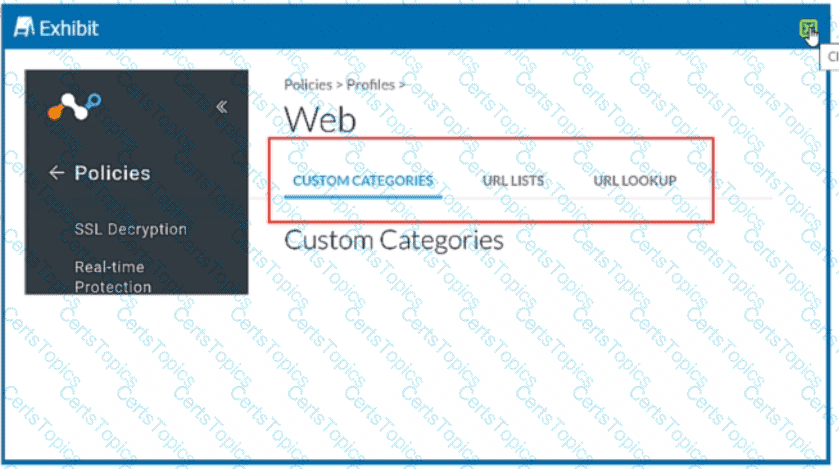
Review the exhibit.

You want to create a custom URL category to apply a secure Web gateway policy combining your own list of URLs and Netskope predefined categories.

In this scenario, which task must be completed?

Options:

A.

Add the URL list to the Client configuration.

B.

Add the URL list to a Custom category.

C.

Add the URL list to a Steering configuration.

D.

Add the URL list to a Real-time Protection policy.

Page: 1 / 7
Total 96 questions