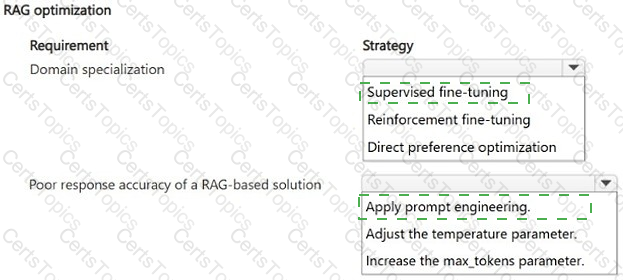
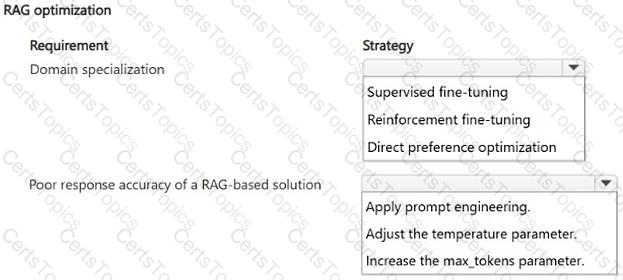
You need to configure an optimization method to meet Fabrikam Inc.’s technical requirements.
Which strategy should you apply first? To answer, select the appropriate options in the answer area.
NOTE: Each correct selection is worth one point.
Fabrikam Inc. must improve its deployment process because traditional machine learning models are deployed manually and the organization has limited rollback capability .
You need to recommend a deployment approach that supports staged rollout and rollback while minimizing operational overhead.
Which deployment approach should you recommend?
You need to recommend an experiment-tracking strategy that ensures consistent experiment results.
What should you recommend?
Fabrikam Inc. needs to improve the performance of a GPT-5 model based on the stated technical requirements.
Which action should you perform first?
You need to standardize how Fabrikam Inc. manages machine learning assets.
Which action should you perform first?
You need to isolate training workloads while remaining cost-aware to address Fabrikam Inc.’s issues, constraints, and technical requirements.
What should you implement?
A team plans to deploy a large foundation model in Microsoft Foundry as part of a new enterprise AI capability.
Different business units across the team ' s organization will access the model from various internal applications.
You need to deploy a foundation model by minimizing latency.
Which deployment type should you use?
You manage an Azure Machine Learning workspace.
You need to define an environment from a Docker image by using the Azure Machine Learning Python SDK v2.
Which parameter should you use?
You have a deployment of an Azure OpenAI Service base model.
You plan to fine-tune the model.
You need to prepare a file that contains training data for multi-turn chat.
Which file encoding method should you use?
A team is experimenting with traditional models for a classification workflow in Azure Machine Learning.
The team requires a consistent way to manage assets that are created during experimentation.
You need to ensure that artifacts can be reused and governed across projects.
Which asset should you register?
When comparing prompt variants, the team plans to assess whether the generated responses are grammatically correct.
You need to evaluate the quality of the language from the generated responses.
Which evaluator should you use?
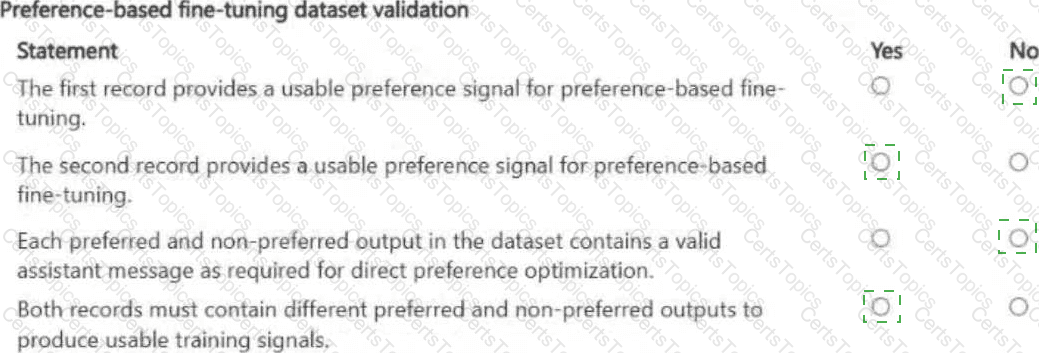
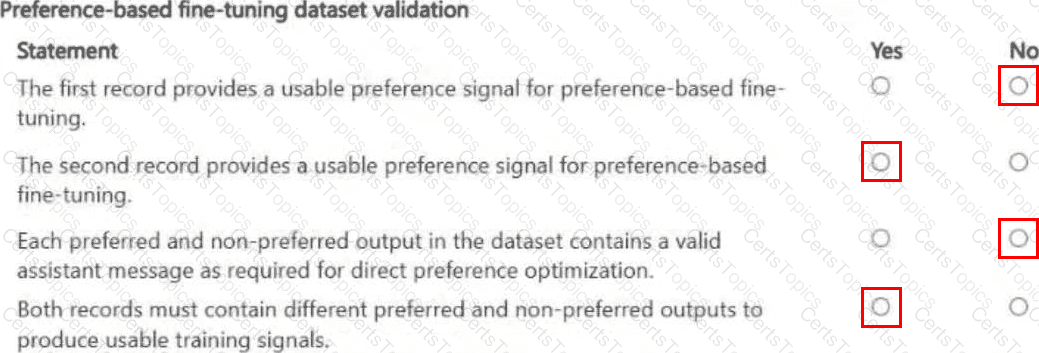
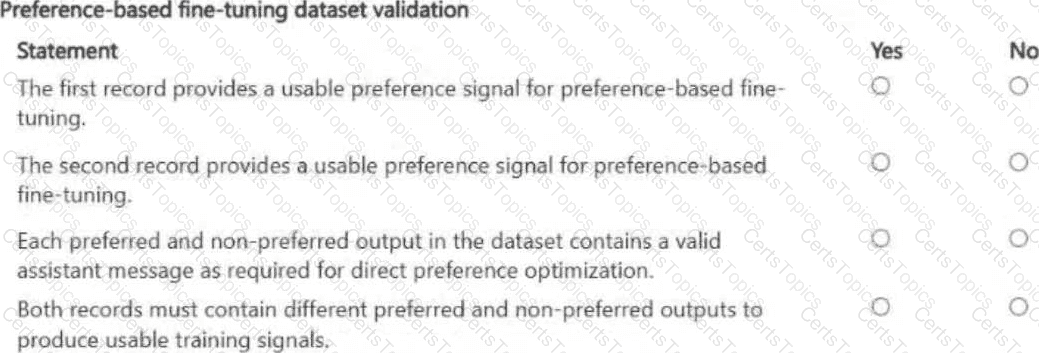
You are reviewing a dataset that will be used for an advanced fine-tuning job in Microsoft Foundry.
The fine-tuning job uses preference comparison data.
You review the following dataset excerpt.
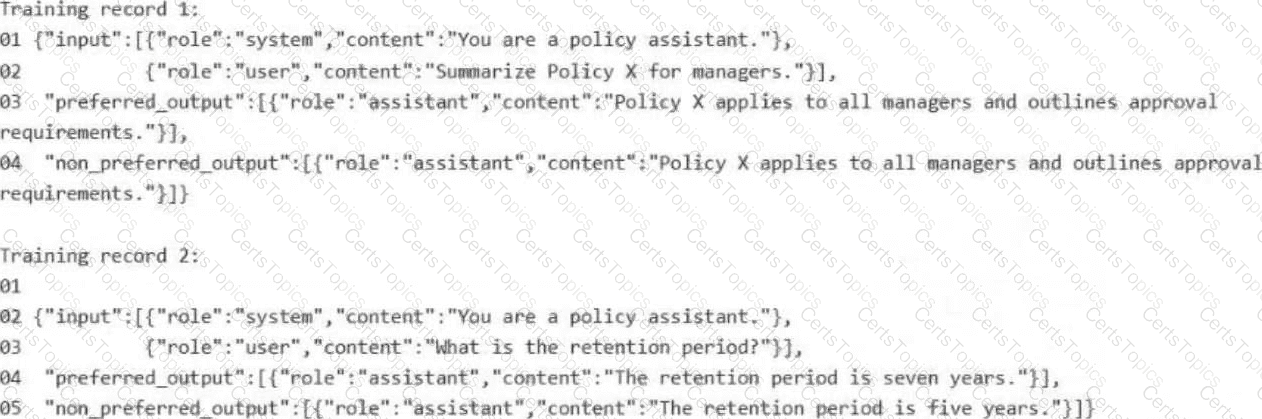
For each of the following statements, select Yes if the statement is true. Otherwise, select No. NOTE: Each correct selection is worth one point.
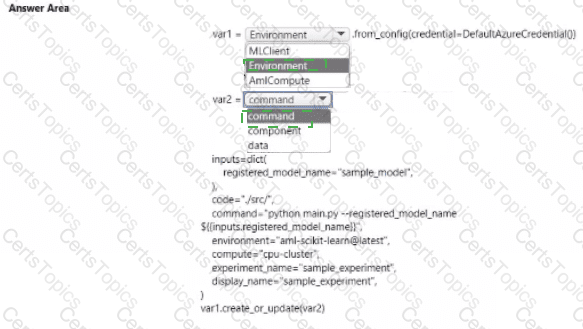
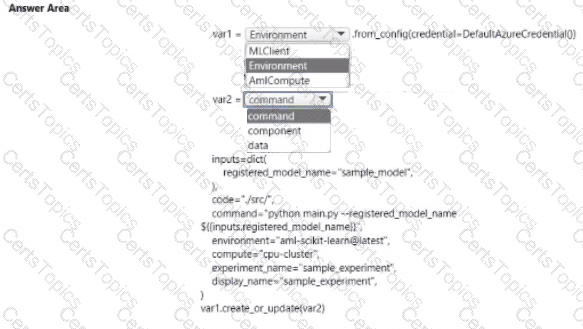
You create an Azure Machine Learning workspace
You are developing a Python SDK v2 notebook to perform custom model training in the workspace. The notebook code imports all required packages.
You need to complete the Python SDK v2 code to include a training script. environment, and compute information.
How should you complete ten code? To answer, select the appropriate options in the answer area.
NOTE: Each correct selection is worth one point
A team provisions an Azure Machine Learning environment by triggering pull requests.
Deployments must be automated, auditable, and require approval before running.
You need to select a deployment automation tool.
Which tool should you use?
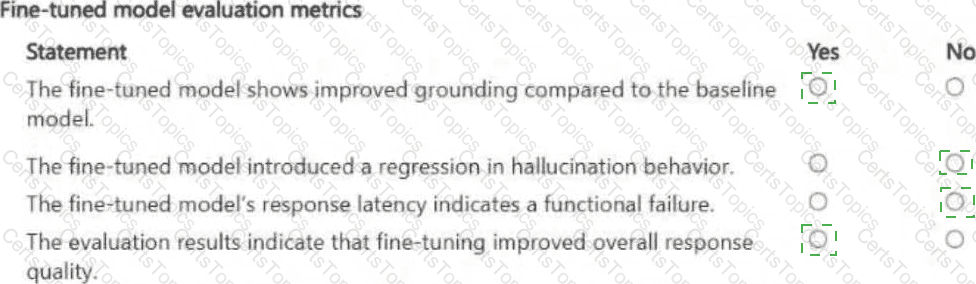
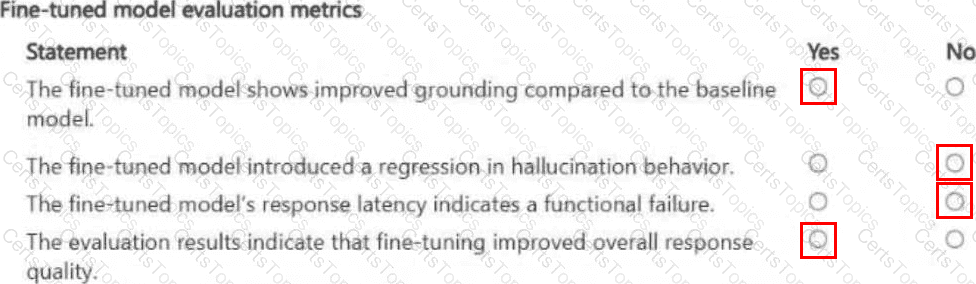
You are monitoring a fine-tuned large language model deployed in Microsoft Foundry.
You evaluate the model before and after fine-tuning by using the same evaluation dataset.
You review the following evaluation results:
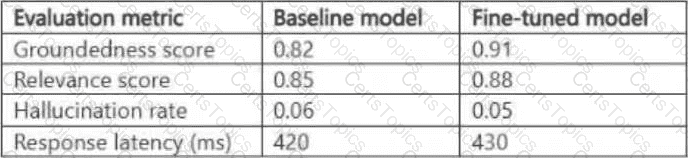
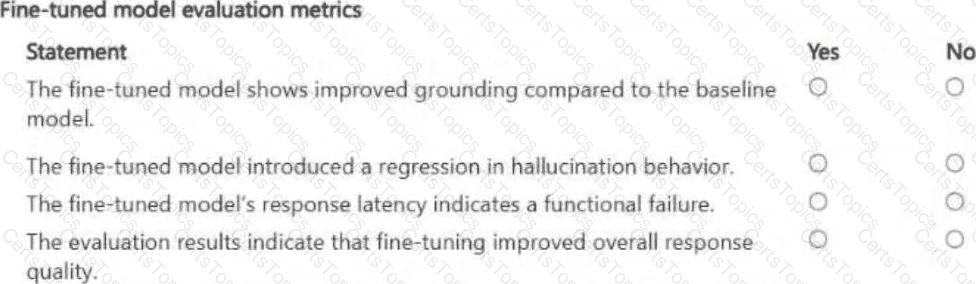
You need to determine whether the fine-tuned model shows improved performance without introducing regression.
For each of the following statements, select Yes if the statement is true. Otherwise, select No. NOTE: Each correct selection is worth one point.
You have a Microsoft Foundry project.
You plan to use the Microsoft Foundry portal to fine-tune a base Azure OpenAI Service model that can accept both text and images as input.
You need to choose the suitable model.
Which model should you choose?
An organization maintains separate Azure Machine Learning workspaces for development and production.
Both environments must use the same validated assets without duplicating them.
Assets must be shared across workspaces while maintaining centralized governance and version control.
You need to enable reuse of assets across workspaces without copying them.
What should you do?
You have an Azure Machine Learning workspace that includes an AmICompute cluster and a batch endpoint. You clone a repository that contains an MLflow model to your local computer. You need to ensure that you can deploy the model to the batch endpoint.
Solution: Create a datastore in the workspace.
Does the solution meet the goal?
A product team is building a customer support assistant that must respond consistently across multiple channels.
Early testing shows that small wording changes in prompts cause large differences in tone and factual accuracy.
The team needs prompts that are reliable, reusable, and adaptable across multiple use cases without retraining the underlying model.
You need to design prompts that improve response quality while remaining flexible for future changes.
Which two actions should you perform? Each correct answer presents part of the solution. (Choose two.)
You manage an Azure Machine Learning workspace.
You must set up an event-driven process to trigger a retraining pipeline.
You need to configure an Azure service that will trigger a retraining pipeline in response to data drift in Azure Machine Learning datasets. Which Azure service should you use?
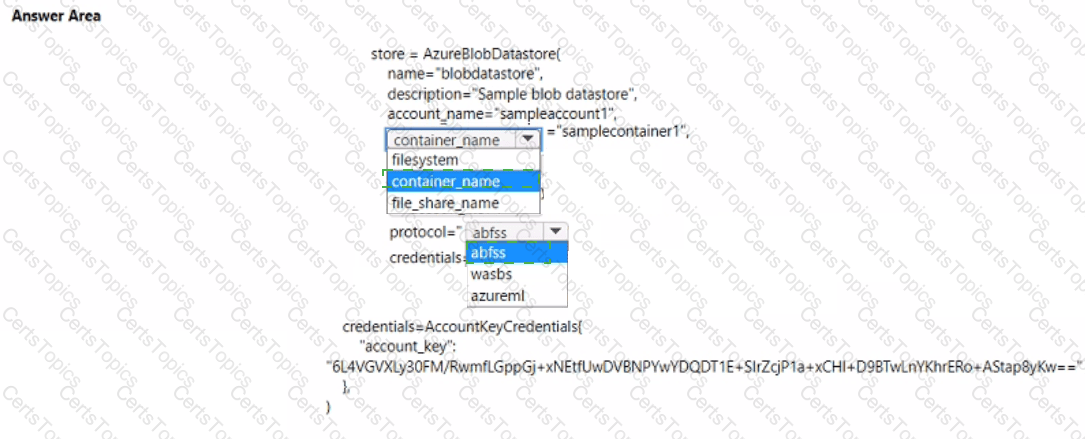
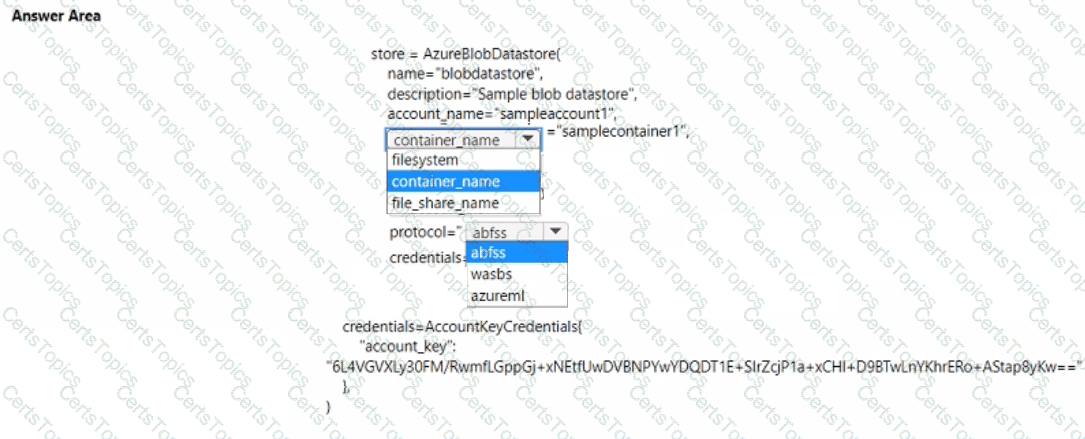
You manage an Azure Machine Learning workspace named workspace1.
You must register an Azure Blob storage datastore in workspace1 by using an access key. You develop Python SDK v2 code to import all modules required to register the datastore.
You need to complete the Python SDK v2 code to define the datastore.
How should you complete the code? To answer, select the appropriate options in the answer area.
NOTE: Each correct selection is worth one point.
You manage an Azure Machine Learning workspace. You have an environment for training jobs which uses an existing Docker image.
A new version of the Docker image is available.
You need to use the latest version of the Docker image for the environment configuration by using the Azure Machine Learning SDK v2.
What should you do?
You manage an Azure Machine Learning workspace. You use Azure Machine Learning Python SDK v2 to configure a trigger to schedule a pipeline job. You need to create a time-based schedule with recurrence pattern.
Which two properties must you use to successfully configure the trigger? Each correct answer presents part of the solution. NOTE: Each correct selection is worth one point.
You use an Azure Machine Learning workspace.
You must monitor cost at the endpoint and deployment level.
You have a trained model that must be deployed as an online endpoint. Users must authenticate by using Microsoft Entra ID.
What should you do?
You manage an Azure Machine Learning workspace named workspace!.
You plan to author custom pipeline components by using Azure Machine Learning Python SDK v2.
You must transform the Python code into a YAML specification that can be processed by the pipeline service.
You need to import the Python library that provides the transformation functionality.
Which Python library should you import?
You manage an Azure Machine learning workspace.
You build a custom model you must log with Mlftow. The custom model includes the following:
• The model is not natively supported by Mlflow.
• The model cannot be serialized in Pickle format.
• The model source code is complex.
• The Python library tor the model must be packaged with the model.
You need to create a custom model flavor to enable logging with ML. flow.
What should you use?
A company ' s platform engineers manage the resource settings and governance of Microsoft Foundry.
Developers must be able to create and update project assets but must not be able to change resource-level configurations.
You need to enforce least privilege access for the engineers and developers.
Which two actions should you perform? Each correct answer presents part of the solution. NOTE: Each correct selection is worth one point. Choose two.
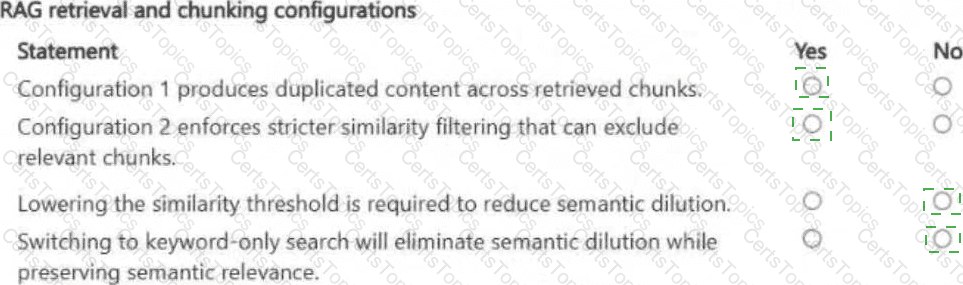
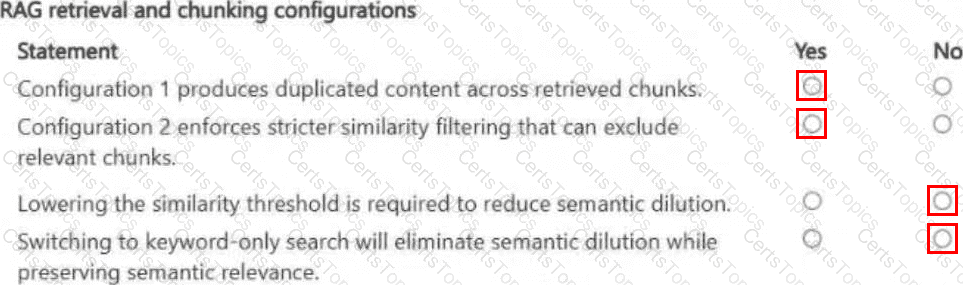
You manage a Retrieval-Augmented Generation (RAG) system that retrieves internal policy documents from a vector index.
Recent analysis shows that:
Retrieved results frequently include duplicated content from the same document.
Retrieved chunks sometimes span unrelated policy sections.
You review the following retrieval and ingestion configurations:
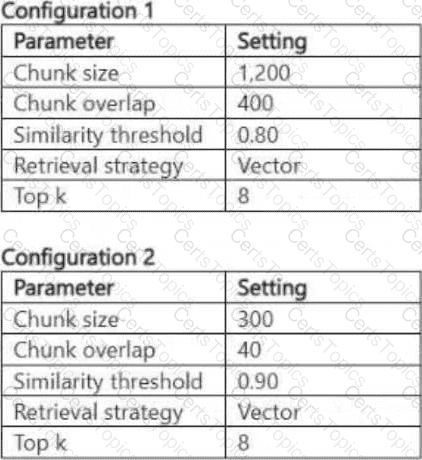
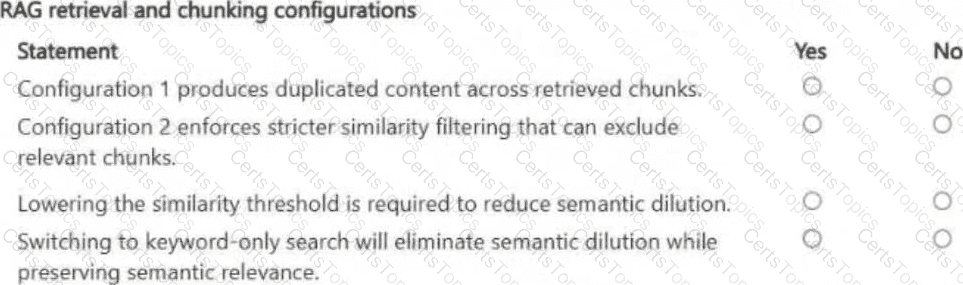
You need to reduce duplicated retrieval results and improve chunk relevance across policy sections.
For each of the following statements, select Yes if the statement is true. Otherwise, select No. NOTE: Each correct selection is worth one point.
Copyright © 2021-2026 CertsTopics. All Rights Reserved