You manage an Azure Machine Learning workspace. You design a training job that is configured with a serverless compute. The serverless compute must have a specific instance type and count
You need to configure the serverless compute by using Azure Machine Learning Python SDK v2. What should you do?
-
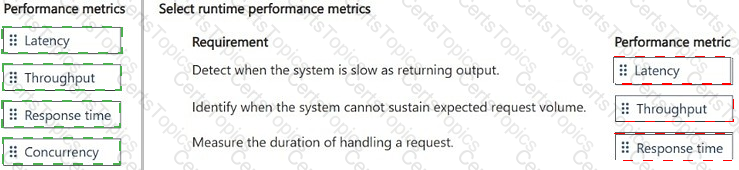
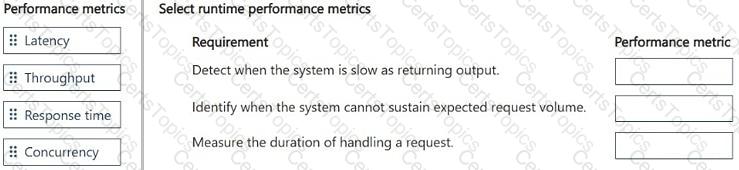
A team operates a generative AI-powered customer support assistant built on Microsoft Foundry. The application serves users globally and supports both real-time chat interactions and batch summarization jobs.
The team must ensure that the application continues to meet defined service-level objectives (SLO) as usage increases.
The team requires visibility into runtime behavior to identify performance regressions that affect the user experience and system capacity.
You need to select the performance metrics that meet the requirements.
Which performance metric should you monitor for each requirement? To answer, move the appropriate performance metrics to the correct requirements. You may use each performance metric once, more than once, or not at all. You may need to move the split bar between panes or scroll to view content.
NOTE: Each correct selection is worth one point.
You use the Azure Machine learning SDK v2 tor Python and notebooks to tram a model. You use Python code to create a compute target, an environment, and a taring script. You need to prepare information to submit a training job.
Which class should you use?
You train and register an Azure Machine Learning model
You plan to deploy the model to an online endpoint
You need to ensure that applications will be able to use the authentication method with a non-expiring artifact to access the model.
Solution:
Create a managed online endpoint and set the value of its auth.mode parameter to aml.token. Deploy the model to the online endpoint.
Does the solution meet the goal?
Copyright © 2021-2026 CertsTopics. All Rights Reserved