
Pre-Winter Sale 70% Discount Offer - Ends in 0d 00h 00m 00s - Coupon code: save70

Free and Premium Linux Foundation Cilium-Associate Dumps Questions Answers

Cilium Certified AssociateCCA Questions and Answers

Question 1

What is the default policy enforcement behavior?

Options:

A.

If any rule selects an Endpoint and the rule has an ingress section, the Endpoint goes Into default deny at egress. f any rule selects an Endpoint and the rule has an egress section, the Endpoint goes into default deny at ingress.

B.

If any rule selects an Endpoint and the rule has an ingress section, the Endpoint goes Into default allow at egress, f any rule selects an Endpoint and the rule has an egress section, the Endpoint goes into default allow at ingress.

C.

If any rule selects an Endpoint and the rule has an ingress section, the Endpoint goes Into default allow at Ingress, f any rule selects an Endpoint and the rule has an egress section, the Endpoint goes into default allow at egress.

D.

If any rule selects an Endpoint and the rule has an ingress section, the Endpoint goes into default deny at ingress. f any rule selects an Endpoint and the rule has an egress section, the Endpoint goes into default deny at egress.

Buy Now
Question 2

After enabling Layer 7 visibility, you can now observe DNS domains and FQDN in your Hubble logs, like the one below.

Nov 16 13:52:07.279: endor/xwing-9bd8f454d-m46mm:34706 (ID:3817) < > example.com:443 (ID:16777217) Policy denied DROPPED (TCP Flags SYN)

Which of these Hubble CLI commands could have returned the output above?

Options:

A.

hubble observe --to-fqdn example.con --from-namespace endor --to-port 443 --verdict DROPPED

B.

hubble obs erve --to-fqdn example.con --fro � -namespace endor --to-port 80 --verdict DROPPED

C.

hubble observe --to-fqdn example.cow --from-namespace kube-system --to-port 443 --verdict DROPPED

D.

hubble observe --to-fqdn example.co* --from-namespace endor --to-port 443 --verdict FORWARDED

Question 3

What is an accurate description related to eBPF?

Options:

A.

After eBPF programs have been loaded, the host needs rebooting before the functionality can be applied.

B.

eBPF program can only be attached in ingress (inbound from the network interface).

C.

Network security tools based on eBPF can only police the containers' traffic as they are unable to access the host.

D.

eBPF programs could inspect the decrypted contents of encrypted traffic.

Question 4

Review the Cilium Network Policy in the YAML file.

It was deployed in the ns-cca namespace on cluster1
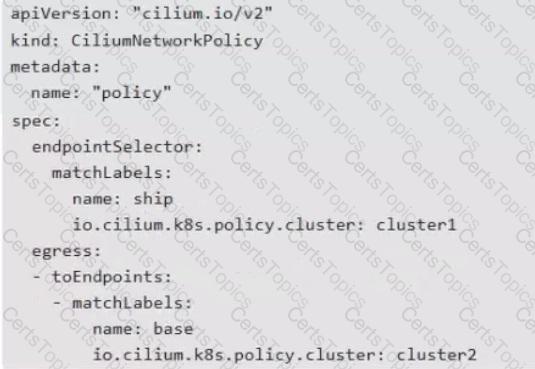
Cluster Mesh CiliumNetworkPolicy exhibit

Which statement Is correct?

Options:

A.

This policy will allow traffic from a Pod named ship in ns-cca namespace in clusterl to a Pod named base in ns-cca namespace in cluster2.

B.

This policy will allow traffic from a Pod named ship in ns-cca namespace in clusterl to a Pod named base in default namespace in cluster2.

C.

This policy will deny traffic from a Pod named ship in ns-cca namespace in clusterl to a Pod named base in ns-cca namespace in cluster2.

D.

This policy will deny traffic from a Pod named ship in ns-cca namespace in clusterl to a Pod named base in default namespace in cluster2.

Question 5

Which statement about Cilium's identity-based security model is correct?

Options:

A.

An endpoint identity Is identified by labels and is tied to a single namespace.

B.

Security is based on the identity of a pod, which is derived through labels.

C.

By using an IP-address security model, identities can be shared between pods.

D.

Cilium enforces security based on IP addresses as it provides better scalability and flexibility.

Question 6

When using Cilium with the kube-proxy replacement enabled, which underlying technology is effectively replaced with eBPF?

Options:

A.

BGP

B.

Routing

C.

Iptables/IPVS

D.

firewalld

Question 7

What does this Egress Gateway policy achieve?
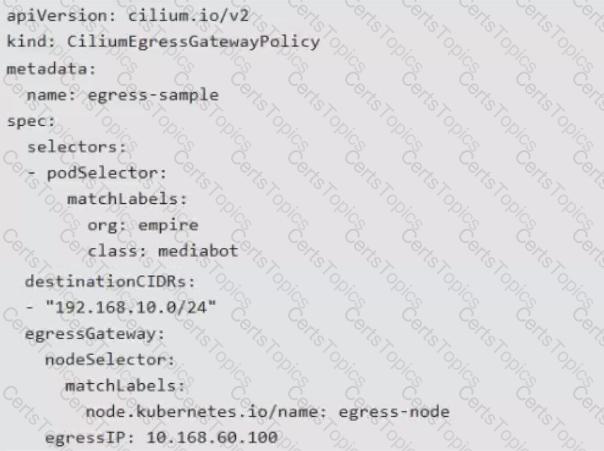
Cilium Egress Gateway policy exhibit

Options:

A.

It would cause all traffic originating from pods with the org: empire and class: mediabot labels in the default namespace and destined to 192.168.19.0/24 to be routed through the gateway node with the node.kubemetes.io/name: egress-node label, which will then SNAT said traffic with the 10.168.60.100 egress IP

B.

It would cause all traffic sent to pods with the org: empire and class: mediabot labels In the default namespace and destined to 192.168.19.9/24 to be routed through the gateway node with the node.kubemetes.io/name: egress-node label, which will then DNAT said traffic with the 19.168.69.199 egress IP

C.

It would cause all traffic sent to pods with the org: empire and class: mediabot labels in the default namespace and destined to 192.168.10.0/24 to be routed through the gateway node with the node.kubernetes.io/name: egress-node label, which will then SNAT said traffic with the 10.168.60.180 egress IP

D.

It would cause all traffic originating from pods with the org: empire and class: nediabot labels in the default namespace and destined to 192.168.19.0/24 to be routed through the gateway node with the node.kubernetes.io/name: egress-node label, which will then DN AT said traffic with the 10.168.60.100 egress IP

Question 8

Which one of the following service mesh features and use cases is natively supported by Cilium?
Options:

A.

AP| request limiting

B.

API authorization

C.

Layer 7 Load Balancing of gRPC

D.

Fault injection, such as injection of delay

Question 9

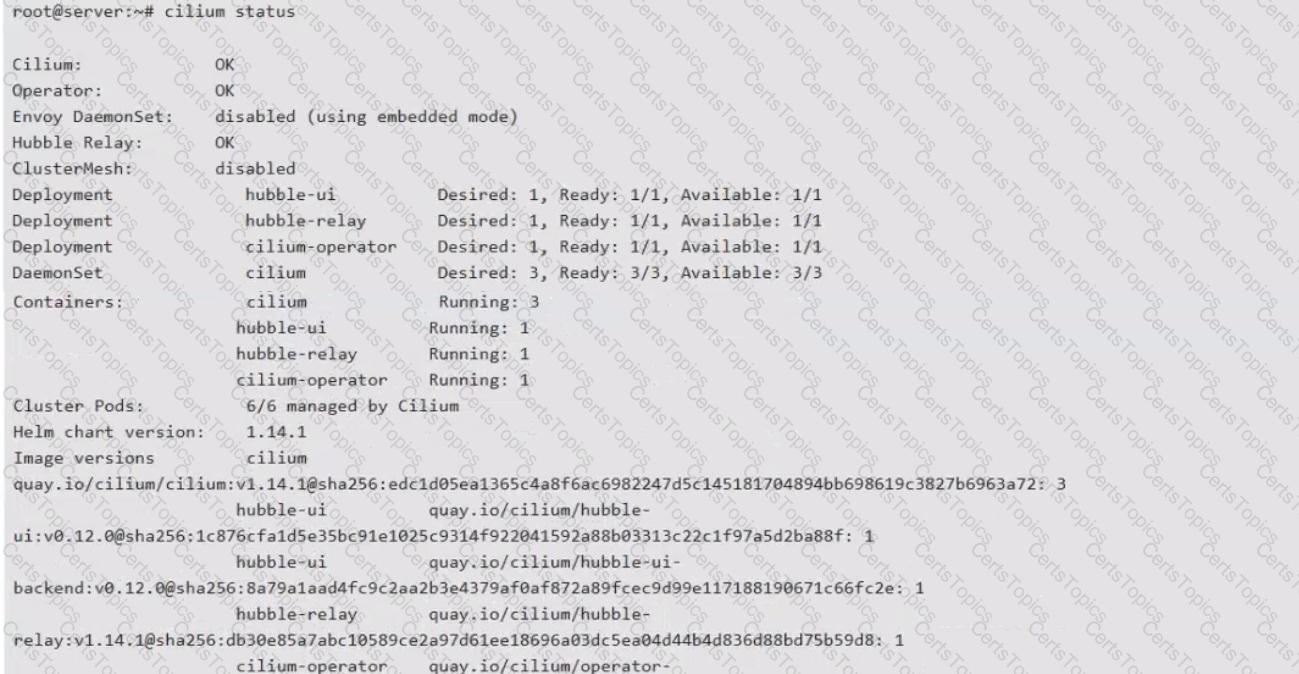
Cilium status exhibit

Based on the cilium status output above, what is correct about the Cilium deployment?

For accessibility, the output of the command has been edited.

Options:

A.

Observability of network flows via a graphical user interface has yet to be enabled for this particular cluster

B.

The component responsible for registering the CRDs used by Cilium is healthy.

C.

The operator has been deployed as a DaemonSet.

D.

Only a single operator replica can be deployed on the cluster.

Question 10

You are managing two Kubernetes clusters, labeled as Cluster A and Cluster B, both of which have Cilium installed. You want to mesh Cluster A and Cluster B together The following characteristics define these clusters:

� Both clusters are configured In encapsulation mode.

� The PodCIDR ranges differ: Cluster A uses 192.168.0.0723, while Cluster B uses 192.168.2.0/24.

� There is IP connectivity between the nodes in all clusters using their respective InternallP addresses.

� The network infrastructure between the clusters enables inter-cluster communication.

� Cluster A runs Kubernetes version 1.28, and Cluster B runs Kubernetes version 1.27.

� Cilium versions also differ, with Cluster A using version 1.14 and Cluster B using version 1.13.

� Both clusters share the same cluster name and cluster ID.

� The Cilium certificate authority differs between Cluster A and Cluster B.

Is it possible to create a cluster mesh given the conditions?

Options:

A.

Yes. but you need to change the cluster name and cluster ID before

B.

No, Cilium certificate authority must be the same to deploy a cluster mesh. You cannot change that after installation

C.

No. cluster name and cluster ID must be different. You cannot change that after installation.

D.

Yes, but you need to upgrade cilium version of Cluster B

Question 11

Which Cilium configuration is recommended to help identify the correct configuration of network policies without interrupting workload communications?

Options:

A.

DNS enforcement mode

B.

HTTP audit mode

C.

Policy enforcement mode

D.

Policy audit mode

Question 12

You need to expose an application over HTTPS on your Cilium-managed Kubernetes cluster

The security team has specifically asked for traffic to be encrypted all the way from the external clients to the Service.

Which option should you use?

Options:

A.

Enable the Gateway API feature and use the TLS Terminate mode and HTTPRoute route type.

B.

Enable the Ingress feature and use the TLS Passthrough mode and TLSRoute route type.

C.

Enable the Ingress feature and use the TLS Terminate mode and HTTPRoute route type.

D.

Enable the Gateway API feature and use the TLS Passthrough mode and TLSRoute route type.

Question 13

Which component is embedded in the Cilium Agent and retrieves eBPF-based visibility from Cilium?

Options:

A.

Cilium CNI

B.

Cilium Operator

C.

Hubble Relay

D.

Hubble Server

Question 14

You are creating a Cilium network policy for pods with the label app: frontend . The policy should allow all pods with that label to communicate with destinations inside 192.168.e.e/24 and using TCP on port 8888.

For example:

� Traffic to 192.168.9.23:8888 should be allowed

� Traffic to 192.168.10.5:8888 should be denied.

� Traffic to 192.168.9.12:5606 should be denied.

Which of the following policies is correct?

A)
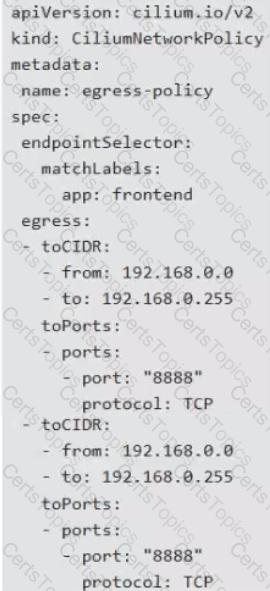
Option A

B)
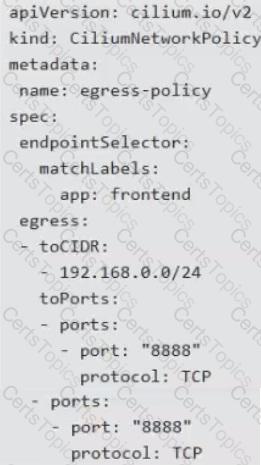
Option B

C)
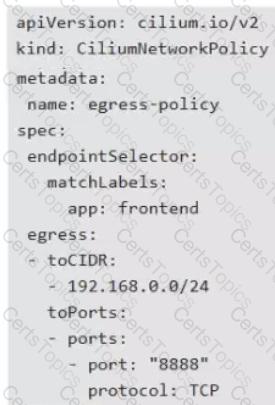
Option C

D)
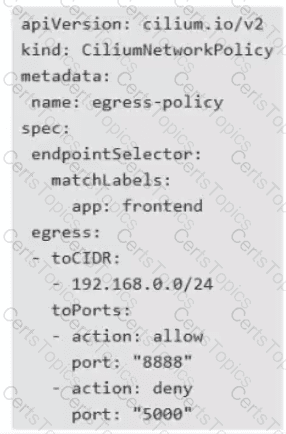
Option D

Options:

A.

Option A

B.

Option B

C.

Option C

D.

Option D

Question 15

Which encapsulation protocols are supported when configuring Cilium in tunnel mode?

Options:

A.

MPLS and Geneve

B.

VXLAN and Geneve

C.

OTV and STT

D.

EVPN and VXLAN

Question 16

Which of the following best describes how eBPF is used within Cilium9

Options:

A.

Cilium utilizes eBPF to gather real-time insights Into network traffic, Including data on latency, bandwidth, and data flows between services. This data Is exposed through a user interface and can be used for network troubleshooting and optimization.

B.

Cilium uses eBPF to provide a reliable and scalable DNS infrastructure for Kubernetes clusters, enabling seamless communication between services and facilitating service discovery within the cluster

C.

Cilium is a security-related project that utilizes eBPF for real-time network security analysis. It employs eBPF to detect and respond to network security threats by inspecting network traffic.

D.

Cilium leverages eBPF to enforce network security policies at the kernel level. Security rules are translated into eBPF programs that are attached to kernel network hooks, allowing packet filtering based on these rules.

Question 17

You must add Hubble to your Kubernetes cluster where Cilium is NOT the installed CNI. Your cluster is already running in production and you must minimise downtime.

Which method is the most appropriate?

Options:

A.

Install Cilium in chaining mode and then enable Hubble.

B.

Install Hubble in the existing cluster as Hubble can be deployed without Cilium.

C.

Migrate your workloads into Cilium and Hubble.

D.

Create a cluster with Cilium and Hubble installed and switch clusters.

Question 18

Which one of the following Cilium Network Policies follow the correct syntax?

A)
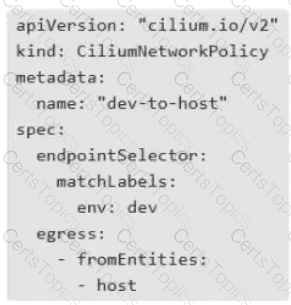
Question 17 option A

B)
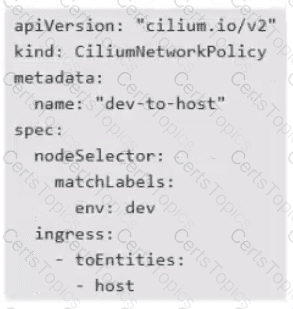
Question 17 option B

C)
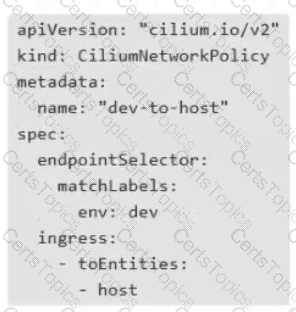
Question 17 option C

D)
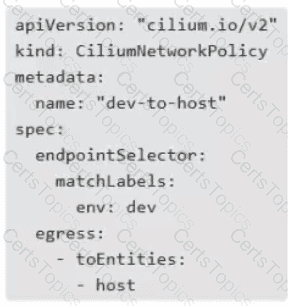
Question 17 option D

Options:

A.

Option A

B.

Option B

C.

Option C

D.

Option D
