
Halloween Sale Special - 75% Discount Offer - Ends in 0d 00h 00m 00s - Coupon code: big75certs

Exactprep Cilium-Associate Questions

Cilium Certified AssociateCCA Questions and Answers

Question 13

Which component is embedded in the Cilium Agent and retrieves eBPF-based visibility from Cilium?

Options:

A.

Cilium CNI

B.

Cilium Operator

C.

Hubble Relay

D.

Hubble Server

Question 14

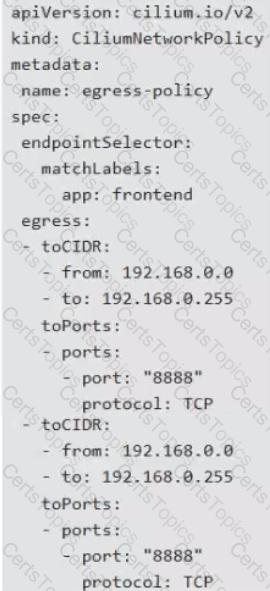
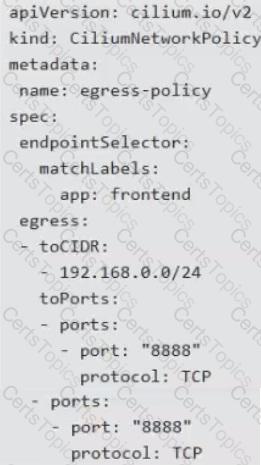
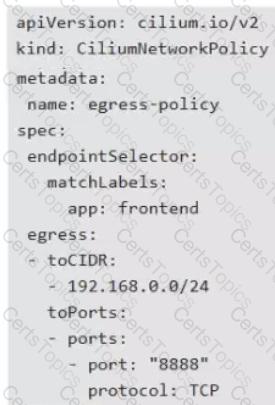
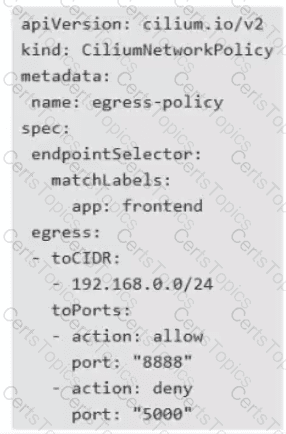
You are creating a Cilium network policy for pods with the label app: frontend . The policy should allow all pods with that label to communicate with destinations inside 192.168.e.e/24 and using TCP on port 8888.

For example:

� Traffic to 192.168.9.23:8888 should be allowed

� Traffic to 192.168.10.5:8888 should be denied.

� Traffic to 192.168.9.12:5606 should be denied.

Which of the following policies is correct?

A)
Option A

B)
Option B

C)
Option C

D)
Option D

Options:

A.

Option A

B.

Option B

C.

Option C

D.

Option D

Question 15

Which encapsulation protocols are supported when configuring Cilium in tunnel mode?

Options:

A.

MPLS and Geneve

B.

VXLAN and Geneve

C.

OTV and STT

D.

EVPN and VXLAN

Question 16

Which of the following best describes how eBPF is used within Cilium9

Options:

A.

Cilium utilizes eBPF to gather real-time insights Into network traffic, Including data on latency, bandwidth, and data flows between services. This data Is exposed through a user interface and can be used for network troubleshooting and optimization.

B.

Cilium uses eBPF to provide a reliable and scalable DNS infrastructure for Kubernetes clusters, enabling seamless communication between services and facilitating service discovery within the cluster

C.

Cilium is a security-related project that utilizes eBPF for real-time network security analysis. It employs eBPF to detect and respond to network security threats by inspecting network traffic.

D.

Cilium leverages eBPF to enforce network security policies at the kernel level. Security rules are translated into eBPF programs that are attached to kernel network hooks, allowing packet filtering based on these rules.
