New Year Sale 70% Discount Offer - Ends in 0d 00h 00m 00s - Coupon code: save70

Free and Premium Juniper JN0-650 Dumps Questions Answers

Page: 1 / 5
Total 65 questions

Enterprise Routing and Switching - Professional (JNCIP-ENT) Questions and Answers

Question 1

Exhibit

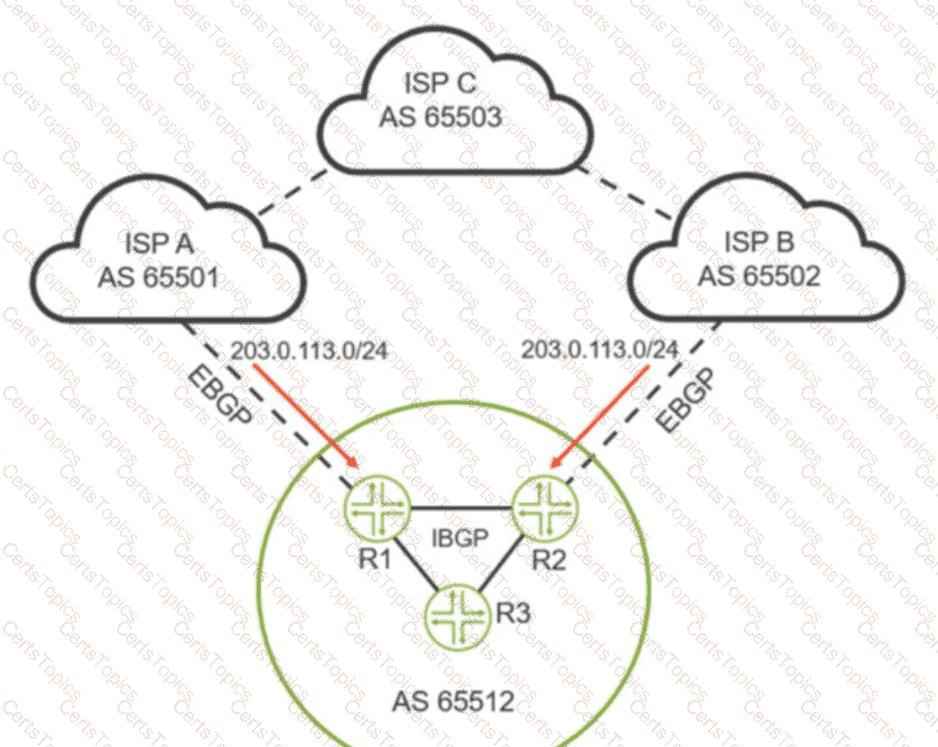
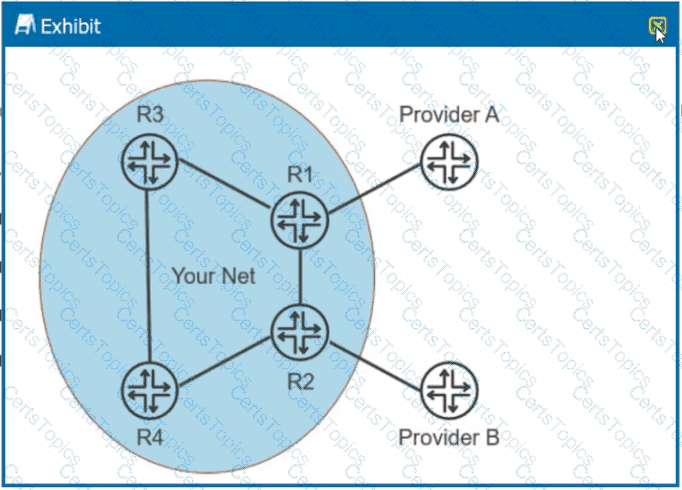
You are receiving the 203 0.113.0/24 route from both upstream ISPs You are asked to ensure that ISP A is the preferred ISP for traffic being sent to the 203.0.113.0/24 network from devices in AS 65512.

Referring to the exhibit, which two statements will accomplish this behavior? (Choose two.)

Options:

A.

You should assign a local preference that is lower than 100 for the route learned from ISP A.

B.

You should assign a local preference that is higher than 100 for the route learned from ISP A.

C.

You should assign a local preference that is lower than 100 for the route learned from ISP B.

D.

You should assign a local preference that is higher than 100 for the route learned from ISP B.

Buy Now
Question 2

You have created a private community VLAN called RND The private community VLAN works fine within switch S1, but traffic in the private RND community VLAN does not reach VLAN members connected to switch S2.

Which statement is correct in this scenario?

Options:

A.

The RND Community VLAN needs to have the same 802.1Q tag as its parent VLAN

B.

The RND community VLAN needs to have an associated 802.1Q tag associated with it.

C.

The RND Community VLAN needs to be stripped of all 802.1Q tags.

D.

The RND community VLAN needs to be defined as an isolated VLAN.

Question 3

You run a multivendor switching environment where you have configured VSTP. You have 450 VLANs and notice that some of your VLANs do not function properly. How should you change the configuration to get all 450 VLANs working?

Options:

A.

Include the force-version stp; statement in your configuration

B.

Enable RSTP to handle additional VLANs.

C.

Set the VLAN max-age to 3600 or more.

D.

Increase the bridge priority on all VLANs to at least 16k.

Question 4

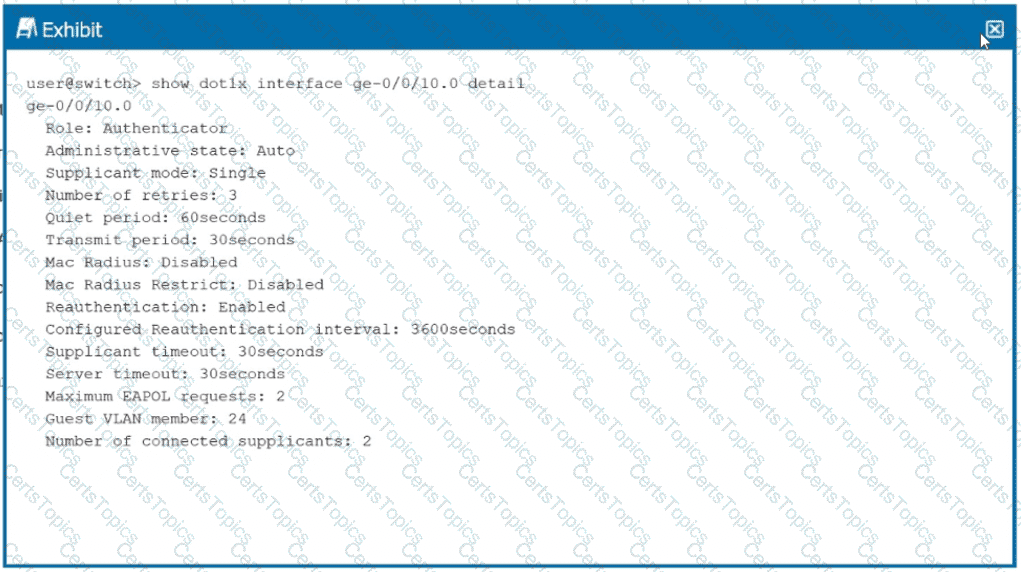
Your organization uses 802 1X with a RADIUS server. If the RADIUS server stops responding, you want the fallback action to continue to permit access for devices that currently have authorization but deny any new access attempts.

Which fallback action provides this capability?

Options:

A.

deny

B.

vlan-name

C.

permit

D.

use-cache

Question 5

You are deploying a new campus switching environment using EX Series switches. This new environment includes IP phones requiring Power over Ethernet (PoE) and end-user client PCs attached to a single switch port that will be configured with 802.1X authentication.

Considering the default configuration on an EX Series access switch and the configuration requirements to support this deployment, which two statements are correct? (Choose two.)

Options:

A.

Configuration for the voice VLAN for all relevant access ports must be added.

B.

Configuration for PoE on all relevant access ports must be added

C.

Configuration for LLDP and LLDP-MED on all relevant access ports must be added.

D.

Configuration for 802.1X on all relevant access ports must be added.

Question 6

You have deployed 802.1X with server fail fallback enabled on an EX Series switch and specified the vlan-name feature for all access ports. The RADIUS server is unavailable.

Which two statements are correct in this scenario? (Choose two )

Options:

A.

All clients already authenticated will immediately be disconnected before the re-authentication timer expires.

B.

All clients already authenticated will be unaffected until reauthentication is required.

C.

All new clients will be granted access only if their requested VLAN matches the configuration

D.

All new clients will be placed in the referenced VLAN in the configuration and given access.

Question 7

According to IETF standards, which two statements are correct about EVPN/VXLAN deployments? (Choose two.)

Options:

A.

Up to 16 million EVPN broadcast domains can exist.

B.

Up to 16 million VXLAN broadcast domains can exist.

C.

IP packets within the same broadcast domain are forwarded unchanged.

D.

Layer 2 frames within the same broadcast domain are forwarded unchanged.

Question 8

You are deploying a three-stage EVPN environment with VXLAN using EX and QFX Series switches. The leaf devices will perform the gateway services. Which two statements are correct in this scenario? (Choose two.)

Options:

A.

Only the leaf devices must support VXLAN capabilities.

B.

The leaf devices will function as VTEPs

C.

Both the leaf and spine devices must support VXLAN capabilities.

D.

The spine devices will function as VTEPs.

Question 9

Exhibit

You are deploying a new campus switching environment using various EX Series switch models. The devices attached to one of the new EX Senes switches include IP phones, loT devices, and wireless access points (APs) requiring power over Ethernet (PoE) with varying power requirements. A sample output from one of these switches is shown in the exhibit.

In this scenario, which two statements are correct? (Choose two.)

Options:

A.

The switch is capable of supplying up to 60 W of power to attached PoE devices.

B.

Port ge-0/0/0 is enabled and has its maximum power and device class designations statically configured.

C.

Port ge-0/0/0 is enabled and has dynamically learned maximum power and device class designations.

D.

The switch is capable of supplying up to 30 W of power to attached PoE devices.

Question 10

Which two statements correctly describe how EX Series switches use captive portal for Layer 2 authentication? (Choose two.)

Options:

A.

The captive portal is the default Layer 2 authentication method that is applied before other methods such as 802 1X or MAC RADIUS.

B.

The captive portal authentication allowlist works for devices that do not have HTTP capabilities.

C.

The captive portal is configured on Layer 3 interfaces and does not participate in Layer 2 authentication on EX Series switches.

D.

The captive portal is used as a fallback mechanism for clients that fail 802.1X or MAC RADIUS authentication.

Question 11

An incorrectly configured routing policy at your service provider led to several hundred thousand routes being placed in your edge router's routing table In this scenario, how would you limit the number of prefixes received on a BGP peer session?

Options:

A.

Enable the damping BGP parameter in the edge router configuration

B.

Enable the prefix-limit BGP parameter in the edge router configuration.

C.

Enable the graceful-restart BGP parameter in the edge router configuration.

D.

Enable the advertise-inactive BGP parameter in the edge router configuration.

Question 12

Exhibit.

Referring to the exhibit. Ieaf2 is elected the designated forwarder

Which two statements are correct if server2 generates a broadcast frame*? (Choose two.)

Options:

A.

The broadcast frame will be forwarded to leaf1 and Ieaf2.

B.

The broadcast frame will not be forwarded to leaf1.

C.

Only Ieaf2 will forward the broadcast frame to server1

D.

Only leaf1 will forward the broadcast frame to server1.

Question 13

Exhibit

What is the OSPF router type shown in the exhibit for router 192.168.2.1?

Options:

A.

neither an ABR nor an ASBR

B.

an ASBR

C.

both an ABR and an ASBR

D.

an ABR

Question 14

You need to perform maintenance on one of your OSPF routers. You do not want the other OSPF routers on the network to forward traffic to this router dunng the maintenance window

Which OSPF configuration parameter would you implement to accomplish this task?

Options:

A.

traffic-engineering

B.

overload

C.

preference

D.

spf-options

Question 15

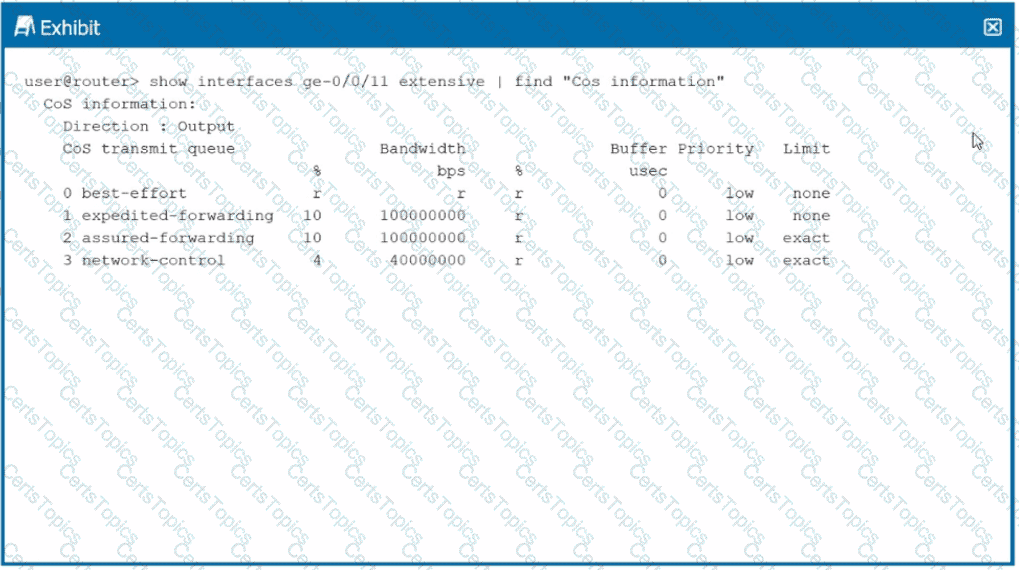
While deploying class of service on an EX Series switch, what are two aspects of the scheduler? (Choose two.)

Options:

A.

It defines interface rate-limiting.

B.

It provides DiffServ code translation.

C.

It identifies the priority of the queue to which it is assigned.

D.

It defines a buffer size of the queue to which it is assigned.

Question 16

Exhibit.

Referring to the exhibit, you see that the 0.0.0.0/0 route is coming from AS 64512.

What is the command to achieve this task?

Options:

A.

show route receive-protocol bgp

B.

show route protocol bgp source-gateway

C.

show route protocol bgp next-hop < peer ip>

D.

show route receive-protocol bgp hidden

Question 17

Which two statements are correct about EVPN/VXLAN deployments? (Choose two.)

Options:

A.

VNIs are used for encapsulating and de-encapsulating traffic entering and leaving the tunnels

B.

VTEPs are used for encapsulating and de-encapsulating traffic entering and leaving the tunnels.

C.

VTEPs are used to identify broadcast domains within an EVPN/VXLAN environment.

D.

VNIs are used to identify broadcast domains within an EVPN/VXLAN environment.

Question 18

Exhibit.

Referring to the exhibit, which statement is correct?

Options:

A.

The device with the highest IP address is elected as the DR.

B.

The OSPF state will be stuck in the Exstart state

C.

The OSPF state will be stuck in the 2Nay state

D.

The device with the lowest IP address is elected as the DR.

Question 19

You have configured DSCP CoS in your network and have applied BA and multifield classifiers to all interfaces.

In this scenario, which statement is correct?

Options:

A.

If traffic matches both classifiers, then the multifield classifier determines into which forwarding class the traffic is assigned

B.

You must set the BA classifier to take precedence over the multifield classifier or the configuration is ignored

C.

You must set the multifield classifier to take precedence over the BA classifier or the configuration is ignored.

D.

If traffic matches both classifiers, then the BA classifier determines into which forwarding class the traffic is assigned.

Page: 1 / 5
Total 65 questions