Weekend Certification Sale 70% Discount Offer - Ends in 0d 00h 00m 00s - Coupon code: save70

Free and Premium Juniper JN0-352 Dumps Questions Answers

Page: 1 / 5
Total 65 questions

Enterprise Routing and Switching, Specialist (JNCIS-ENT) Questions and Answers

Question 1

Depending on the link type, OSPF sends link-state update packets to which two addresses? (Choose two.)

Options:

A.

224.0.0.8

B.

224.0.0.6

C.

224.0.0.5

D.

224.0.0.9

Buy Now
Question 2

You have enabled MACsec on two directly connected Ethernet devices but MACsec is not working.

Which two actions will solve this problem? (Choose two.)

Options:

A.

Configure the switch interface as a trunk port.

B.

Configure the switch interface as an access port.

C.

Verify the CAK and CKN match on both sides of the link.

D.

Verify the MTU on both sides of the link.

Question 3

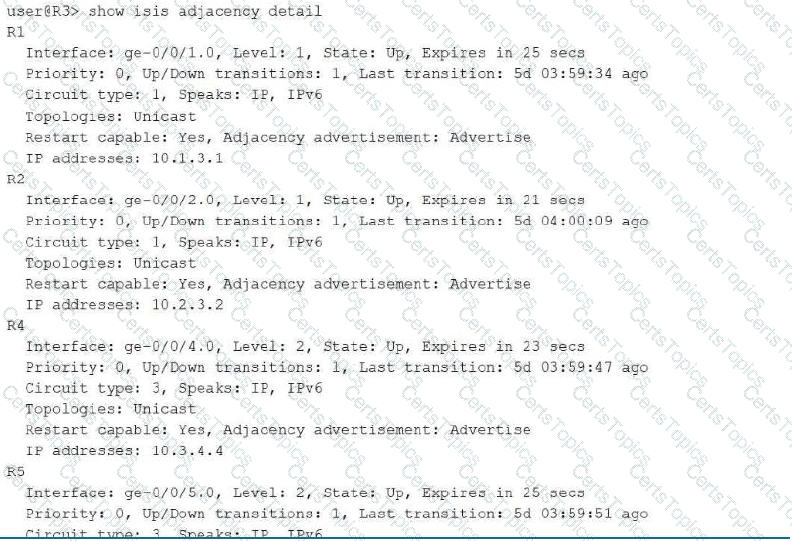
[Exhibit]

Click the Exhibit button.

Which two statements about the IS-IS output shown in the exhibit are correct? (Choose two.)

Options:

A.

R3 is connected to the IS-IS backbone.

B.

R3 is connected to two Level 1 IS-IS neighbors.

C.

These IS-IS neighbors have the IPv6 address family disabled.

D.

The IS-IS adjacency with R5 requires authentication.

Question 4

Which statement describes how Rapid Spanning Tree Protocol (RSTP) identifies an alternate port?

Options:

A.

An alternate port is the upstream port that is not receiving BPDUs from the root bridge.

B.

An alternate port is the upstream port that provides the least-cost path to the root bridge.

C.

An alternate port is the upstream port that provides a backup path to the root bridge and stays in the discarding state.

D.

An alternate port is the upstream port that forwards traffic only when the designated port is overloaded.

Question 5

Which two fields must match in an OSPF hello packet to form an adjacency over a broadcast link? (Choose two.)

Options:

A.

network mask

B.

designated router

C.

router priority

D.

dead interval

Question 6

You have traffic for a video streaming application traversing a GRE tunnel in your network and users are reporting poor performance. Both ends of the tunnel are using the default settings for a gigabit Ethernet interface, but you observe excessive packet drops due to exceeding the MTU.

Which two steps would you take to improve connectivity for this application? (Choose two.)

Options:

A.

Increase the MTU for the member interfaces to 1524 bytes.

B.

Route the GRE tunnel through a higher bandwidth link.

C.

Configure the clear-dont-fragment option on the member interfaces.

D.

Increase the MTU for the member interfaces to 1500 bytes.

Question 7

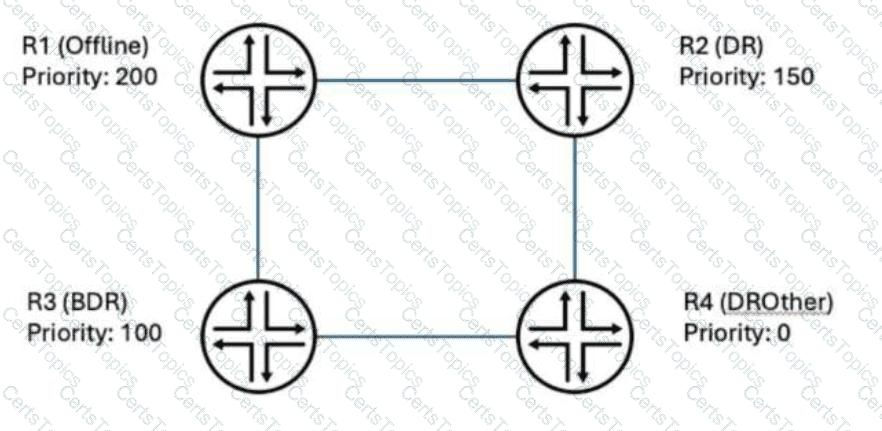
[Exhibit]

Click the Exhibit button.

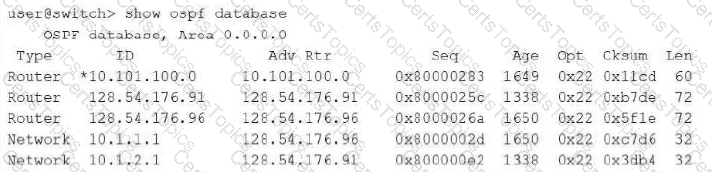
You run the show ospf database command and you see a Router LSA marked with an asterisk.

Referring to the exhibit, what is the significance of this result?

Options:

A.

The LSA is advertised by a remote device.

B.

The LSA is advertised by the local device.

C.

The LSA is advertised by the designated router.

D.

The LSA is advertised by the backup designated router.

Question 8

[Exhibit]

Click the Exhibit button.

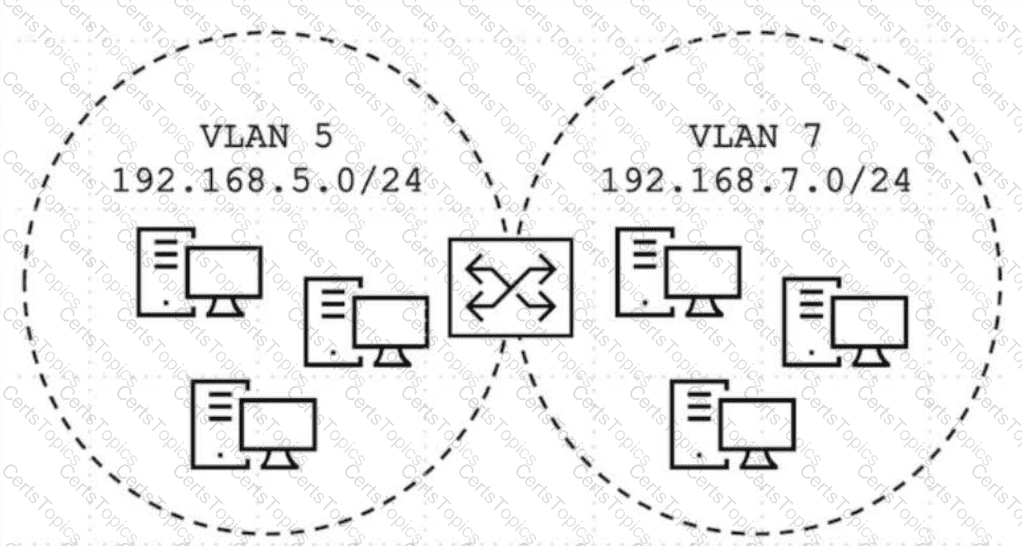
Devices on VLAN 5 and VLAN 7 need to communicate with each other.

Referring to the exhibit, what will satisfy this requirement?

Options:

A.

Configure a family inet interface connecting the two VLANs and assign both subnet IPs to it using secondary addressing.

B.

Enable spanning tree on both VLANs and set the EX Series Switch as the root bridge.

C.

Add both VLANs to a single trunk port and enable the Multiple VLAN Registration Protocol.

D.

Create an integrated routing and bridging (IRB) interface for each VLAN, assign the gateway IP to each IRB, and enable static routing.

Question 9

You are verifying a new BGP peering session with an ISP. You issue the show bgp summary command, but the output shows the peer in the Active state.

Which statement is correct in this scenario?

Options:

A.

The session is waiting to be configured.

B.

The session is established, and routing information is being exchanged.

C.

The session is actively trying to establish a TCP connection.

D.

The session is idle and disabled.

Question 10

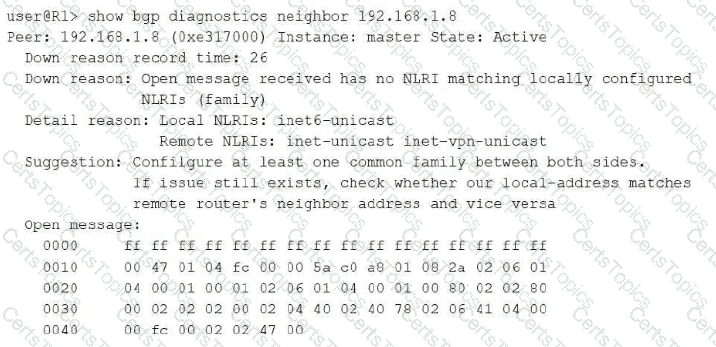
[Exhibit]

Click the Exhibit button.

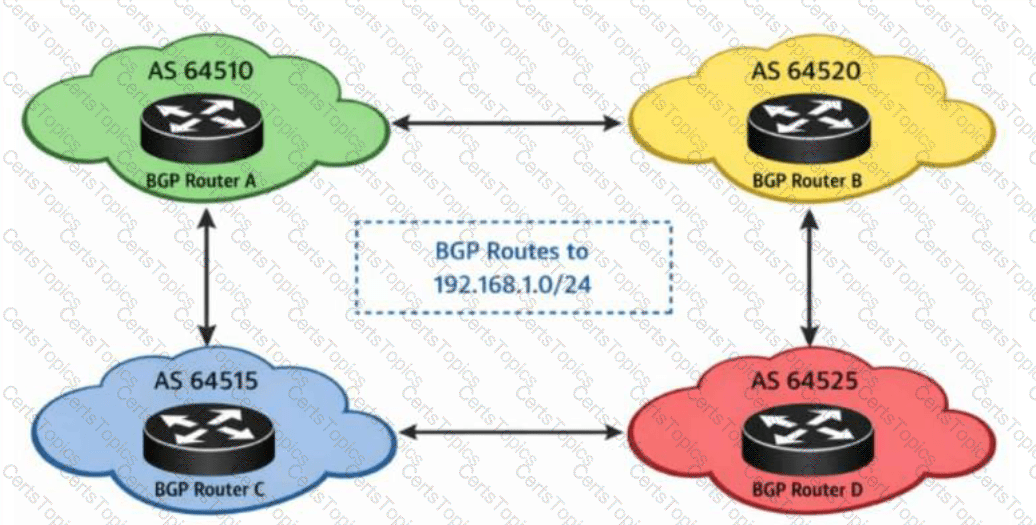
A network includes several autonomous systems that exchange routing information using BGP. Multiple BGP routes exist for the same prefix.

Referring to the exhibit, which attribute would BGP use first when selecting a preferred route?

Options:

A.

local preference

B.

AS path length

C.

origin type

D.

MED

Question 11

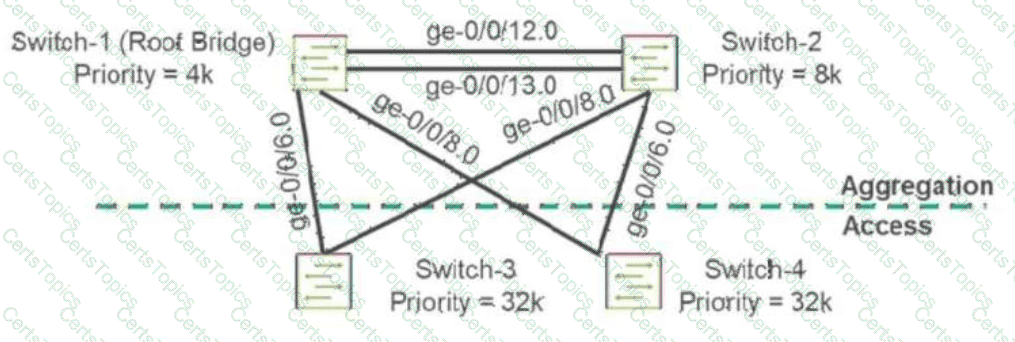
[Exhibit]

Click the Exhibit button.

You are asked to ensure that there will not be any unwanted STP topology changes affecting your root bridge placement because a rogue switch was introduced into the network at the access layer.

Referring to the exhibit, which interfaces will need to have root protection applied to accomplish this task?

Options:

A.

Place root protection on ge-0/0/6 and ge-0/0/8 on Switch-1 only.

B.

Place root protection on ge-0/0/6 and ge-0/0/8 on Switch-3 and Switch-4.

C.

Place root protection on ge-0/0/6 and ge-0/0/8 on Switch-1 and Switch-2.

D.

Place root protection on ge-0/0/12 and ge-0/0/13 on Switch-1 and Switch-2.

Question 12

Which two statements are true about routing instances on Junos devices? (Choose two.)

Options:

A.

A user-configured virtual-router instance type is used for non-VPN-related applications.

B.

A user-configured virtual-router instance type is used for Layer 2 and Layer 3 VPNs.

C.

A user-configured routing instance automatically generates a new routing table.

D.

A user-configured routing instance automatically uses the master inet.0 table unless configured otherwise.

Question 13

Two Juniper Networks EX Series Switches are connected with four 1-GbE links configured as a single link aggregation group (LAG). One of the physical member links experiences a failure.

By default, what impact will this failure have on traffic forwarding between the switches?

Options:

A.

The LAG continues forwarding traffic across the remaining member links.

B.

All traffic will be dropped because the LAG goes administratively down.

C.

Only broadcast traffic continues to be forwarded across the LAG.

D.

The LAG renegotiates and temporarily disables all member links.

Question 14

A switch uses the factory-default storm control configuration. A sudden unknown-unicast burst causes packet loss for only 4-5 seconds before stabilizing.

Which statement describes why normal operation resumes automatically?

Options:

A.

Storm control applies only to multicast traffic by default.

B.

Storm control triggers GRES recovery.

C.

Storm control shuts down the interface and re-enables it after 5 seconds.

D.

Storm control drops only excess packets until traffic falls below the threshold.

Question 15

On Juniper devices, which statement correctly describes a basic characteristic of a GRE tunnel?

Options:

A.

GRE tunnels support only IPv4 payload encapsulation.

B.

GRE tunnels need keepalives configured by default to stay operational.

C.

GRE tunnels require the tunnel endpoints to have a valid route to each other.

D.

GRE tunnels maintain session state information about the remote endpoint.

Question 16

Which two statements are correct about BGP local preference? (Choose two.)

Options:

A.

A local preference of 100 is the Junos default.

B.

Local preference is advertised to EBGP peers.

C.

Local preference is used to direct outbound traffic within an AS to a specific peer.

D.

A local preference of 0 means to drop the route.

Question 17

Which statement describes how nonstop active routing (NSR) maintains routing protocol information during a Routing Engine switchover?

Options:

A.

The backup Routing Engine retrieves routing information from neighboring routers after a switchover.

B.

The primary Routing Engine copies protocol information only when an NSR event begins.

C.

The backup Routing Engine continuously synchronized protocol states by running the RPD process.

D.

The Packet Forwarding Engine updates protocol state based on the most recent LSA or BGP update received.

Question 18

What determines the preferred route to a destination in an IS-IS network?

Options:

A.

the path that passes through a Level 2 router closest to the destination

B.

the path that has the lowest accumulated metric value

C.

the path that has the most recently originated LSP

D.

the path that has the highest accumulated metric value

Question 19

You need to configure a Juniper Networks EX Series Switch to be able to accept both tagged and untagged traffic on the same access port.

Which feature will allow you to accomplish this task?

Options:

A.

default VLAN

B.

native VLAN

C.

IRB interface

D.

voice VLAN

Page: 1 / 5
Total 65 questions