Spring Sale 70% Discount Offer - Ends in 0d 00h 00m 00s - Coupon code: save70

Free and Premium Juniper JN0-281 Dumps Questions Answers

Page: 1 / 5
Total 65 questions

Data Center Associate (JNCIA-DC) Questions and Answers

Question 1

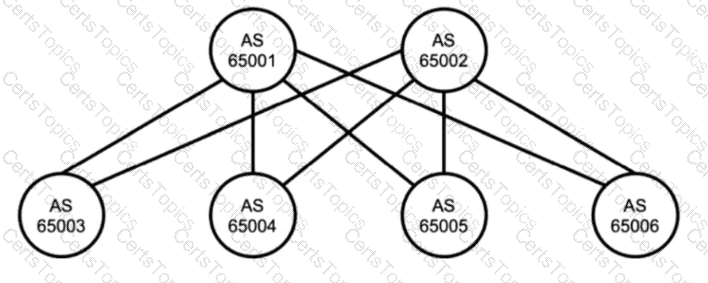
Referring to the exhibit, which two statements are true about BGP? Choose two.

Options:

A.

The exhibit uses IBGP.

B.

Devices should peer using loopback addresses.

C.

The exhibit uses EBGP.

D.

Devices should peer using physically connected IP addresses.

Buy Now
Question 2

When using spine and leaf fabric architectures, what is the role of each device? (Choose two.)

Options:

A.

Spine nodes are used for host connectivity.

B.

Spine nodes are used for transit to other leaf nodes.

C.

Leaf nodes are used for traffic to other leafs.

D.

Leaf nodes are used for host connectivity.

Question 3

You are asked to ensure that traffic and routing information is not interrupted if your primary Routing Engine fails or switches to the backup Routing Engine. In this scenario, which high availability feature will accomplish this behavior?

Options:

A.

nonstop active routing NSR

B.

graceful Routing Engine switchover GRES

C.

link aggregation control protocol LACP

D.

bidirectional forwarding detection BFD

Question 4

When evaluating BGP routes, what will be evaluated first?

Options:

A.

The local preference value

B.

The AS path

C.

The MED value

D.

The origin value

Question 5

What are two available modes when using LACP with an aggregated Ethernet bundle? Choose two.

Options:

A.

aggressive

B.

mixed

C.

passive

D.

active

Question 6

What is the purpose of Bidirectional Forwarding Detection BFD? Choose one.

Options:

A.

to process destination host unreachable messages

B.

to detect routing loops

C.

to detect link failures

D.

to detect route flaps

Question 7

What is the purpose of generated routes? Choose one.

Options:

A.

to create a route when required conditions are met

B.

to create a unique routing table

C.

to increase the number of route advertisements

D.

to expand a single route advertisement into multiple routes

Question 8

Which two statements are correct about configuring VLANs? Choose two.

Options:

A.

You must assign an IRB interface to each VLAN.

B.

You must assign a VLAN name or ID and a Layer 2 interface to the VLAN.

C.

You can assign one or more VLANs to a trunk mode interface.

D.

You can assign one or more VLANs to an access mode interface.

Question 9

Which two statements are correct about configuring VLANs? Choose two.

Options:

A.

You must assign an IRB interface to each VLAN.

B.

You must assign a VLAN name or ID and a Layer 2 interface to the VLAN.

C.

You can assign one or more VLANs to a trunk mode interface.

D.

You can assign one or more VLANs to an access mode interface.

Question 10

What are two names used to refer to the Layer 2 table that maintains known switching information? Choose two.

Options:

A.

inet.0 table

B.

routing information base RIB

C.

Ethernet switching table

D.

forwarding information base FIB

Question 11

What is a function of an integrated routing and bridging IRB interface?

Options:

A.

to route traffic between different VLANs

B.

to encrypt traffic between network segments

C.

to bridge traffic within the same VLAN

D.

to provide Network Address Translation NAT

Question 12

In a five-stage IP fabric, what is the role of the superspine layer?
Options:

A.

It ensures that every leaf device has a physical connection to every spine device in the five-stage IP fabric.

B.

It establishes a common BGP autonomous system that combines multiple three-stage IP fabric spine-and-leaf nodes into one autonomous system.

C.

It creates a Layer 2 underlay network between the spine nodes and leaf nodes in the five-stage IP fabric.

D.

It interconnects the spine layers in different three-stage IP fabric pods in a data center at the same site or across different sites.

Question 13

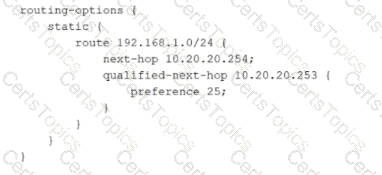
Referring to the exhibit, which statement is correct about the 192.168.1.0/24 route?

Options:

A.

The 192.168.1.0/24 route is load balanced across both next hops.

B.

The 192.168.1.0/24 route will select 10.20.20.254 as the next hop.

C.

The 192.168.1.0/24 route will select 10.20.20.253 as the next hop.

D.

The 192.168.1.0/24 route is not installed in the routing table.

Question 14

You are troubleshooting a downed BGP session.
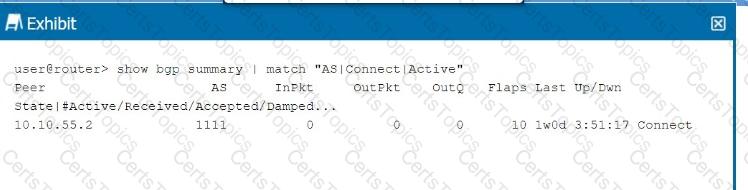
Referring to the exhibit, what is the cause of the problem?

Options:

A.

The UDP session between the peers has not been established.

B.

The local peer has sent an Open message but not received one from the remote peer.

C.

The TCP session between the peers has not been established.

D.

The local peer has sent an Update message but not received one from the remote peer.

Question 15

By default, which two statements about trunk and access ports are correct? Choose two.

Options:

A.

Trunk ports forward untagged traffic.

B.

Access ports forward untagged traffic.

C.

Access ports forward tagged traffic.

D.

Trunk ports forward tagged traffic.

Question 16

A switch receives an Ethernet frame that contains source and destination MAC addresses that are not in the Ethernet switching table. In this scenario, which two actions does the switch perform? Choose two.

Options:

A.

The switch floods the frame out every port in the broadcast domain except the ingress port.

B.

The switch adds the source MAC address to the Ethernet switching table.

C.

The switch drops the frame.

D.

The switch forwards the frame to the Routing Engine.

Question 17

What are three correct layer names used in legacy hierarchical network design? (Choose three.)

Options:

A.

Access layer

B.

Modular layer

C.

Aggregation layer

D.

Core layer

E.

Function layer

Question 18

Which statement is correct about nonstop bridging? Choose one.

Options:

A.

Graceful Routing Engine switchover is required.

B.

It preserves Layer 3 information and protocol sessions.

C.

Nonstop active routing is required.

D.

The gigether-options flow-control parameter is required.

Question 19

What are two characteristics of EBGP? Choose two.

Options:

A.

EBGP sessions do not require an IGP.

B.

EBGP sessions require loopback IP address peering.

C.

EBGP does not support sessions with non-directly connected peers.

D.

EBGP sessions are typically established between directly connected peers.

Question 20

What are two device roles in a five-member Virtual Chassis? (Choose two.)

Options:

A.

PFE

B.

Control-board

C.

Line card

D.

Routing-engine

Page: 1 / 5
Total 65 questions