Spring Sale 70% Discount Offer - Ends in 0d 00h 00m 00s - Coupon code: save70

Free and Premium Juniper JN0-106 Dumps Questions Answers

Page: 1 / 7
Total 95 questions

Junos - Associate (JNCIA-Junos) Junos OS 21.2 Questions and Answers

Question 1

Which two statements are correct about SNMPv3? (Choose two.)

Options:

A.

It uses plain-text community strings.

B.

It protects against tampering and eavesdropping.

C.

It is simpler to configure than SNMPv2c.

D.

It provides encrypted passwords for secure communication.

Buy Now
Question 2

Referring to the exhibit, which command would be used to view the IP subnet addresses associated with prefix-list DIRECT-IP?

Options:

A.

show policy-options prefix-list DIRECT-IP

B.

show configuration policy-options prefix-list DIRECT-IP

C.

show configuration policy-options prefix-list DIRECT-IP | display inheritance

D.

show configuration policy-options prefix-list DIRECT-IP apply-path

Question 3

Referring to the exhibit, what would be the next-hop address for the packet destined for the 10.0.0.0/24 network if the ge-0/0/1 interface goes down?

Options:

A.

10.23.0.3

B.

10.12.0.2

C.

10.12.0.1

D.

10.25.11.1

Question 4

Exhibit:

Referring to the exhibit, which routing configuration is required for these two users to access the remote server?

Options:

A.

Users and the server require a default gateway.

B.

Trunk ports must be enabled on the switch.

C.

Users must connect directly to the router.

D.

A routing protocol must be enabled on the router.

Question 5

Exhibit:

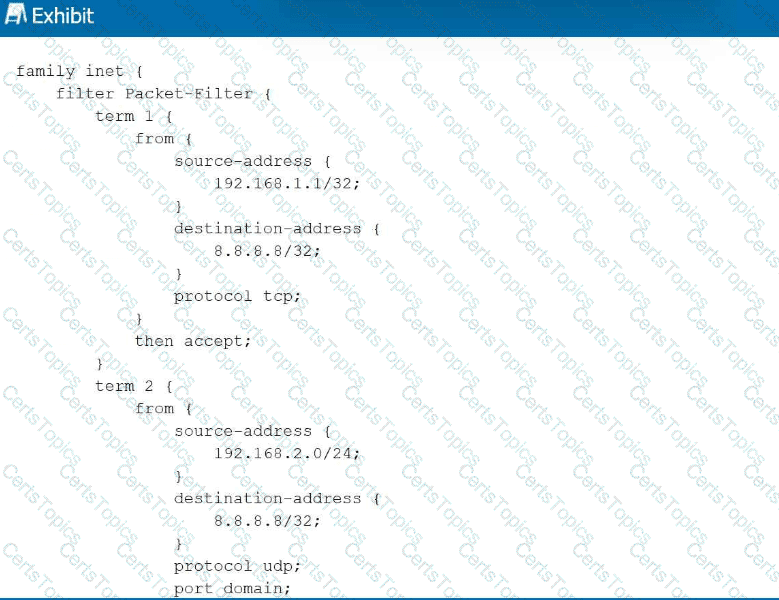
Referring to the exhibit, with firewall filter Packet-Filter attached to an interface, if traffic is sent from 192.168.1.1 to 8.8.8.8 for a UDP DNS query, what will happen to the traffic?

Options:

A.

The traffic will match term 1 and be forwarded.

B.

The traffic will match the default last term and be forwarded.

C.

The traffic will match the default last term and be discarded.

D.

The traffic will match term 3 and be forwarded.

Question 6

You want to automatically back up your Junos device configuration to an external server every time you commit a configuration change. In this scenario, which command would accomplish this task?

Options:

A.

set system commit synchronize

B.

set system archival configuration transfer-interval

C.

set system archival configuration transfer-on-commit

D.

set system archival configuration archive-sites

Question 7

Which interface type prefix represents a 10-Gigabit Ethernet interface?

Options:

A.

ge

B.

xe

C.

et

D.

fe

Question 8

Which two tasks are performed by the Routing Engine in a Junos device? (Choose two.)

Options:

A.

The Routing Engine runs routing protocols.

B.

The Routing Engine evaluates transit traffic against firewall filters.

C.

The Routing Engine manages the device configuration.

D.

The Routing Engine forwards transit traffic.

Question 9

You successfully committed a configuration change. You now realize an issue exists and must revert back to the previous configuration. Which command entered in configuration mode will accomplish this task when committed?

Options:

A.

show | compare

B.

save config

C.

rollback 0

D.

rollback 1

Question 10

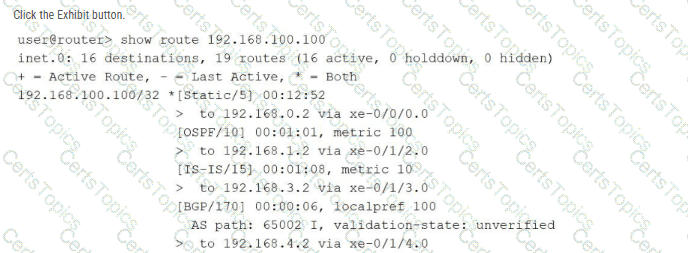
Referring to the exhibit using the show route 192.168.100.100 command output, over which interface will the traffic be forwarded?

Options:

A.

xe-0/1/3.0

B.

xe-0/0/0.0

C.

xe-0/1/4.0

D.

xe-0/1/2.0

Question 11

Which command would you use to gracefully power off a Junos device?

Options:

A.

request system reboot

B.

shutdown now

C.

request system logout

D.

request system halt

Question 12

What are two functions of the Routing Engine? (Choose two.)

Options:

A.

It evaluates firewall filters for transit traffic.

B.

It runs Junos OS.

C.

It processes all management traffic.

D.

It processes transit traffic.

Question 13

An administrator wants to set up a remote user authentication service for the many users that access a Juniper security device. In this scenario, what are two supported authentication protocols? (Choose two.)

Options:

A.

RADIUS

B.

TACACS+

C.

SHA

D.

IPsec

Question 14

Which two statements are correct about a Routing Engine? (Choose two.)

Options:

A.

It processes management traffic.

B.

It processes CoS marked traffic.

C.

It forwards transit traffic.

D.

It maintains routing tables.

Question 15

Which two statements about prefix lists in Junos are correct? (Choose two.)

Options:

A.

Prefix lists can be re-used in multiple routing policies.

B.

Prefix lists can be used in both firewall filters and routing policies.

C.

Prefix lists cannot be used in routing policies.

D.

Prefix lists cannot be used in firewall filters.

Question 16

Which Junos tool should you use to identify the path that packets take through the network to a destination?

Options:

A.

monitor interface traffic

B.

traceroute

C.

SNMP

D.

ping

Question 17

What does the Junos CLI prompt indicate when it ends with a hash symbol (#)?

Options:

A.

The user is in operational mode.

B.

The user is in configuration mode.

C.

The user is in shell mode.

D.

The user is in recovery mode

Question 18

You manage a Junos device with 20 interfaces. Each interface requires the same description and MTU setting. Which configuration approach would reduce repetitive commands and ensure consistency?

Options:

A.

Use the wildcard delete command to remove duplicate settings.

B.

Configure each interface individually.

C.

Use a configuration group.

D.

Use search and replace to apply settings across interfaces.

Question 19

Which two statements about route preference in Junos are correct? (Choose two.)

Options:

A.

Both direct and static routes have the same preference.

B.

Both direct and local routes have the same preference.

C.

Both OSPF internal and OSPF AS external routes have the same preference.

D.

Both EBGP and IBGP routes have the same preference.

Question 20

What are two characteristics of IPv6 addressing? (Choose two.)

Options:

A.

The IPv6 address is represented by a 128-bit address.

B.

The IPv6 header automatically includes a checksum.

C.

IPv6 uses ARP to discover neighboring devices.

D.

IPv6 addresses that begin with fe80 are not routable.

Question 21

Your team alerts you that users connected to ge-0/0/5 are experiencing intermittent slowness. You log in to the switch and want to see live, real-time traffic updates for that interface to determine whether the link is being over-utilized. Which monitoring command should you use in this scenario?

Options:

A.

show chassis hardware

B.

monitor interface ge-0/0/5

C.

show interfaces terse

D.

show interfaces ge-0/0/5 extensive

Question 22

You want to redeploy a Junos device by clearing the existing configuration and resetting it to factory defaults. In this scenario, which command would help to accomplish this task?

Options:

A.

show system storage

B.

request system storage cleanup dry-run

C.

request system zeroize

D.

request system storage cleanup

Question 23

Which statement describes the primary purpose of a routing policy in Junos OS?

Options:

A.

It controls which routes are accepted or advertised by a routing protocol. B. It determines the physical interface used for forwarding traffic. C. It sets the maximum number of routes in the routing table. D. It enables automatic rollback of routing changes.

Question 24

Your switch01 device lost network connectivity after a configuration change. You must recover the device to a known working state using the rescue configuration that was previously saved. The device is only accessible using the console. In this scenario, which command sequence will successfully restore the rescue configuration?

Options:

A.

user@switch01 > configure

[edit]

user@switch01# load override rescue

[edit]

user@switch01# commit

B.

user@switch01 > request system configuration rescue delete

user@switch01 > reboot

C.

user@switch01 > configure

[edit]

user@switch01# rollback rescue

load complete

[edit]

user@switch01# commit

D.

user@switch01 > request system configuration rescue save

user@switch01 > configure

[edit]

user@switch01# commit

Question 25

Referring to the exhibit, you are configuring a Junos router to provide connectivity to a building across town on the network 10.10.10.0/24. The next-hop router is at 10.10.1.1, which is reachable using interface ge-0/0/1. After committing the configuration in the exhibit, users report they still cannot reach the 10.10.10.0/24 network, and the route does not appear as active in the routing table. In this scenario, which statement is correct?

Options:

A.

The next-hop address 10.1.1.1 is not directly connected or reachable through another route.

B.

Static routes must include the outgoing interface as the next hop.

C.

The static route requires a preference value to be specified or it will not install.

D.

The static route requires the retain keyword to remain active in the routing table.

Question 26

Which protocol provides secure remote CLI access to a Junos device?

Options:

A.

FTP

B.

SNMP

C.

Telnet

D.

SSH

Question 27

You power on a new MX Series router for the first time and connect to the console. You notice that no transit interfaces are passing traffic. In this scenario, which statement is correct?

Options:

A.

All interfaces are enabled with DHCP client enabled.

B.

All interfaces are enabled and have an IP address of 10.0.0.1.

C.

The interfaces are configured as Layer 2 trunk ports.

D.

The interfaces are not configured.

Question 28

Which two statements are correct about Junos OS? (Choose two.)

Options:

A.

Junos OS provides the ability to run unsigned third-party binaries.

B.

Junos OS provides modularization of software processes.

C.

Junos OS combines security and routing policies.

D.

Junos OS separates the control plane and the forwarding plane.

Page: 1 / 7
Total 95 questions