Winter Sale - Limited Time 65% Discount Offer - Ends in 0d 00h 00m 00s - Coupon code: top65certs

IFPUG I40-420 Exam With Confidence Using Practice Dumps

Exam Code:
I40-420
Exam Name:
Certified Function Point Specialist
Certification:
Vendor:
Questions:
249
Last Updated:
Jan 20, 2026
Exam Status:
Stable
IFPUG I40-420

I40-420: IFPUG Certification Exam 2025 Study Guide Pdf and Test Engine

Are you worried about passing the IFPUG I40-420 (Certified Function Point Specialist) exam? Download the most recent IFPUG I40-420 braindumps with answers that are 100% real. After downloading the IFPUG I40-420 exam dumps training , you can receive 99 days of free updates, making this website one of the best options to save additional money. In order to help you prepare for the IFPUG I40-420 exam questions and verified answers by IT certified experts, CertsTopics has put together a complete collection of dumps questions and answers. To help you prepare and pass the IFPUG I40-420 exam on your first attempt, we have compiled actual exam questions and their answers. 

Our (Certified Function Point Specialist) Study Materials are designed to meet the needs of thousands of candidates globally. A free sample of the CompTIA I40-420 test is available at CertsTopics. Before purchasing it, you can also see the IFPUG I40-420 practice exam demo.
Related IFPUG Exams

Certified Function Point Specialist Questions and Answers

Question 1

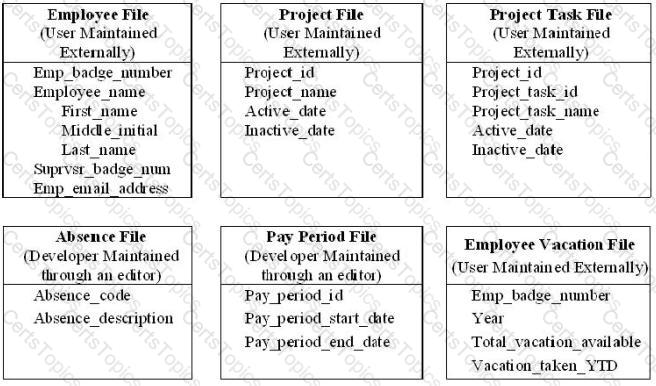
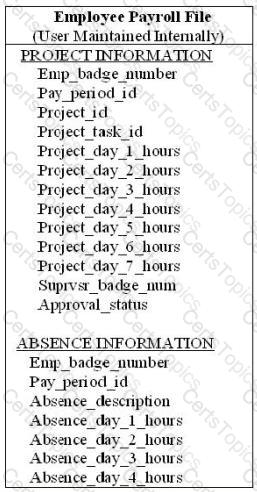
Data used by the Payroll Activity application is organized in the following logical groups:

The Absence file and Pay Period file were implemented as part of the technical solution to facilitate business transactions.

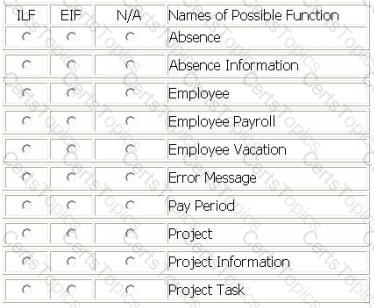
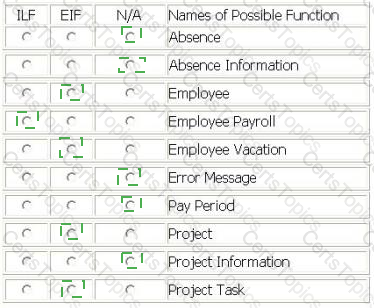
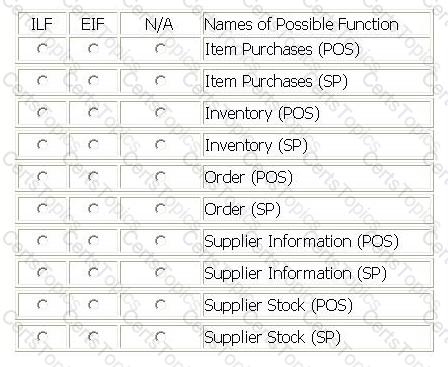
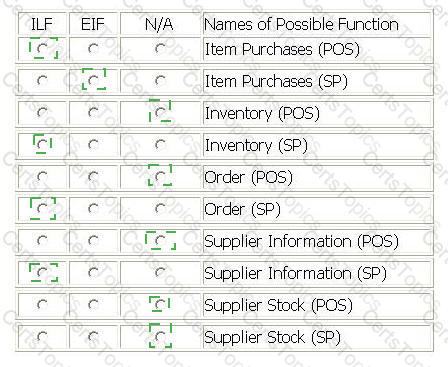
From the Names of Possible Functions listed identify the data functions for the Payroll Activity application. Select N/A if a Name of Possible Function does not apply.

Identify the data functions used:

Options:

Buy Now
Question 2

INTERNET APPLICATION (IA) -MAINTAIN INTERNET DATA

  • From the IA main menu, the IA user selects the Purchase Item option.
  • The Purchase Item option opens a screen which allows the user to pay their internet shopping bill after performing an inquiry of the items selected for purchase. The Pay Bill option updates the Customer logical file to store the date of last purchase. The Inventory logical file is updated to determine when stock is depleted. The Inventory logical file contains the following information: product id, units of measure, count of product on hand, count of product on order, count of product on back-order, and reorder point.
  • The Product logical file is maintained by the PARTS application. Product contains product id, description, expected life of product, category, manufacturer, SKU, and weight.
  • Upon the customer's first purchase, the Customer Information screen captures the following information about the customer and stores it on the Customer logical file which includes: customer number, name, street address, state/province/region, country, postal code, payment type, gender, and future email offer flag.
  • The Purchase History logical file (PHF) is used to contain the history of customer purchases. The PHF contains a demographics section which contains the following: customer number, gender, product category, product id, and purchase frequency. The other part of the PHF contains information pertaining to the cost of purchases: customer number, purchase date, quantity, purchase cost, expected life of product. An additional part of the PHF contains information about email offers sent to the customer. This part of the PHF contains information: date of email, product id, sale price, sale end date, and offer end date.
  • The purchase cost is stored in the PHF in US Dollars after conversion from the customer's local currency using the Currency logical file. The Currency logical file contains the following information: country currency converting from, country currency converting to, conversion rate, date and time of conversion rate.

Determine the complexity of the data functions:

Determine the complexity of the following function:

Options:

Question 3

An EO is defined as an elementary process that:

Options:

A.

includes additional processing logic beyond that of an EQ

B.

processes data or control information sent from outside the boundary

C.

sends data or control information outside the boundary

D.

Both A and C