Power Up Your Study Prep: Black Friday 75% Discount! Use coupon code below to save! - Ends in 0d 00h 00m 00s - Coupon code: big75certs

Free and Premium Huawei H12-323_V2.0 Dumps Questions Answers

HCIP-WLAN V2.0 Questions and Answers

Question 1

A Huawei Wi-Fi 6 AP supports up to 8x8 MIMO on the 5 GHz band when operating in dual-radio mode. When its 5 GHz radio uses 160 MHz channel bandwidth, a Wi-Fi 6 STA operating in 2x2 MIMO + 160 MHz mode connects to that radio. What is this STA’s maximum theoretical rate?

Options:

A.

4.8 Gbps

B.

9.6 Gbps

C.

2.4 Gbps

D.

1.2 Gbps

Buy Now
Question 2

Which of the following statements are correct regarding network optimization in the WLAN optimization solution?

CHOOSE THREE

Options:

A.

The AP management VLAN and service VLAN cannot be set to VLAN 1 to prevent loops.

B.

As there are a large number of APs, different service VLANs can be used when different SSIDs are configured.

C.

It is recommended that AP/WAC management addresses be separated from user service addresses to facilitate management and control.

D.

In scenarios where users move frequently, it is recommended that the lease of the address pool be shortened so that IP addresses can be reclaimed in a timely manner.

Question 3

The CloudCampus APP’s AP calculator incorporates a variety of scenarios and network-construction standards. Which of the following scenarios is not included?

Options:

A.

Mine

B.

High-density stadium

C.

Hotel

D.

Shopping mall

Question 4

Which of the following statements are true regarding STA steering?

Options:

A.

STAs with voice or video services running are not steered.

B.

An AP steers 802.11v-capable STAs in Deauthentication mode.

C.

Before sending BTM or Deauthentication messages, an AP instructs neighboring APs to suppress association of STAs.

D.

An AP steers 802.11v-incapable STAs in BTM mode.

Question 5

Which of the following statements are accurate about the wireless health evaluation feature in CampusInsight?

CHOOSE THREE

Options:

A.

This function can be used to rank different networks or different areas of one network based on comprehensive experience evaluation results, so as to identify the networks or areas ranking lowest in terms of overall health status or key metrics.

B.

This function can be used to diagnose and display details of key experience metrics, including the health of the experience metrics and factors that affect the metrics.

C.

A wireless health report can be sent to users in the corresponding user groups as a PDF document. The report contains the analysis of metrics such as the access success rate, time required for access, throughput fulfillment rate, capacity health, signal and interference, and roaming fulfillment rate.

D.

This function can be used to evaluate the following key metrics: access success rate, time required for access, signal coverage and interference, and AP forwarding efficiency, as well as roaming, capacity, and throughput fulfillment rates.

Question 6

A VLAN pool can be configured to supply service VLANs. Which of the following statements about a VLAN pool is false?

Options:

A.

If the VLAN assignment algorithm is set to hash and a STA goes online multiple times, the STA is preferentially assigned the IP addresses it uses previously.

B.

Configuring a VLAN pool to provide service VLANs can reduce the number of STAs in each VLAN and also the size of the broadcast domain.

C.

If the VLAN assignment algorithm is set to even and a STA goes online multiple times, the STA obtains different IP addresses each time.

D.

Nonexistent VLANs cannot be added to a VLAN pool.

Question 7

For the parking-lot scenario shown, it is recommended to deploy APs above lanes and at intersections as well, to provide continuous signal coverage.
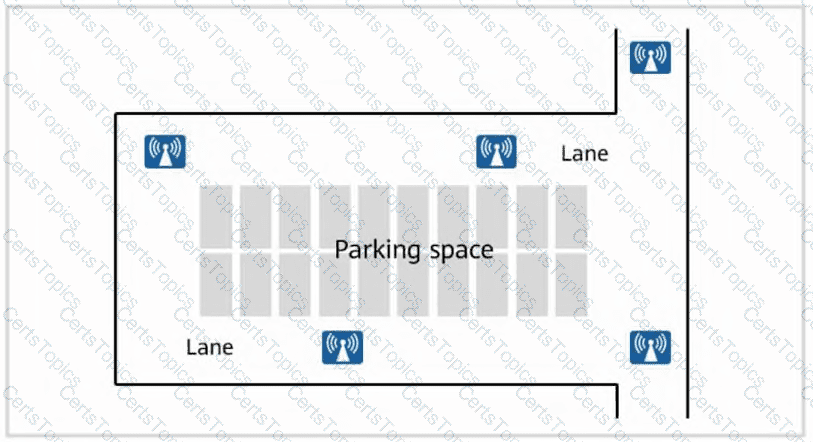
Original exhibit: Q25 Parking Exhibit

Options:

A.

TRUE

B.

FALSE

Question 8

APs may be deployed either automatically or manually in WLAN Planner. In most scenarios, manual AP deployment is recommended. Automatic AP deployment applies only to certain scenarios with simple structures.

Options:

A.

TRUE

B.

FALSE

Question 9

In a network with Huawei's CloudCampus Solution deployed, an AP cannot come online on iMaster NCE-Campus. Which of the following could cause this issue?

CHOOSE THREE

Options:

A.

The AP is not switched to the cloud mode.

B.

AP information added on the cloud management controller is incorrect leading to a registration failure.

C.

The network between the AP and cloud management platform is disconnected.

D.

The CAPWAP source IP address is not configured on the AP.

Question 10

Roaming handover time is a key factor affecting WLAN service experience when an STA roams. Fast roaming with PMK caching reduces roaming latency for 802.IX users and improves WLAN service experience. Which of the following helps reduce roaming latency in fast roaming that uses PMK caching?

Options:

A.

STA reassociation is omitted.

B.

Both 802.1X authentication and key negotiation are omitted.

C.

Key negotiation is omitted.

D.

802.1X authentication is omitted.

Question 11

When using the CloudCampus APP for Wi-Fi experience, network security tests—such as ARP spoofing and DNS hijacking—can be conducted in addition to basic coverage-effect and service-experience testing.

Options:

A.

TRUE

B.

FALSE

Question 12

In an N+1 backup scenario, APs determine an active/standby WAC switchover. By default, how long after an AP stops receiving CAPWAP heartbeat detection packets from the active WAC is an active/standby switchover triggered?

Options:

A.

90s

B.

180s

C.

150s

D.

75s

Question 13

When using the CloudCampus APP to run a speed test, the Internet speed test cannot be performed if the radio signal associated with the current STA cannot access the Internet.

Options:

A.

TRUE

B.

FALSE

Question 14

Place the following WLAN-fault troubleshooting steps in the correct order.
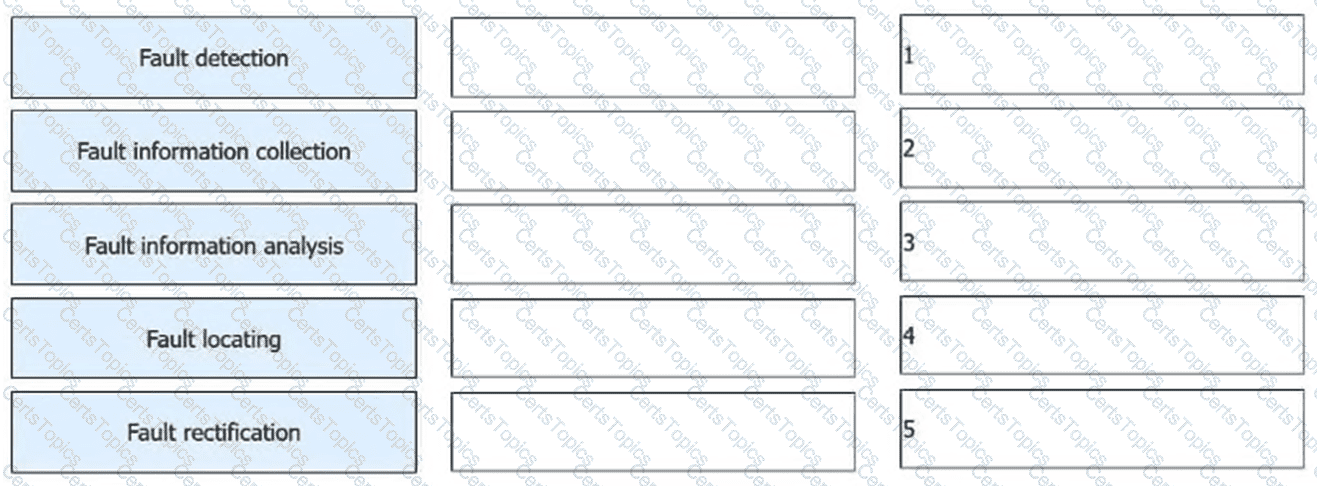
Options:

Question 15

Which of the following tools are typically used for WLAN optimization?

CHOOSE FOUR

Options:

A.

CloudCampus APP

B.

Rangefinder

C.

Antenna Alignment

D.

WLAN Planner

Question 16

CAPWAP is an application-layer protocol for communication between WACs and Fit APs. Its TCP-based transmission mechanism provides reliable data delivery, improving WLAN stability.

Options:

A.

TRUE

B.

FALSE