
Month End Sale Special - 75% Discount Offer - Ends in 0d 00h 00m 00s - Coupon code: big75certs

Free and Premium HP HPE7-S02 Dumps Questions Answers

Page: 1 / 3
Total 40 questions

Advanced HPE Compute Integrator Solutions Written Exam Questions and Answers

Question 1

A customer uses HPE Synergy servers as VMware ESXi hosts, assigned to clusters.

What is one action that is enabled by your importing the ESXi clusters in HPE OneView for vCenter?

Options:

A.

Dynamically moving VMs away from a host that is experiencing hardware failures

B.

Selecting the local drives used for the vSAN capacity tier

C.

Provisioning a datastore from a connected SAN array

D.

Applying workflows that incorporate vCenter and OneView tasks

Buy Now
Question 2

An HPE Private Cloud AI customer wants to eliminate the certificate errors that show when users access HPE AI Essentials. The customer has created a certificate signed by their CA to replace the current certificate. The customer has given you the certificate file, private key file, and CA certificate file.

How should you install this certificate?

Options:

A.

Use the HPE Private Cloud AI interface to access the VM that hosts the HPE AI Essentials UI. Install the certificate, private key, and CA certificate on that VM.

B.

Create a CertificateIssuer that references the CA certificate in the HPE AI Essential cert-manager namespace. Then create an ingress-cert certificate based on the provided certificate and private key in the istio-system namespace.

C.

Log into the Keycloak interface using the credentials stored in the HPE AI Essentials ezaddon-system namespace. Upload the certificate, private key, and CA certificate files in the “ua” realm.

D.

Delete the current “ingress-cert” certificate and secret in the HPE AI Essentials istio-system namespace. Add a new “ingress-cert” secret in this namespace referencing the provided files.

Question 3

Which correctly characterizes HPE ProLiant Compute XD685 servers?

Options:

A.

Support for 4 processors and 4 Lovelace GPUs per 5U chassis, combined with a choice of iLO or BMC management

B.

Support for up to 8 NVIDIA Blackwell GPUs per 5U chassis, combined with iLO management

C.

Scale-out design with up to 8 single-processor nodes per 5U chassis

D.

Scale-up design with 8 processors and 8TB of memory per chassis

Question 4

An organization has an HPE Cray Storage Systems C500 solution. IT is interested in scripting management of these systems.

Which API can they use?

Options:

A.

HPE GreenLake

B.

Redfish

C.

HPE OneView

D.

Slurm

Question 5

An HPE Private Cloud AI Administrator has imported a custom framework. Users can click the framework’s endpoint link and access the framework successfully. However, sometimes users will try to go to the framework’s page and they get an error.

What is one thing to investigate?

Options:

A.

Whether the framework’s virtual service uses the correct service port number

B.

Whether the framework’s ezua.virtualService.endpoint value uses the correct domain name

C.

Whether the users have been authorized to access the framework in the HPE GreenLake cloud User Management settings

D.

Whether the correct redirect URL has been added for the framework to the Keycloak UA client

Question 6

A customer requires accessing the HPE AI Essentials KubeRay cluster interactively (with ray.init()) from an external client.

What should you explain?

Options:

A.

External access is enabled by default at the Ray dashboard UI. The external client should direct the ray.init() requests to TCP port 10001.

B.

External access is not supported with the built-in KubeRay cluster. The customer should deploy a new cluster to achieve this access.

C.

External access is not available by default, but can be achieved by, for example, changing the kuberay-head-svc to a NodePort service.

D.

External access is enabled by default at the Ray dashboard UI. The external client should direct the ray.init() requests to TCP port 8265.

Question 7

A customer has fine-tuned a model and wants to find out whether the model is producing any toxic content.

Which NVIDIA microservice best meets this need?

Options:

A.

NeMo Customizer

B.

NeMo Curator

C.

NeMo Guardrails

D.

NeMo Evaluator

Question 8

What is one difference between a Class 1 and a Class 3 HPE Slingshot topology?

Options:

A.

The Class 1 topology supports more compute node NICs per switch than the Class 3 topology.

B.

The Class 1 topology scales to a larger number of compute node NICs than the Class 3 topology.

C.

The Class 1 topology supports a higher ratio of L1 and L2 links versus L0 links than the Class 3 topology.

D.

The Class 1 topology supports additional adaptive routing technologies beyond those supported with the Class 3 topology.

Question 9

What option does HPE Private Cloud AI provide for organizations who want to retain Prometheus metrics over the long term?

Options:

A.

Enabling metric collection on the HPE Private Cloud AI workspace from HPE GreenLake cloud

B.

Installing Grafana on the pod running the HPE AI Essentials UI

C.

Exporting alerts from the HPE AI Essentials UI

D.

Registering an OTel endpoint

Question 10

You are planning to demonstrate how you can use KServe to run NIMs on HPE Private Cloud AI. You have downloaded the CodeLlama-70B-Instruct model to a volume in your namespace named demo-model.

The objects that you are planning to deploy are shown below:
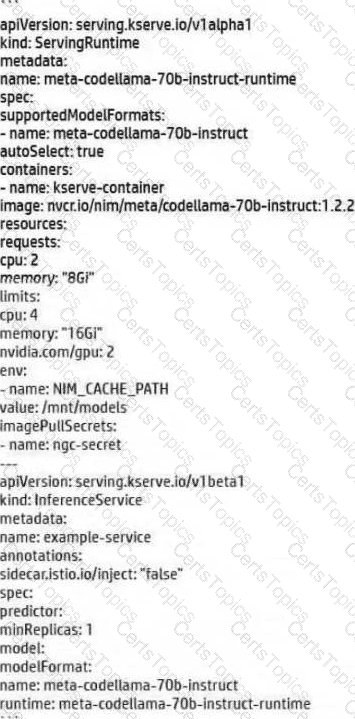
What change should you make to the objects?

Options:

A.

In the InferenceService, change spec.predictor.model.modelFormat.name to: pvc://demo-model/codellama-70b-instruct

B.

Add this line to the ServingRuntime under spec: storageUri: pvc://demo-model

C.

In the ServingRuntime, change the NIM_CACHE_PATH environment variable value to “/mnt/demo-model”

D.

Add this line to the InferenceService under spec.predictor.model: storageUri: pvc://demo-model

Question 11

An HPE Private Cloud AI customer wants to implement access controls on Airflow DAGs such that only HPE Private Cloud AI Administrators can trigger the DAGs.

What should you recommend?

Options:

A.

From within the HPE GreenLake cloud User management page, assign the Airflow Admin role to HPE Private Cloud AI Administrators.

B.

Configure the Airflow framework and change the value for the access_control line to “Admin.”

C.

Within the Airflow UI, go to the Security > List Roles page and assign the “trigger” permission to the Admin role.

D.

Add an access control line to the DAG code that permits “Admin” the “can_edit” privilege.

Question 12

At the request of an HPE Private Cloud AI customer, you have added an AWS S3 object store to HPE AI Essentials. Several HPE Private Cloud AI Users should be able to access that source when running notebooks and Spark applications. Other users should have no access.

What should you do?

Options:

A.

Go to the Identity and access management page in the HPE AI Essentials UI. Manage the privileges of individual users to grant them access to the object store.

B.

Go to the User Management page within HPE GreenLake cloud. Select the user and add privileges to access the data source from there.

C.

Configure the data source settings and select the users permitted access within those settings.

D.

Manually create an “access-token” secret with the data store credentials within the namespace of each user who should be permitted access to the store.

Page: 1 / 3
Total 40 questions
