New Year Sale 70% Discount Offer - Ends in 0d 00h 00m 00s - Coupon code: save70

Free and Premium HP HPE7-A02 Dumps Questions Answers

Page: 1 / 10
Total 135 questions

Aruba Certified Network Security Professional Exam Questions and Answers

Question 1

You manage AOS-10 APs with HPE Aruba Networking Central. A role is configured on these APs with the following rules:

    Allow UDP on port 67 to any destination

    Allow any to network 10.1.6.0/23

    Deny any to network 10.1.0.0/16 + log

    Deny any to network 10.0.0.0/8

    Allow any to any destination

You add this new rule immediately before rule 2:

Deny SSH to network 10.1.4.0/23 + denylist

What happens when a client assigned to this role sends SSH traffic to 10.1.11.42?

Options:

A.

The traffic is permitted.

B.

The traffic is dropped and logged.

C.

The traffic is dropped (without any logging or further action against the client).

D.

The traffic is dropped, and the client is denylisted.

Buy Now
Question 2

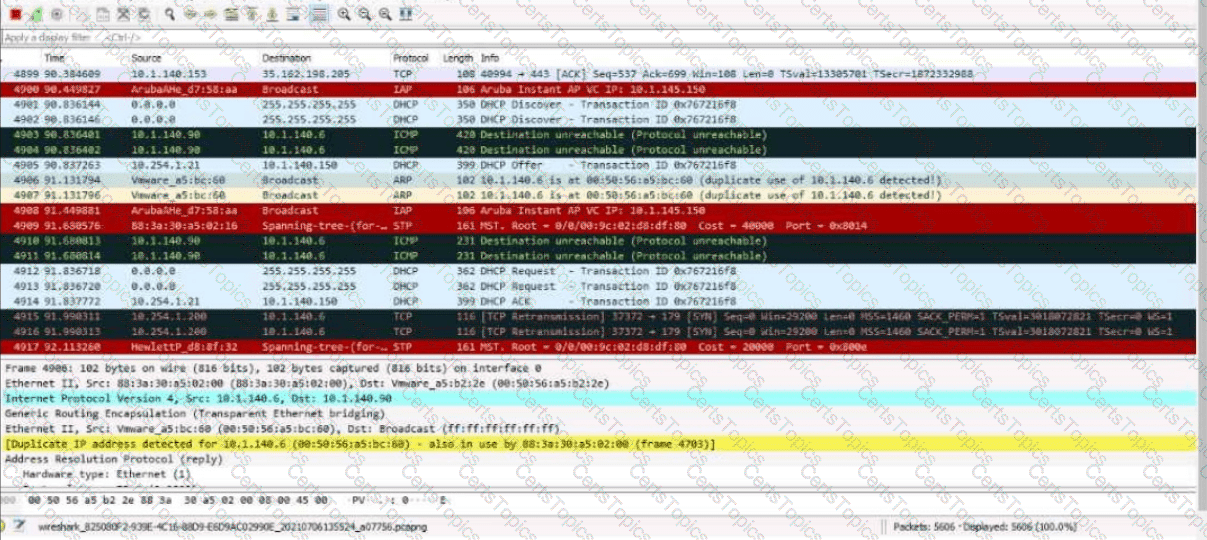
Refer to the Exhibit:

These packets have been captured from VLAN 10. which supports clients that receive their IP addresses with DHCP.

What can you interpret from the packets that you see here?

These packets have been captured from VLAN 10, which supports clients that receive their IP addresses with DHCP. What can you interpret from the packets that you see here?

Options:

A.

Someone is possibly implementing a MAC spoofing attack to gain unauthorized access.

B.

The mirroring session that captured the packets was likely misconfigured and captured duplicate traffic.

C.

An admin has likely misconfigured two clients to use the same DHCP settings.

D.

Someone is possibly implementing an ARP poisoning and MITM attack.

Question 3

A company is using HPE Aruba Networking ClearPass Device Insight (CPDI) (the standalone application). In the CPDI security settings, Security Analysis is On,

the Data Source is ClearPass Devices Insight, and Enable Posture Assessment is On. You see that device has a Risk Score of 90.

What can you know from this information?

Options:

A.

The posture is unhealthy, and CPDI has also detected at least one vulnerability on the device.

B.

The posture is unhealthy, but CPDI has not detected any vulnerabilities on the device.

C.

The posture is healthy, but CPDI has detected multiple vulnerabilities on the device.

D.

The posture is unknown, and CPDI has detected exactly four vulnerabilities on the device.

Question 4

A company is using HPE Aruba Networking ClearPass Device Insight (CPDI) (the standalone application). You have identified a device, which is currently

classified as one type, but you want to classify it as a custom type. You also want to classify all devices with similar attributes as this type, both already-discovered

devices and new devices discovered later.

What should you do?

Options:

A.

Create a user tag from the Generic Devices page, select the desired attributes for the tag, and save the tag.

B.

In the device details, select reclassify, create a user rule based on its attributes, and choose "Save & Reclassify."

C.

In the device details, select filter, create a user tag based on the device attributes, and save the tag.

D.

Create a user rule from the Generic Devices page, select the desired attributes for the rule, and choose "Save."

Question 5

A company has HPE Aruba Networking infrastructure devices. The devices authenticate clients to HPE Aruba Networking ClearPass Policy Manager (CPPM). You want CPPM to track information about clients, such as their IP addresses and their network bandwidth utilization. What should you set up on the network infrastructure devices to help that happen?

Options:

A.

Logging with CPPM configured as a Syslog server.

B.

Dynamic authorization enabled in the RADIUS settings for CPPM.

C.

RADIUS accounting to CPPM, including interim updates.

D.

An IF-MAP interface with CPPM as the destination.

Question 6

A company lacks visibility into the many different types of user and loT devices deployed in its internal network, making it hard for the security team to address

those devices.

Which HPE Aruba Networking solution should you recommend to resolve this issue?

Options:

A.

HPE Aruba Networking ClearPass Device Insight (CPDI)

B.

HPE Aruba Networking Network Analytics Engine (NAE)

C.

HPE Aruba Networking Mobility Conductor

D.

HPE Aruba Networking ClearPass OnBoard

Question 7

You are helping an organization deploy HPE Aruba Networking SSE. What is one reason to recommend that the company install agents on remote users' devices?

Options:

A.

To run posture checks and apply different permissions based on those checks.

B.

To permit admins to manage the HPE Aruba Networking SSE policy rules.

C.

To permit users to access private servers using SSH.

D.

To run threat inspection on clients in a local sandbox rather than in the cloud.

Question 8

You have enabled "rogue AP containment" in the Wireless IPS settings for a company’s HPE Aruba Networking APs. What form of containment does HPE Aruba Networking recommend?

Options:

A.

Wireless deauthentication only

B.

Wireless tarpit and wired containment

C.

Wireless tarpit only

D.

Wired containment

Question 9

Assume that an AOS-CX switch is already implementing DHCP snooping and ARP inspection successfully on several VLANs.

What should you do to help minimize disruption time if the switch reboots?

Options:

A.

Configure the switch to act as an ARP proxy.

B.

Create static IP-to-MAC bindings for the DHCP and DNS servers.

C.

Save the IP-to-MAC bindings to external storage.

D.

Configure the IP helper address on this switch, rather than a core routing switch.

Question 10

A company has Aruba APs that are controlled by Central and that implement WIDS. When you check WIDS events, you see a "detect valid SSID misuse" event. What can you interpret from this event, and what steps should you take?

Options:

A.

Clients are failing to authenticate to corporate SSIDs. You should first check for misconfigured authentication settings and then investigate a possible threat.

B.

Admins have likely misconfigured SSID security settings on some of the company's APs. You should have them check those settings.

C.

Hackers are likely trying to pose as authorized APs. You should use the detecting radio information and immediately track down the device that triggered the event.

D.

This event might be a threat but is almost always a false positive. You should wait to see the event over several days before following up on it.

Question 11

What is a use case for running periodic subnet scans on devices from HPE Aruba Networking ClearPass Policy Manager (CPPM)?

Options:

A.

Using DHCP fingerprints to determine a client's device category and OS

B.

Detecting devices that fail to comply with rules defined in CPPM posture policies

C.

Identifying issues with authenticating and authorizing clients

D.

Using WMI to collect additional information about Windows domain clients

Question 12

A company has HPE Aruba Networking APs, which authenticate users to HPE Aruba Networking ClearPass Policy Manager (CPPM).

What does HPE Aruba Networking recommend as the preferred method for assigning clients to a role on the AOS firewall?

Options:

A.

Configure CPPM to assign the role using a RADIUS enforcement profile with a RADIUS:IETF Username attribute.

B.

Configure CPPM to assign the role using a RADIUS enforcement profile with an Aruba-User-Role VSA.

C.

OCreate server rules on the APs to assign clients to roles based on RADIUS IETF attributes returned by CPPM.

D.

Create user rules on the APs to assign clients to roles based on a variety of criteria.

Question 13

A company uses HPE Aruba Networking ClearPass Device Insight (CPDI) (the standalone application option). In the details for a generic device cluster, you see a

recommendation for "Windows 8/10" with 70% accuracy.

What does this mean?

Options:

A.

CPDI has detected that these devices match about 70% of the system rule for defining "Windows 8/10" devices.

B.

CPDI has matched these devices against several, conflicting system rules. 70% of those rules are for "Windows 8/10" devices.

C.

CPDI has grouped this cluster with similar classified devices. 70% of those classified devices are "Windows 8/10."

D.

CPDI has used MAC OUI to group these devices together. The average device's MAC address matches 70% of the "Windows 8/10" OUI.

Question 14

A company uses both HPE Aruba Networking ClearPass Policy Manager (CPPM) and HPE Aruba Networking ClearPass Device Insight (CPDI). What is one way integrating the two solutions can help the company implement Zero Trust Security?

Options:

A.

CPPM can inform CPDI that it has assigned a particular Aruba-User-Role to a client; CPDI can then use that information to reclassify the client.

B.

CPDI can use tags to inform CPPM that clients are using prohibited applications. CPPM can then tell the network infrastructure to quarantine those clients.

C.

CPPM can provide CPDI with custom device fingerprint definitions in order to enhance the company's total visibility.

D.

CPDI can provide CPPM with extra information about users' identity. CPPM can then use that information to apply the correct identity-based enforcement.

Question 15

HPE Aruba Networking Central displays an alert about an Infrastructure Attack that was detected. You go to the Security > RAPIDS events and see that the attack

was "Detect adhoc using Valid SSID."

What is one possible next step?

Options:

A.

Use HPE Aruba Networking Central floorplans or the detecting AP identities to locate the general area for the threat.

B.

Look for the IP address associated with the offender and then check for that IP address among HPE Aruba Networking Central clients.

C.

Make sure that you have tuned the threshold for that check, as false positives are common for it.

D.

Make sure that clients have updated drivers, as faulty drivers are a common explanation for this attack type.

Question 16

As part of setting up an HPE Aruba Networking ClearPass Onboard solution for wireless clients, you created Network Settings, a Configuration Profile, and a Provisioning Settings object in ClearPass Onboard. You also ran the ClearPass Onboard Service Only Template on ClearPass Policy Manager (CPPM).

You now need to ensure that only domain users are authenticated and allowed to log into the ClearPass Onboard portal.

Which component should you edit?

Options:

A.

The Network Settings on ClearPass Onboard

B.

The ClearPass Onboard Service Pre-Auth service on CPPM

C.

The 802.1X services on CPPM used for wireless clients

D.

The Provisioning profile on ClearPass Onboard

Question 17

A company uses HPE Aruba Networking ClearPass Policy Manager (CPPM) as a TACACS+ server to authenticate managers on its AOS-CX switches. The

company wants CPPM to control which commands managers are allowed to enter. You see there is no field to enter these commands in ClearPass.

How do you start configuring the command list on CPPM?

Options:

A.

Add the Shell service to the managers' TACACS+ enforcement profiles.

B.

Edit the TACACS+ settings in the AOS-CX switches' network device entries.

C.

Create an enforcement policy with the TACACS+ type.

D.

Edit the settings for CPPM's default TACACS+ admin roles.

Question 18

Which statement describes Zero Trust Security?

Options:

A.

Companies must apply the same access controls to all users, regardless of identity.

B.

Companies that support remote workers cannot achieve zero trust security and must determine if the benefits outweigh the cost.

C.

Companies should focus on protecting their resources rather than on protecting the boundaries of their internal network.

D.

Companies can achieve zero trust security by strengthening their perimeter security to detect a wider range of threats.

Question 19

A company uses HPE Aruba Networking ClearPass Policy Manager (CPPM) as a TACACS+ server to authenticate managers on its AOS-CX switches. You want

to assign managers to groups on the AOS-CX switch by name.

How do you configure this setting in a CPPM TACACS+ enforcement profile?

Options:

A.

Add the Shell service and set autocmd to the group name.

B.

Add the Shell service and set priv-Ivl to the group name.

C.

Add the Aruba:Common service and set Aruba-Admin-Role to the group name.

D.

Add the Aruba:Common service and set Aruba-Priv-Admin-User to the group name.

Question 20

An AOS-CX switch has this admin user account configured on it:

netadmin in the operators group.

You have configured these commands on an AOS-CX switch:

tacacs-server host cp.example.com key plaintext &12xl,powmay7855

aaa authentication login ssh group tacacs local

aaa authentication allow-fail-through

A user accesses the switch with SSH and logs in as netadmin with the correct password. When the switch sends a TACACS+ request to the ClearPass server at cp.example.com, the server does not send a response. Authentication times out.

What happens?

Options:

A.

The user is logged in and granted operator access.

B.

The user is logged in and allowed to enter auditor commands only.

C.

The user is logged in and granted administrators access.

D.

The user is not allowed to log in.

Question 21

A company wants to use the HPE Aruba Networking ClearPass OnGuard agent to assign posture to clients.

How do you define the conditions by which a client receives a particular posture?
Options:

A.

Create rules within a posture policy

B.

Create rules within a WebAuth enforcement policy

C.

Create the rules directly in a service’s Enforcement tab

D.

Create rules directly in a service’s Posture tab

Question 22

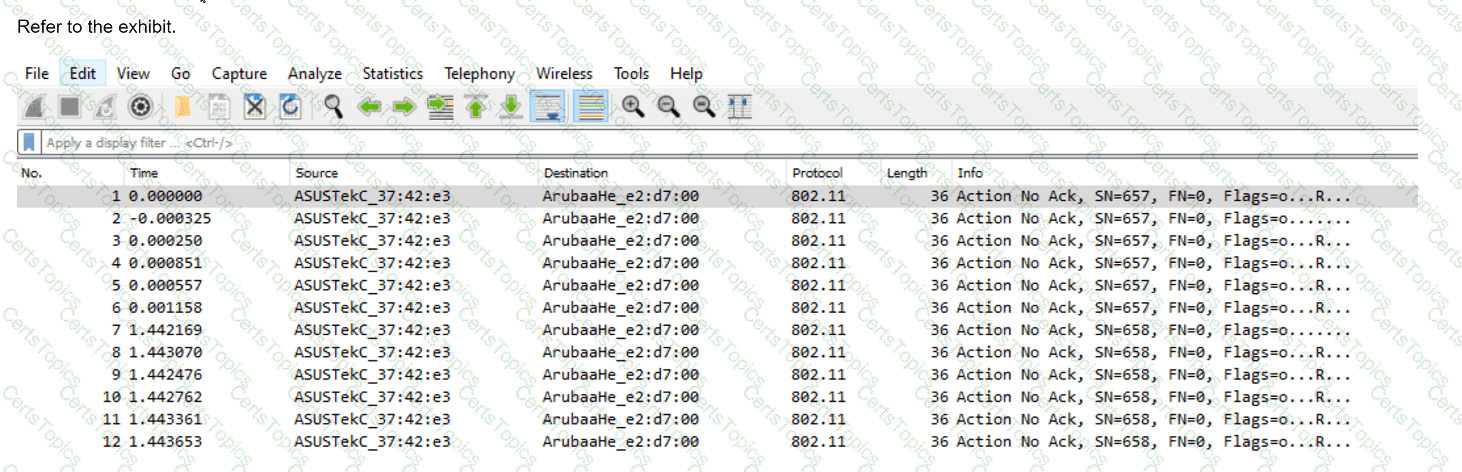
You have downloaded a packet capture that you generated on HPE Aruba Networking Central. When you open the capture in Wireshark, you see the output shown in the

exhibit.

What should you do in Wireshark so that you can better interpret the packets?

Options:

A.

Choose to decode UDP port 5555 packets as ARUBA_ERM and set the Aruba ERM Type to 0.

B.

Edit preferences for IEEE 802.11 and chose to ignore the Protection bit with IV.

C.

Apply the following display filter: wlan.fc.type == 1.

D.

Edit the Enabled Protocols and make sure that 802.11, GRE, and Aruba_ERM are enabled.

Question 23

A company has HPE Aruba Networking APs and AOS-CX switches, as well as HPE Aruba Networking ClearPass. The company wants CPPM to have HTTP User-

Agent strings to use in profiling devices.

What can you do to support these requirements?

Options:

A.

Add the CPPM server's IP address to the IP helper list in all client VLANs on routing switches.

B.

Schedule periodic subnet scans of all client subnets on CPPM.

C.

Configure mirror sessions on the APs and switches to copy client HTTP traffic to CPPM.

D.

On the APs and switches, configure a redirect to ClearPass Guest in the role for devices being profiled.

Question 24

A company wants to apply a standard configuration to all AOS-CX switch ports and have the ports dynamically adjust their configuration based on the identity of

the user or device that connects. They want to centralize configuration of the identity-based settings as much as possible.

What should you recommend?

Options:

A.

Having HPE Aruba Networking ClearPass Policy Manager (CPPM) send standard RADIUS AVPs to customize port settings

B.

Having switches pull port configurations dynamically from HPE Aruba Networking Activate

C.

Having switches download user-roles from HPE Aruba Networking gateways

D.

Having switches download user-roles from HPE Aruba Networking ClearPass Policy Manager (CPPM)

Question 25

You are setting up HPE Aruba Networking SSE to prohibit users from uploading and downloading files from Dropbox. What is part of the process?

Options:

A.

Adding a web category that includes Dropbox

B.

Installing the HPE Aruba Networking SSE root certificate on clients

C.

Deploying a connector that can reach the remote users

D.

Deploying a connector that can reach Dropbox

Question 26

A company issues user certificates to domain computers using its Windows CA and the default user certificate template. You have set up HPE Aruba Networking

ClearPass Policy Manager (CPPM) to authenticate 802.1X clients with those certificates. However, during tests, you receive an error that authorization has failed

because the usernames do not exist in the authentication source.

What is one way to fix this issue and enable clients to successfully authenticate with certificates?

Options:

A.

Configure rules to strip the domain name from the username.

B.

Change the authentication method list to include both PEAP MSCHAPv2 and EAP-TLS.

C.

Add the ClearPass Onboard local repository to the authentication source list.

D.

Remove EAP-TLS from the authentication method list and add TEAP there instead.

Question 27

What is a typical use case for using HPE Aruba Networking ClearPass Onboard to provision devices?

Options:

A.

Enabling unmanaged devices to succeed at certificate-based 802.1X

B.

Enabling managed Windows domain computers to succeed at certificate-based 802.1X

C.

Enhancing security for loT devices that need to authenticate with MAC-Auth

D.

Enforcing posture-based assessment on managed Windows domain computers

Question 28

A company uses both HPE Aruba Networking ClearPass Policy Manager (CPPM) and HPE Aruba Networking ClearPass Device Insight (CPDI).

What is one way integrating the two solutions can help the company implement Zero Trust Security?

Options:

A.

CPPM can provide CPDI with custom device fingerprint definitions in order to enhance the company's total visibility.

B.

CPDI can provide CPPM with extra information about users' identity; CPPM can then use that information to apply the correct identity-based enforcement.

C.

CPPM can inform CPDI that it has assigned a particular Aruba-User-Role to a client; CPDI can then use that information to reclassify the client.

D.

CPDI can use tags to inform CPPM that clients are using prohibited applications; CPPM can then tell the network infrastructure to quarantine those clients.

Question 29

You have created a Web-based Health Check Service that references a posture policy. You want the service to trigger a RADIUS change of authorization (CoA) when a client receives a Healthy or Quarantine posture. Where do you configure those rules?

Options:

A.

In a RADIUS enforcement policy

B.

In the Agents and Software Updates > OnGuard Settings

C.

In the posture policy

D.

In a WEBAUTH enforcement policy

Question 30

You are establishing a cluster of HPE Aruba Networking ClearPass servers. (Assume that they are running version 6.9.).

For which type of certificate it is recommended to install a CA-signed certificate on the Subscriber before it joins the cluster?

Options:

A.

Database

B.

HTTPS

C.

RADIUS/EAP

D.

RadSec

Question 31

You are setting up user-based tunneling (UBT) between access layer AOS-CX switches and AOS-10 gateways. You have selected reserved (local) VLAN mode.

Tunneled devices include IoT devices, which should be assigned to:

    Roles: iot on the switches and iot-wired on the gateways

    VLAN: 64, for which the gateways route traffic.

IoT devices connect to the access layer switches' edge ports, and the access layer switches reach the gateways on their uplinks.

Where must you configure VLAN 64?

Options:

A.

In the iot-wired role and on no physical interfaces

B.

In the iot role and the iot-wired role and on no physical interfaces

C.

In the iot-wired role and the access switch uplinks

D.

In the iot role and the access switch uplinks

Question 32

A company is using HPE Aruba Networking Central SD-WAN Orchestrator to establish a hub-spoke VPN between branch gateways (BGWs) at 1444 site and

VPNCs at multiple data centers.

What is part of the configuration that admins need to complete?

Options:

A.

At the global level, create default IPsec policies for the SD-WAN Orchestrator to use.

B.

In BGWs' groups, select the VPNCs to which to connect in a DC preference list.

C.

In VPNCs' groups, establish VPN pools to control which branches connect to which VPNCs.

D.

In BGWs' and VPNCs' groups, create default IKE policies for the SD-WAN Orchestrator to use.

Question 33

You are using OpenSSL to obtain a certificate signed by a Certification Authority (CA). You have entered this command:

openssl req -new -out file1.pem -newkey rsa:3072 -keyout file2.pem

Enter PEM pass phrase: **********

Verifying - Enter PEM pass phrase: **********

Country Name (2 letter code) [AU]:US

State or Province Name (full name) [Some-State]:California

Locality Name (eg, city) []:Sunnyvale

Organization Name (eg, company) [Internet Widgits Pty Ltd]:example.com

Organizational Unit Name (eg, section) []:Infrastructure

Common Name (e.g. server FQDN or YOUR name) []:radius.example.com

What is one guideline for continuing to obtain a certificate?

Options:

A.

You should use a third-party tool to encrypt file2.pem before sending it and file1.pem to the CA.

B.

You should concatenate file1.pem and file2.pem into a single file, and submit that to the desired CA to sign.

C.

You should submit file1.pem, but not file2.pem, to the desired CA to sign.

D.

You should submit file2.pem, but not file1.pem, to the desired CA to sign.

Question 34

A company has AOS-CX switches at the access layer, managed by HPE Aruba Networking Central. You have identified suspicious activity on a wired client. You want to analyze the client's traffic with Wireshark, which you have on your management station.

What should you do?
Options:

A.

Access the client's switch's CLI from your management station. Access the switch shell and run a TCP dump on the client port.

B.

Go to the client's switch in HPE Aruba Networking Central. Use the "Security" page to run a packet capture.

C.

Set up a policy that implements a captive portal redirect to your management station. Apply that policy to the client's port.

D.

Set up a mirror session on the client's switch; set the client port as the source and your station IP address as the tunnel destination.

Question 35

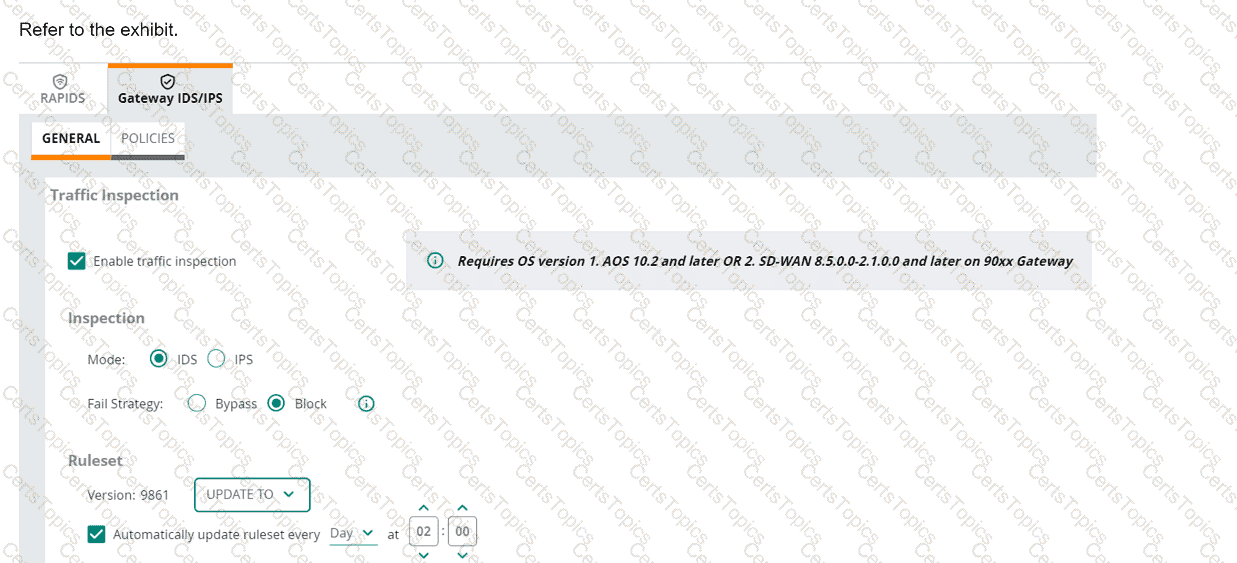
(Note that the HPE Aruba Networking Central interface shown here might look slightly different from what you see in your HPE Aruba Networking Central

interface as versions change; however, similar concepts continue to apply.)

An HPE Aruba Networking 9x00 gateway is part of an HPE Aruba Networking Central group that has the settings shown in the exhibit. What would cause the

gateway to drop traffic as part of its IDPS settings?

Options:

A.

Its site-to-site VPN connections failing

B.

Traffic matching a rule in the active ruleset

C.

Its IDPS engine failing

D.

Traffic showing anomalous behavior

Question 36

What is one benefit of integrating HPE Aruba Networking ClearPass Policy Manager (CPPM) with third-party solutions such as Mobility Device Management (MDM) and firewalls?

Options:

A.

CPPM can exchange contextual information about clients with third-party solutions, which helps make better decisions.

B.

CPPM can make the third-party solutions more secure by adding signature-based threat detection capabilities.

C.

CPPM can offload policy decisions to the third-party solutions, enabling CPPM to respond to authentication requests more quickly.

D.

CPPM can take over filtering internal traffic so that the third-party solutions have more processing power to devote to filtering external traffic.

Question 37

A company is implementing a client-to-site VPN based on tunnel-mode IPsec.

Which devices are responsible for the IPsec encapsulation?

Options:

A.

Gateways at the remote clients' locations and devices accessed by the clients at the main site

B.

The remote clients and devices accessed by the clients at the main site

C.

The remote clients and a gateway at the main site

D.

Gateways at the remote clients' locations and a gateway at the main site

Question 38

A company wants to turn on Wireless IDS/IPS infrastructure and client detection at the high level on HPE Aruba Networking APs. The company does not want to

enable any prevention settings.

What should you explain about HPE Aruba Networking recommendations?

Options:

A.

HPE Aruba Networking recommends turning on both wired and wireless prevention whenever you enable detection at high.

B.

HPE Aruba Networking recommends using hybrid AP mode, as opposed to Air Monitors (AMs), when implementing detection without prevention.

C.

HPE Aruba Networking recommends disabling client detection when you configure infrastructure detection at high, as infrastructure detection includes all the client checks and more.

D.

HPE Aruba Networking recommends configuring infrastructure and client detection at a custom level and disabling or tuning some of the settings that are likely to produce false positives.

Question 39

A company has a variety of HPE Aruba Networking solutions, including an HPE Aruba Networking infrastructure and HPE Aruba Networking ClearPass Policy Manager (CPPM). The company passes traffic from the corporate LAN destined to the data center through a third-party SRX firewall. The company would like to further protect itself from internal threats. What is one solution that you can recommend?

Options:

A.

Have the third-party firewall send Syslogs to CPPM, which can work with network devices to lock internal attackers out of the network.

B.

Add ClearPass Device Insight (CPDI) to the solution, integrate it with the third-party firewall to develop more complete device profiles.

C.

Configure CPPM to poll the third-party firewall for a broad array of information about internal clients, such as profile and posture.

D.

Use tunnel mode SSIDs and user-based tunneling (UBT) on AOS-CX switches to pass all internal traffic directly through the third-party firewall.

Question 40

A company has an HPE Aruba Networking ClearPass cluster with several servers. ClearPass Policy Manager (CPPM) is set up to:

. Update client attributes based on Syslog messages from third-party appliances

. Have the clients reauthenticate and apply new profiles to the clients based on the updates

To ensure that the correct profiles apply, what is one step you should take?

Options:

A.

Configure a CoA action for all tag updates in the ClearPass Device Insight integration settings.

B.

Tune the CoA delay on the ClearPass servers to a value of 5 seconds or greater.

C.

Set the cluster's Endpoint Context Servers polling interval to a value of 5 seconds or less.

D.

Configure the cluster to periodically clean up (delete) unknown endpoints.

Page: 1 / 10
Total 135 questions