Big Cyber Monday Sale 70% Discount Offer - Ends in 0d 00h 00m 00s - Coupon code: save70

Free and Premium Fortinet FCSS_LED_AR-7.6 Dumps Questions Answers

Fortinet NSE 6 - LAN Edge 7.6 Architect Questions and Answers

Question 1

Refer to the exhibits.
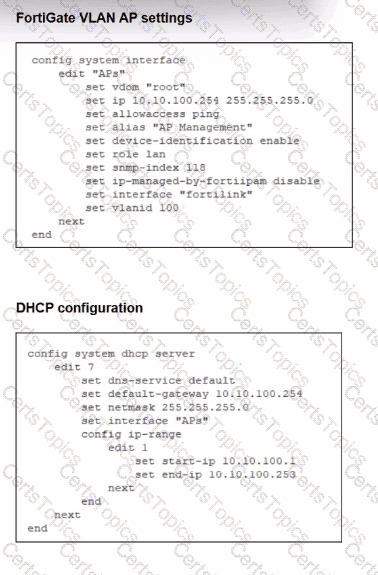
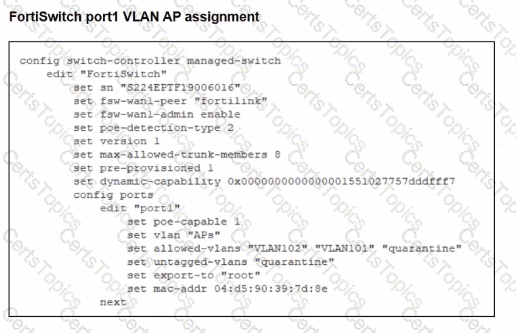
A FortiSwitch is successfully managed by a FortiGate. FortiAP is connected to port1 of the managed FortiSwitch. On FortiGate, the VLAN AP is configured to detect and manage FortiAP, along with a DHCP server for the VLAN AP. Additionally, the VLAN AP is assigned to port1 of FortiSwitch. However. FortiGate is unable to detect or manage FortiAP.

Which FortiGate misconfiguration is preventing the detection of FortiAP?

Options:

A.

Security Fabric is disabled in the administrative access options of the VLAN.

B.

The FortiAP firmware is incompatible with the FortiGate firmware version.

C.

The VLAN is not tagged correctly on the FortiSwitch uplink port.

D.

The CAPWAP ports (UDP 5246 and 5247) are not open on FortiGate.

Buy Now
Question 2

Refer to the exhibits.

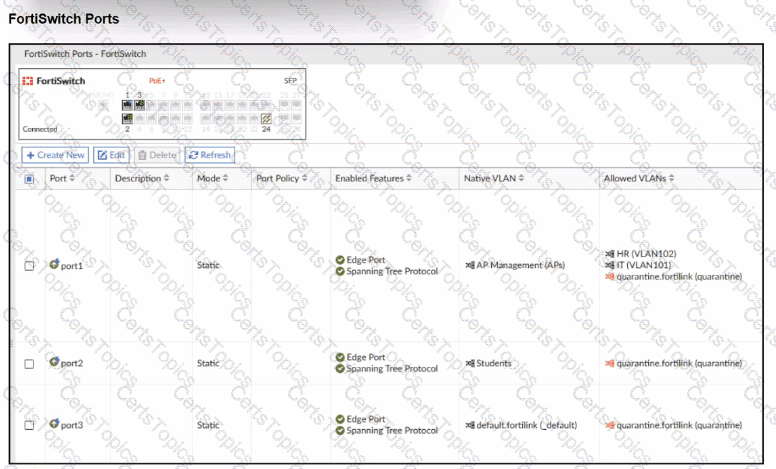
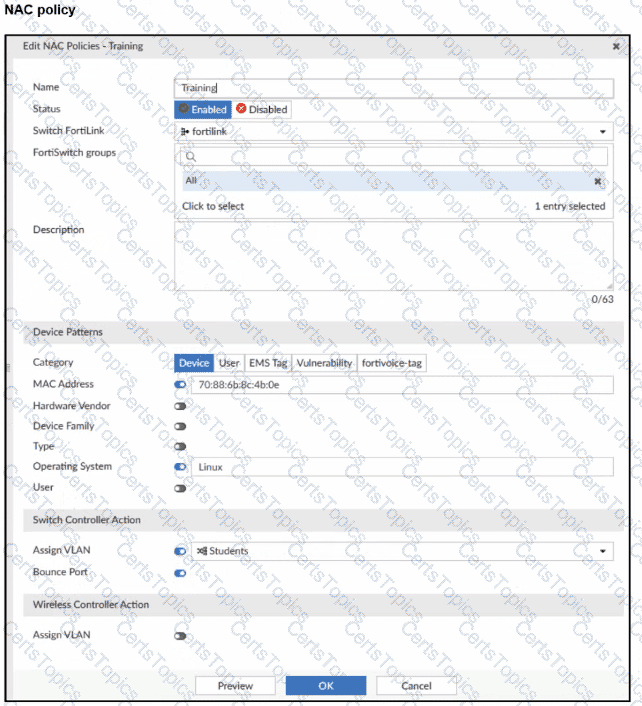
A NAC policy has been configured to apply traffic that flows through FortiSwitch port 2. Traffic that meets the NAC policy criteria will be assigned to the Students VLAN. However, the NAC policy does not seem to be taking effect.

Which configuration is missing?

Options:

A.

Port2 Access mode should be set to NAC mode.

B.

The MAC address or OS might be misconfigured for the connected device.

C.

Port2 Access mode should be set to Port Policy mode.

D.

The Students VLAN should be set to Allowed VLANs instead of Native VLAN.

Question 3

Refer to the exhibit.

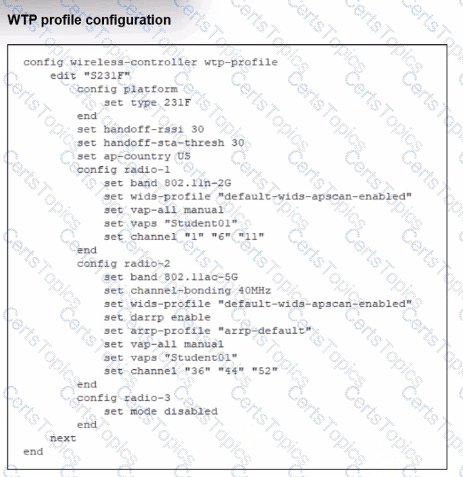
Which shows the WTP profile configuration.

The AP profile is assigned to two FAP-231F APs that are installed in an open plan area.

The first AP has 32 clients associated with the 5 GHz radios and 22 clients associated with the 2.4 GHz radio. The second AP has 12 clients associated with the 5 GHz radios and 20 clients associated with the 2.4 GHz radio.

A dual-band-capable client enters the area near the first AP and the first AP measures the new client at - 3 3 dBm signal strength. The second AP measures the new client at -43 dBm signal strength.

If the new client attempts to conned to the student 01 wireless network, which AP radio will the client be associated with?

Options:

A.

The first AP 2.4 GHz interface provides a stronger signal, which clients often prioritize.

B.

The first AP 5 GHz interface because it has a stronger signal.

C.

The second AP 5 GHz interface has fewer clients, which ensures better performance despite the weaker signal.

D.

The second AP 2.4 GHz interface is preferred over 5 GHz for better speed and lower interference.

Question 4

What is the expected behavior when enabling auto TX power control on a FortiAP interface?

Options:

A.

FortiGate monitors the signal strength of nearby AP interfaces and adjusts its own transmit power every 30 seconds to match the signal strength of the adjacent AP

B.

FortiGate measures the signal strength of nearby FortiAP interfaces every 30 seconds and adjusts their transmit power to ensure they remain detectable at -70 dBm.

C.

FortiGate periodically measures the signal strength of the weakest associated client and adjusts the AP radio power to align with the detected signal strength of that client.

D.

The AP periodically evaluates the signal strength of its own transmission from the client perspective and adjusts its power to ensure the signal is detected at -70 dBm.

Question 5

Which VLAN is used by FortiGate to place devices that fail to match any configured NAC policies? CRSPAN
Options:

A.

NAC

B.

segment

C.

Quarantine

D.

Onboarding

Question 6

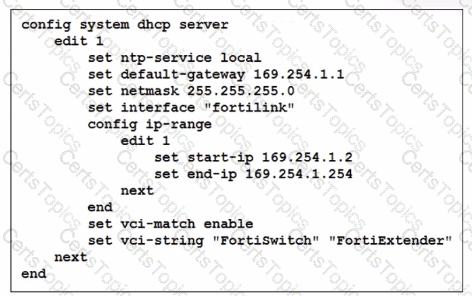
You've configured the FortiLink interface, and the DHCP server is enabled by default. The resulting DHCP server settings are shown in the exhibit. What is the role of the vci-string setting in this configuration?

Options:

A.

To ignore DHCP requests coming from FortiSwitch and FortiExtender devices.

B.

To restrict the IP address assignment to devices that have FortiSwitch or FortiExtender as their hostname.

C.

To connect, devices must match the VCI string; otherwise, they will not receive an IP address.

D.

To reserve IP addresses for FortiSwitch and FortiExtender devices.

Question 7

In a Windows environment using AD machine authentication, how does FortiAuthenticator ensure that a previously authenticated device is maintaining its network access once the device resumes operating after sleep or hibernation?

Options:

A.

It temporarily assigns the device to a guest VLAN until full reauthentication is completed.

B.

It sends a wake-on-LAN packet to trigger reauthentication.

C.

It uses machine authentication based on the device IP address.

D.

It caches the MAC address of authenticated devices for a configurable period of time.

Question 8

Refer to the exhibit.

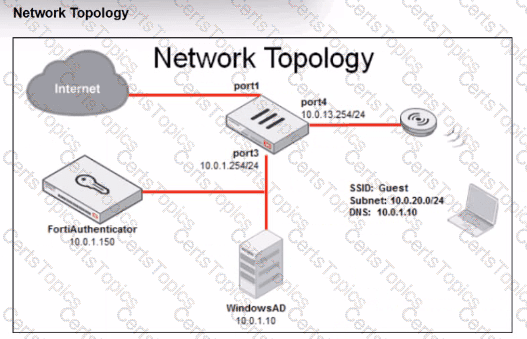
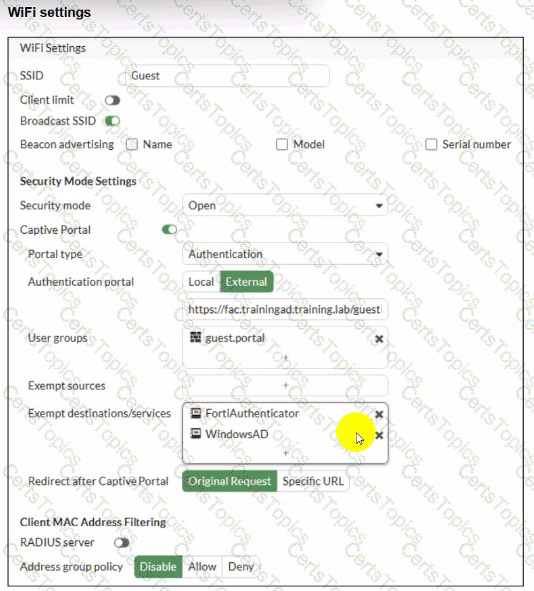
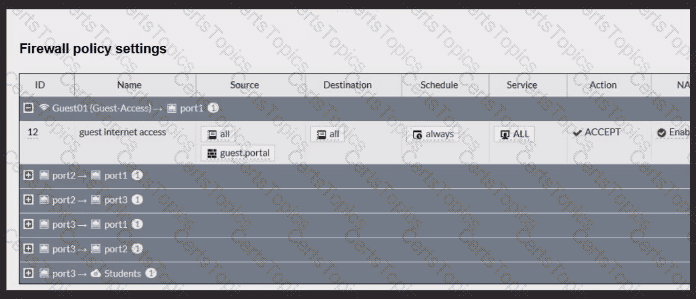
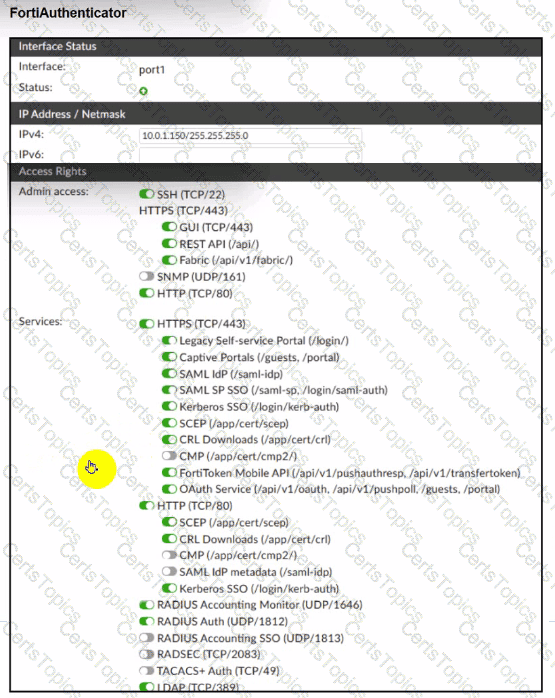
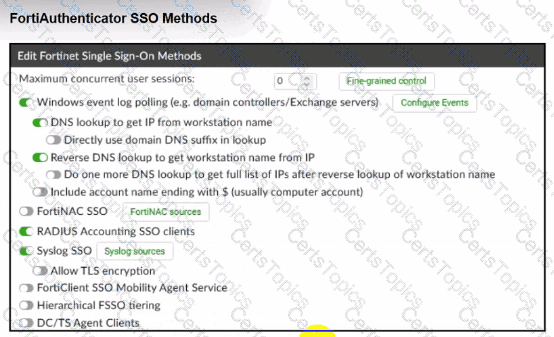
Review the exhibits to analyze the network topology, SSID settings, and firewall policies.

FortiGate is configured to use an external captive portal for authentication to grant access to a wireless network. During testing, it was found that users attempting to connect to the SSID cannot access the captive portal login page.

What configuration change should be made to resolve this issue to allow users to access the captive portal?

Options:

A.

Change the SSID security mode to WPA2-Enterprise for authentication.

B.

Disable HTTPS redirection for the captive portal authentication page.

C.

Exclude FortiAuthenticator and Windows AD address objects from filtering.

D.

A firewall policy allowing Guest SSID traffic to reach FortiAuthenticator and Windows AD.

Question 9

A conference center wireless network provides guest access through a captive portal, allowing unregistered users to self-register and connect to the network. The IT team has been tasked with updating the existing configuration to enforce captive portal authentication over a secure HTTPS connection. Which two steps should the administrator take to implement this change? (Choose two.)

Options:

A.

Enable HTTP redirect in the user authentication settings.

B.

Create a new SSID with the HTTPS captive portal URL.

C.

Disable HTTP administrative access on the guest SSID to enforce HTTPS connection.

D.

Update the captive portal URL to use HTTPS on FortiGate and FortiAuthenticator.

Question 10

Refer to the exhibits.

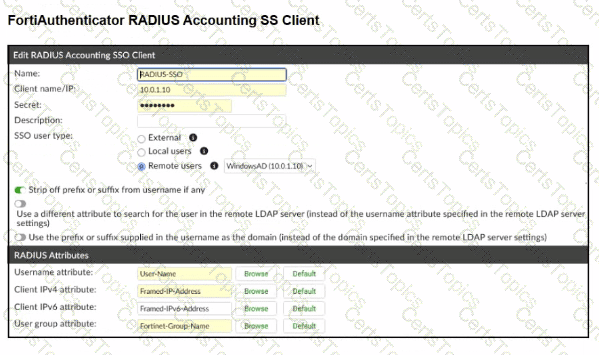
A company has multiple FortiGate devices deployed and wants to centralize user authentication and authorization. The administrator decides to use FortiAuthenticator to convert RSSO messages to FSSO, allowing all FortiGate devices to receive user authentication updates.

After configuring FortiAuthenticator to receive RADIUS accounting messages, users can authenticate, but FortiGate does not enforce the correct policies based on user groups. Upon investigation, the administrator discovers that FortiAuthenticator is receiving RADIUS accounting messages from the RADIUS server and successfully queries LDAP for user group information. But, FSSO updates are not being sent to FortiGate devices and FortiGate firewall policies based on FSSO user groups are not being applied.

What is the most likely reason FortiGate is not receiving FSSO updates?

Options:

A.

The RADIUS Username and Client IPv4 attributes are not defined on FortiAuthenticator.

B.

The LDAP server is not configured to retrieve group memberships for RSSO users.

C.

FortiAuthenticator is missing the FSSO user group attribute in the configuration.

D.

The FortiAuthenticator interface is not enabled to receive RADIUS accounting messages.

Question 11

You are setting up a captive portal to provide Wi-Fi access for visitors. To simplify the process, your team wants visitors to authenticate using their existing social media accounts instead of creating new accounts or entering credentials manually.

Which two actions are required to enable this functionality? (Choose two.)

Options:

A.

Set up a remote open authorization (OAuth) server for each selected social media platform.

B.

Configure only the email login option because a social media login cannot be used with captive portals.

C.

Enable Account Login as the authentication type and configure a remote LDAP server.

D.

Set up the FortiAuthenticator internal database as the primary source for user credentials

E.

Configure the social login profiles for the supported platforms.

Question 12

In each user certificate, you can define the subject field, expiration date. User Principal Name (UPN), URL for CRL download, and the OCSP URL. How does the detailed configuration of these attributes impact the certificate?

Options:

A.

It makes the certificate easier to revoke manually because it reduces the need for automatic checks.

B.

It limits the validity of the certificate to specific devices and applications, reducing its general usability.

C.

It enables precise identification of the user and ensures timely certificate revocation checks.

D.

It makes the certificate compatible with a wide range of applications and services by ensuring universal validity