Summer Certification Sale 70% Discount Offer - Ends in 0d 00h 00m 00s - Coupon code: save70

Free and Premium CSI CSC2 Dumps Questions Answers

Page: 1 / 17
Total 232 questions

Canadian Securities Course Exam 2 Questions and Answers

Question 1

What is the bottom price of a security ' s trading range at which most investors would sense value and be willing to buy it?

Options:

A.

Reversal pattern.

B.

Sentiment indicator.

C.

Support level.

D.

Moving average.

Buy Now
Question 2

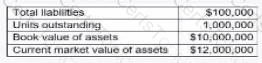
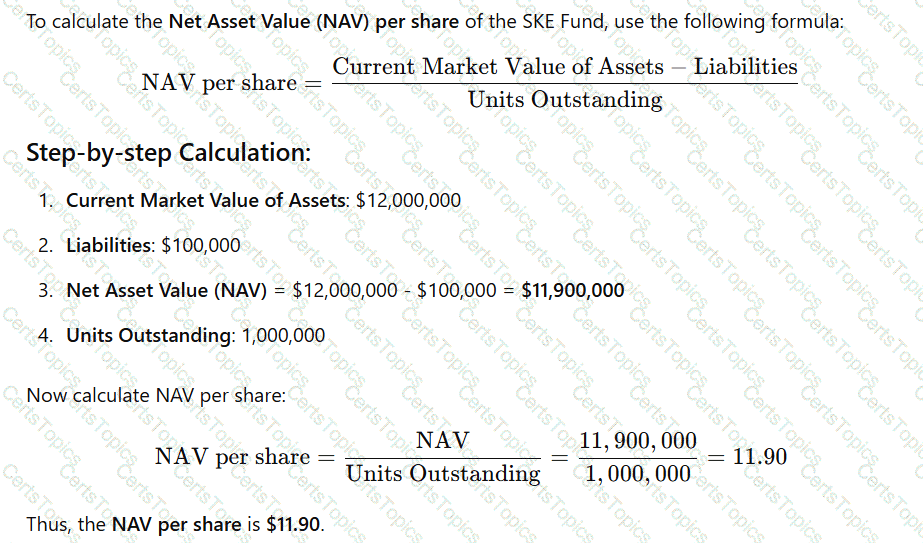
The following financial information is available for fund SKE:

What is SKE fund’s net asset value per share?

Options:

A.

$9,90

B.

$11, 90

C.

$12,00

D.

$10, 00

Question 3

What correlation would an investor need in order to eliminate the variability in the total returns between two stocks?

Options:

A.

+0.5.

B.

-1.0.

C.

0.0.

D.

+1.0.

Question 4

An emerging Canadian company is exploring the possibility of using hot water springs to produce clear energy for remote rural communities. The company has strong human resource capital and few assets, and raised SI 20,000 through the Capital Pool Company program. Which option is best for this company to continue maximizing public exposure and raising capital?

Options:

A.

Crowfunding

B.

Escrowing shares

C.

offering a greenshee option

D.

Filling disclosure documents with SEDAR+.

Question 5

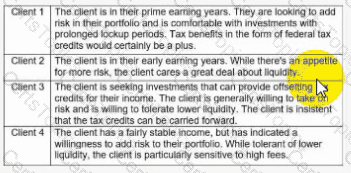
An advisor to explain the benefits of labour sponsored funds (LSVCC) to some of his clients.

With which client should the advisor have this discussion?
Options:

A.

Client 2

B.

Client 4

C.

Client 1

D.

Client 3

Question 6

An investor has earned additional Income and is looking to invest in a security that guarantees returns over. The next seven years. What is the Best option for purchase?

Options:

A.

Proffered shares

B.

Provincial saving bond

C.

Common shares

D.

Exchange-traded fund.

Question 7

If an advisor is interested in a top-down, active equity management approach that is more aggressive and likely to be successful, which type of fund manager should he choose?

Options:

A.

Sector rotation.

B.

Buy and hold.

C.

Value oriented.

D.

Market timing.

Question 8

What is the most accurate feature of a Canada Education Savings Grant (CESG)?

Options:

A.

CESG payments are made directly to the RESP firm.

B.

CESG may be earned until the beneficiary is 21 years of age.

C.

The maximum CESG per beneficiary is $2,500 annually.

D.

The maximum lifetime CESG per beneficiary is $8,500.

Question 9

The price of FMA common stock is set to break through its 200-day moving average line from below on heavy volume. How might a technical analyst interpret this information?

Options:

A.

A buy signal as FMA ' s price is set to rise.

B.

A sell signal as FMA ' s price is set to fall.

C.

The upward price trend is reversing.

D.

The declining price trend will continue.

Question 10

How can an analyst use trend analysis to analyze a company’s financial statements?

Options:

A.

Computer the company’s current ratios with its ratios from prior years to determine a trend.

B.

Review the company’s ratio over the past year, as they provide the best estimate of near-term performance and future trends.

C.

Identity trends by selecting the lowest ratio for the base year, even if a loss is experienced, as it represents a good starting point for analyzing the growth in the ratios.

D.

Analyze the ratios against companies in a wide a range of industries to see how the company is trending in the current economic cycle.

Question 11

When a futures contract is entered into, who sets the minimum initial margin rate?

Options:

A.

investment dealer

B.

Buyer

C.

Seller

D.

Exchange

Question 12

Who generally executes portfolio strategy within a buy-side firm?

Options:

A.

Portfolio manager.

B.

Head of fixed income

C.

Investment advisor.

D.

Trader

Question 13

What is typically discussed during the establishment of the client-advisor relationship step?

Options:

A.

The client ' s investment goals.

B.

The current financial and personal status.

C.

By what means does the client prefer to communicate with the advisor.

D.

What services will the advisor provide.

Question 14

What type of risk could theoretically be eliminated completely by buying a portfolio of shares comprising all S & P/TSX Composite Index stocks?

Options:

A.

Business risk.

B.

Specific risk.

C.

Default risk.

D.

Systematic risk.

Question 15

The Bank of Canada uses an operating band to help manage the oversight rate. How wide is the operating Band?

Options:

A.

25 basis points

B.

75 basis points

C.

50 basis points

D.

100 basis points.

Question 16

Over the previous three calendar years, fund LMO had five drawdowns as follows:

What was the maximum drawdown during this time period?

Options:

A.

18.00%

B.

52.50%

C.

22.50%

D.

21.25%

Question 17

What happens if a company ' s dividend payout ratio exceeds 100%?

Options:

A.

The company will be unable to repay its debts

B.

Profits will be reduced

C.

Shareholders ' equity will be eroded

D.

The share price will increase

Question 18

Which individual is most likely to have income as an investment objective?

Options:

A.

Elaine, who is contributing to an RRSP with a plan to use the funds for the Lifelong Learning Plan in seven years.

B.

Naveed, who plans to use his investments to buy a house in five years.

C.

Hira, who is investing in her RRSP in anticipation of retirement in 15 years.

D.

Andrew, who is retired and needs to supplement his retirement pension.

Question 19

When acting as a principal, how do investment dealers generate revenue?

Options:

A.

Through commissions

B.

Thrown tracers.

C.

Through brokerage changes.

D.

Through spreads on buy/sell prices.

Question 20

Which funds have a similar objective to those of balanced funds?

Options:

A.

Fixed-income funds

B.

Target-date funds

C.

Dividend funds

D.

Asset allocation funds

Question 21

Which type of ETF could incur roll yield loss?

Options:

A.

Index-based.

B.

Futures-based.

C.

Physical-based.

D.

Equity-based.

Question 22

Pierre has been plotting the price behaviour of QLT using a 100-day moving average. The 100-day moving average line has been above the daily market price for several weeks. However, the price of QLT broke through the moving average line with heavy trading volume, and the moving average line is moving higher. What action should Pierre take based on this information?

Options:

A.

Buy put option on QLT shares

B.

Sell QLT shares

C.

Buy QLT shares

D.

Sell call option on QLT shares

Question 23

The following information is available for REW Co:

What is the price of REW Co. if calculated using the dividend discount model?

Options:

A.

$13.75.

B.

$15.71.

C.

$12.50.

D.

$14.29.

Question 24

Supriya, an advisor, receives a research service from a dealer in exchange for placing securities transactions with that dealer. What statement best applies to this type of arrangement?

Options:

A.

This arrangement is permissible if it benefits Supriya ' s firm.

B.

This arrangement can only be used for equity transactions.

C.

This arrangement needs to be disclosed to Supriya ' s clients.

D.

This arrangement violates best execution requirements.

Question 25

What do the returns on treasury bills often represent?

Options:

A.

Bank prime rate.

B.

Inflation rate

C.

Risk-free rate

D.

Federal funds rate

Question 26

Which primary value is violated if an advisor places an unsuitable order requested by a client?

Options:

A.

Compliance.

B.

Integrity.

C.

Duty of care.

D.

Professionalism.

Question 27

How does beta help assess the risk of a mutual fund?

Options:

A.

Compares management expense ratios.

B.

Monitors trading volumes.

C.

Measures comparative performance.

D.

Relates its returns to the underlying markets.

Question 28

What obligation dues an IA have when communicating information about a preliminary prospectus to prospective investors?

Options:

A.

The IA must ensure 3 proxy is mailed to the investors to vote for approval or disapproval of the offering.

B.

The IA must provide a greensheet

C.

The IA must make a tombstone advertisement.

D.

The IA mum record the names addresses of those who have requested and received a preliminary prospectus

Question 29

Tom sold some bonds in his RRSP and used the total $100,000 in proceeds to buy a 75% guaranteed segregated fund. Three years later, Tom died. At the time of his death, the market value of the segregated fund was $700,000. Assuming no interim withdrawal on market value reset, what is the death benefit payable from this investment?

Options:

A.

$0,

B.

$70,000

C.

$30,000

D.

$5, 000

Question 30

Siobhan designed an equity portfolio with a beta of 1.2. What is the expected return on the portfolio if the overall stock market return was 7.9%? (Round to the nearest decimal.)

Options:

A.

7.9%

B.

6.6%

C.

9.5%

D.

6.3%

Question 31

What financial ratio reveals the nature of a company’s capital structure?

Options:

A.

Debt-to-net-income.

B.

Price-to-earnings.

C.

Return-on-equity.

D.

Debt-to-equity.

Question 32

Why is liquidity important when analyzing the shares of a public company?

Options:

A.

Trading should be sufficient to absorb transactions without undue distortion in the market price.

B.

It affects the company’s ability to raise additional capital.

C.

Too much liquidity causes excessive buying or selling in the market.

D.

It affects the trading cost and volume of the stock for retail investors.

Question 33

What must happen for a redemption to be processed from a mutual fund?

Options:

A.

Payment for redeemed securities must be within two business days after the NAVPS is determined.

B.

Mutual funds representatives must submit the order within two business days of when the order is received from the client.

C.

The offering price of the mutual fund must be calculated.

D.

The client redeeming the mutual fund must receive a Fund facts document.

Question 34

Jenny contributed $5,000 each year for five years to a spousal RRSP in Albert ' s name. In the calendar year immediately following Jenny ' s last contribution, Albert withdrew $25,000 from the RRSP. What are the tax implications of the withdrawal for Albert and Jenny?

Options:

A.

Albert includes $10,000 in his taxable income and Jenny includes $15,000 in her taxable income.

B.

No effect on Jenny ' s taxable income and Albert includes $25,000 in his taxable income.

C.

Jenny includes $25,000 in her taxable income and Albert includes $0 in his taxable income.

D.

Jenny includes $10,000 in her taxable income and Albert includes $15,000 in his taxable income.

Question 35

What is one type of linked PPN in Canada?

Options:

A.

Participation

B.

Zero-coupon plus option

C.

Performance

D.

Stock basket

Question 36

A business trust would typically purchase the underlying company assets of which type of operation?

Options:

A.

Senior housing

B.

Restaurants

C.

Industrial rentals

D.

Shopping centres

Question 37

Which statutory right allows a purchaser to caned their order if a prospectus has a misrepresentation?

Options:

A.

Right of rescission.

B.

Right of action for damages

C.

Right of amended prospectus delivery

D.

Right of withdrawal.

Question 38

If a mutual fund is set up as a corporation, how much of income generated by the fund flows through directly to the shareholders?

Options:

A.

100% of dividends

B.

100% of interest

C.

None

D.

50% of capital gain

Question 39

When considering management accounts, what is most accurate regarding model-based account management?

Options:

A.

It is only intended for short-term use.

B.

It requires solicitation.

C.

It permits tax loss selling.

D.

It requires client permission before executing trades.

Question 40

Based on market capitalization. which sector of the SSP. ' TSX Composite index has one of the highest weightings within the index?

Options:

A.

Energy

B.

Health care

C.

Utilities

D.

Information technology

Question 41

Which method of technical analysis involves the use of devices for smoothing out fluctuating values in an individual stock or aggregate market over time?

Options:

A.

Moving average.

B.

Chart.

C.

Sentiment indicators.

D.

Cycle.

Question 42

A bond with a duration of five is currently priced at $103. If Interest rates rise by 2%. approximately what win be me bond ' s price?

Options:

A.

$108.15

B.

$113.30

C.

$97.85

D.

$92.70

Question 43

What is the Sharpe ratio given the following information?

Options:

A.

1.5

B.

0.4

C.

20

D.

2.5

Question 44

What type of equity analysis tracks the moving average in an attempt to identify buy or sell signals?

Options:

A.

Quantitative.

B.

Sentiment indicators.

C.

Cycle.

D.

Fundamental.

Question 45

What is the requirement regarding the discretionary authority in managed accounts?

Options:

A.

The IA can implement the transaction upon approval from the client, or by any person on a client’s behalf.

B.

The discretionary authority must be given by the client in writing and accepted by the IA verbally.

C.

The IA must use a model portfolio due to the short-term nature of these types of accounts.

D.

The discretionary authority must specify the client’s investment objectives in the trading authorization.

Question 46

Institutional clients tend to be more sophisticated than retail clients. What benefit does this translate into for CIRO dealer members?

Options:

A.

They are free of fiduciary obligations to their clients.

B.

They are subject to few, if any, investment restrictions.

C.

They can organize their firms based specifically on client needs.

D.

They are permitted to make trades on a discretionary basis for their clients.

Question 47

Why would a corporation choose to issue preferred shares rather than debt?

Options:

A.

Existing assets have excess financing capacity to justify the issue of preferred shares.

B.

The preferred dividend rate usually varies with the market interest rates

C.

issuing preferred shares would reduce the amount of leverage.

D.

The costs for issuing preferred shares are usually kwh than debt.

Question 48

A shareholder receives rights from a company through direct ownership in shares. Not expecting to exercise them, she sells the rights on the relevant exchange. What is her capital gain?

Options:

A.

The sale price less the exercise price of the rights.

B.

The current share price less the exercise price of the rights.

C.

The sale price of the rights.

D.

The current price of the shares less the sale price of the rights.

Question 49

An investment analyst at a bank is reviewing the high, low and closing prices of a financial services stock. What type of analysis is this analyst conducting?

Options:

A.

Quantitative analysis

B.

Moving average analysis

C.

Chart analysis

D.

Cycle analysis

Question 50

SK AI-Equity Mutual Fund reported a year-end NAVPS of $25.50, a beginning of the year NAVPS of $21.50, and a dividend yield of 4.34%. What was the performance of the SK fund assuming reinvestment of all dividends and that no additions or withdrawals were made?

Options:

A.

22.94%

B.

18.60%

C.

15.69%

D.

14.25%

Question 51

A financial institution is selling their pooled mortgages to a Special Purpose Vehicle. What process are they engaging in?

Options:

A.

Merger strategy.

B.

Asset securitization.

C.

Share splitting.

D.

Credit spread arbitrage.

Question 52

A young couple is looking to buy a house in the near future with a down payment. What type of investment should they consider for their portfolio?

Options:

A.

Corporate bonds

B.

Stable bank Stocks

C.

Diversified balanced portfolio.

D.

Government Treasury bills

Question 53

Which ratio, when showing a decreasing trend, suggests declining operating efficiency?

Options:

A.

Price-earnings

B.

Return on common equity

C.

Dividend payout

D.

Debt/equity

Question 54

Yusef is a high-net-worth individual who wants to diversify his portfolio with private equity but is concerned with the potential disadvantages of this asset class. What disadvantage should Yusef be considering as a potential private equity investor?

Options:

A.

Private equity excludes investment from private debt

B.

Private equity companies are not listed on stock exchanges

C.

Private equity is a high-risk investment

D.

Private equity typically provides lower long-term returns than other asset classes

Question 55

According to the life cycle hypothesis, what stage is almost always determined by the level of disposable income available?

Options:

A.

Early earning years

B.

Peak earning years

C.

Retirement years

D.

Mature earning years

Question 56

Which document details certain rights of the investor and provides audited financial statements of a hedge fund structured as a limited partnership?

Options:

A.

Information folder

B.

Fund Facts document

C.

Offering memorandum

D.

Managers discussion and analysis

Question 57

Why are inverse exchange-traded funds effective in declining markets?

Options:

A.

They use physical commodities.

B.

They use borrowed capital.

C.

They use active management.

D.

They use derivatives.

Question 58

Max bought $7,000 of fund units. Two years later, the total value of his portfolio went up to $10,000 and he decided to sell the fund. Max had received a total of $1,000 in reinvested dividends over the course of the holding period. What is the adjusted cost base of his investment?

Options:

A.

$8,000.

B.

$2,000.

C.

$7,000.

D.

$3,000.

Question 59

What is the main responsibility of the trustees of a mutual fund trust?

Options:

A.

Portfolio trading and implementation of investment strategy.

B.

Arranging cash distributions through dividend payments.

C.

Day-to-day supervision of the investment portfolio.

D.

Ensuring investments are in line with the fund ' s investment objectives.

Question 60

According to the Bank of Canada, approximately how many months does it take for the effect of changes in monetary policy to be felt through the whole economy?

Options:

A.

18

B.

6

C.

3

D.

36

Question 61

Which statement best describes the Sharpe ratio?

Options:

A.

It compares the return of the portfolio with the return of the market as a whole, relative to the portfolio ' s risk as measured by its standard deviation.

B.

It compares the return of the portfolio with the riskless rate of return, relative to the portfolio ' s risk as measured by its standard deviation.

C.

It compares the return of the portfolio with the return of the market as a whole, relative to the portfolio ' s risk as measured by its beta.

D.

It compares the return of the portfolio with the riskless rate of return, relative to the market ' s risk as measured by its standard deviation.

Question 62

Which type of ETF is also referred to as smart beta ETF?

Options:

A.

Rules-based

B.

Standard

C.

Synthetic

D.

Index-based

Question 63

Which type of industry typically has a high inventory turnover ratio?

Options:

A.

Wineries.

B.

Distillers.

C.

Steel manufacturers.

D.

Cosmetics.

Question 64

Which is a typical feature of investing in a listed private equity company?

Options:

A.

Average levels of liquidity.

B.

Access to a wide range of skills and large number of personnel.

C.

Controls and limits on private equity management to protect existing investors.

D.

Ability to act on legitimate insider information.

Question 65

What industry stocks tend to have lower betas than the market?

Options:

A.

Transportation

B.

Capital goods

C.

Utilities

D.

Automobiles and components

Question 66

In a multi-mandate managed account, who sets the overall optimal asset mix?

Options:

A.

Investment advisor

B.

Sub-advisor

C.

Client

D.

Overlay manager

Question 67

How are monthly Canada Pension Plan (CPP) benefits treated when both spouses are eligible for CPP?

Options:

A.

Each spouse receives the higher pension amount.

B.

Each spouse can only receive their own benefits.

C.

Each spouse receives the lower pension amount.

D.

Each spouse can share a portion of the total pension amount.

Question 68

What is an example of an activity that is restricted in a mutual fund?

Options:

A.

The purchase of 6% of net assets in the securities of a single issuer.

B.

The purchase of a put option on an equity index.

C.

The purchase of a silver futures contract.

D.

The purchase of an ETF, while netting out the fees.

Question 69

The principle of retraction in retractable preferred shares is identical to what other security?

Options:

A.

Callable preferred shares.

B.

Retractable common shares

C.

Redeemable preferred shares.

D.

Retractable bonds and debentures

Page: 1 / 17
Total 232 questions