A security engineer receives a notice about suspicious activity from a Linux-based Amazon EC2 instance that uses Amazon Elastic Block Store (Amazon EBS)-based storage. The instance is making connections to known malicious addresses.
The instance is in a development account within a VPC that is in the us-east-1 Region. The VPC contains an internet gateway and has a subnet in us-east-1a and us-east-1b. Each subnet is associated with a route table that uses the internet gateway as a default route. Each subnet also uses the default network ACL. The suspicious EC2 instance runs within the us-east-1b subnet. During an initial investigation, a security engineer discovers that the suspicious instance is the only instance that runs in the subnet.
Which response will immediately mitigate the attack and help investigate the root cause?
A company has AWS accounts in an organization in AWS Organizations. The organization includes a dedicated security account.
All AWS account activity across all member accounts must be logged and reported to the dedicated security account. The company must retain all the activity logs in a secure storage location within the dedicated security account for2 years.No changes or deletions of the logs are allowed.
Which combination of steps will meet these requirements with theLEAST operational overhead? (Select TWO.)
A company runs critical workloads in an on-premises data center. The company wants to implement an AWS based disaster recovery (DR) solution that will achieve an RTO of less than 1 hour. The company needs to continuously replicate physical and virtual servers. The company must optimize costs for data storage and bandwidth usage. The DR solution must be automated.
Which solution will meet these requirements?
A company plans to create Amazon S3 buckets to store log data. All the S3 buckets will have versioning enabled and will use the S3 Standard storage class.
A security engineer needs to implement a solution that protects objects in the S3 buckets from deletion for 90 days. The solution must ensure that no object can be deleted during this time period, even by an administrator or the AWS account root user.
Which solution will meet these requirements?
A security engineer needs to control access to data that is encrypted with an AWS Key Management Service (AWS KMS) customer managed key. The security engineer also needs to use additional authenticated data (AAD) to prevent tampering with ciphertext.
Which solution will meet these requirements?
A consultant agency needs to perform a security audit for a company ' s production AWS account. Several consultants need access to the account. The consultant agency already has its own AWS account. The company requires multi-factor authentication (MFA) for all access to its production account. The company also forbids the use of long-term credentials.
Which solution will provide the consultant agency with access that meets these requirements?
A company needs to detect unauthenticated access to its Amazon Elastic Kubernetes Service (Amazon EKS) clusters. The solution must require no additional configuration of the existing EKS deployment.
Which solution will meet these requirements with the LEAST operational effort?
A company is developing an application that runs across a combination of Amazon EC2 On-Demand Instances and Spot Instances. A security engineer needs to provide a logging solution that makes logs for all instances available from a single location. The solution must allow only a specific set of users to analyze the logs for event patterns. The users must be able to use SQL queries on the logs to perform root cause analysis.
Which solution will meet these requirements?
A company operates an Amazon EC2 instance that is registered as a target of a Network Load Balancer (NLB). The NLB is associated with a security group. The security group allows inbound TCP traffic on port 22 from 10.0.0.0/23.
The company maps the NLB to two subnets that share the same network ACL and route table. The route table has a route for 0.0.0.0/0 to an internet gateway. The network ACL has one inbound rule that has a priority of 20 and that allows TCP traffic on port 22 from 10.0.0.0/16.
A security engineer receives an alert that there is an unauthorized SSH session on the EC2 instance. The unauthorized session originates from 10.0.1.5. The company ' s incident response procedure requires unauthorized SSH sessions to beimmediately interrupted. The instance must remain running, and its memory must remain intact.
Which solution will meet these requirements?
A company operates a web application that runs on Amazon EC2 instances. The application listens on port 80 and port 443. The company uses an Application Load Balancer (ALB) with AWS WAF to terminate SSL and to forward traffic to the application instances only on port 80.
The ALB is in public subnets that are associated with a network ACL named NACL1. The application instances are in dedicated private subnets that are associated with a network ACL named NACL2. An Amazon RDS for PostgreSQL DB instance that uses port 5432 is in a dedicated private subnet that is associated with a network ACL named NACL3. All the network ACLs currently allow all inbound and outbound traffic.
Which set of network ACL changes will increase the security of the application while ensuring functionality?
A company has AWS accounts in an organization in AWS Organizations. An Amazon S3 bucket in one account is publicly accessible. A security engineer must remove public access and ensure the bucket cannot be made public again.
Which solution will meet these requirements?
AWS Config cannot deliver configuration snapshots to Amazon S3.
Which TWO actions will remediate this issue?
A security engineer needs to develop a process to investigate and respond to potential security events on a company’s Amazon EC2 instances. All the EC2 instances are backed by Amazon EBS. The company uses AWS Systems Manager to manage all the EC2 instances and has installed Systems Manager Agent on all the EC2 instances.
The process that the security engineer is developing must comply with AWS security best practices and must meet the following requirements:
• A compromised EC2 instance’s volatile memory and non-volatile memory must be preserved for forensic purposes.
• A compromised EC2 instance’s metadata must be updated with corresponding incident ticket information.
• A compromised EC2 instance must remain online during the investigation but must be isolated to prevent the spread of malware.
• Any investigative activity during the collection of volatile data must be captured as part of the process.
Which combination of steps should the security engineer take to meet these requirements with the LEAST operational overhead? (Select THREE.)
A security engineer for a company wants to maintain all IAM users and roles according to the principle of least privilege. The security engineer plans to audit the IAM permissions once every 365 days. The security engineer must view the permissions that each IAM identity used in the last 365 days and must remove any unused permissions.
Which solution will meet these requirements?
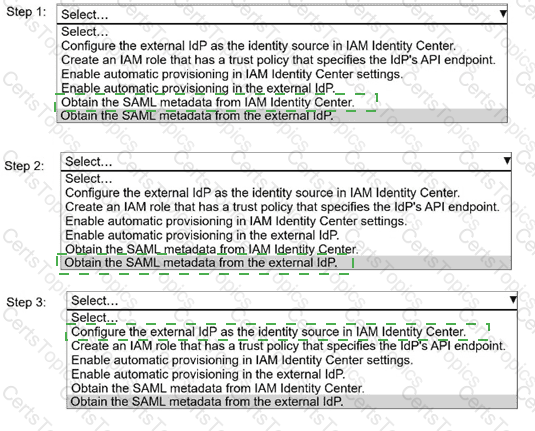
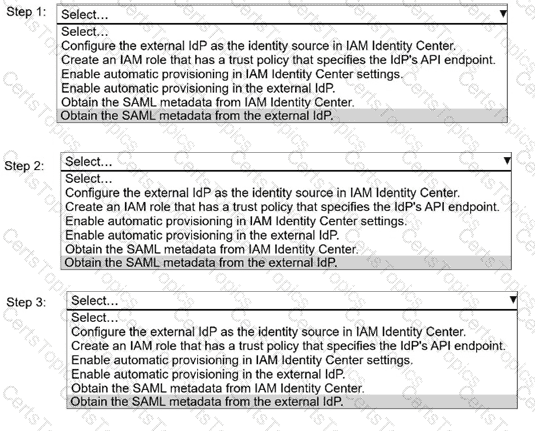
A security engineer needs to implement AWS IAM Identity Center with an external identity provider (IdP).
Select and order the correct steps from the following list to meet this requirement. Select each step one time or not at all. (Select and order THREE.)
. Configure the external IdP as the identity source in IAM Identity Center.
. Create an IAM role that has a trust policy that specifies the IdP ' s API endpoint.
. Enable automatic provisioning in IAM Identity Center settings.
. Enable automatic provisioning in the external IdP.
. Obtain the SAML metadata from IAM Identity Center.
. Obtain the SAML metadata from the external IdP.
A company has a platform that is divided into 12 AWS accounts under the same organization in AWS Organizations. Many of these accounts use Amazon API Gateway to expose APIs to the company ' s frontend applications. The company needs to protect the existing APIs and any resources that will be deployed in the future against common SQL injection and bot attacks.
Which solution will meet these requirements with the LEAST operational overhead?
A company is attempting to conduct forensic analysis on an Amazon EC2 instance, but the company is unable to connect to the instance by using AWS Systems Manager Session Manager. The company has installed AWS Systems Manager Agent (SSM Agent) on the EC2 instance.
The EC2 instance is in a subnet in a VPC that does not have an internet gateway attached. The company has associated a security group with the EC2 instance. The security group does not have inbound or outbound rules. The subnet’s network ACL allows all inbound and outbound traffic.
Which combination of actions will allow the company to conduct forensic analysis on the EC2 instance without compromising forensic data? (Select THREE.)
An IAM user receives an Access Denied message when the user attempts to access objects in an Amazon S3 bucket. The user and the S3 bucket are in the same AWS account. The S3 bucket is configured to use server-side encryption with AWS KMS keys (SSE-KMS) to encrypt all of its objects at rest by using a customer managed key from the same AWS account. The S3 bucket has no bucket policy defined. The IAM user has been granted permissions through an IAM policy that allows thekms:Decryptpermission to the customer managed key. The IAM policy also allows thes3:List* ands3:Get* permissions for the S3 bucket and its objects.
Which of the following is a possible reason that the IAM user cannot access the objects in the S3 bucket?
A company uses an incident response team to troubleshoot incidents. The incident response team must use temporary credentials from AWS STS for cross-account IAM role access when troubleshooting. Occasionally, each team member will need to respond to multiple different types of incidents simultaneously. Based on the type of incident, the company wants to dynamically assign minimal permissions to whichever team member responds.
Which solution will meet these requirements?
CloudFormation stack deployments fail for some users due to permission inconsistencies.
Which combination of steps will ensure consistent deployments MOST securely? (Select THREE.)
A company ' s public website consists of an Application Load Balancer (ALB), a set of Amazon EC2 instances that run a stateless application behind the ALB, and an Amazon DynamoDB table from which the application reads data. The company is concerned about malicious scanning and DDoS attacks. The company wants to impose a restriction in which each client IP address can read the data only3 times in any 5-minute period.
Which solution will meet this requirement with the LEAST effort?
A company ' s security team wants to receive near-real-time email notifications about AWS abuse reports related to DoS attacks. An Amazon SNS topic already exists and is subscribed to by the security team.
What should the security engineer do next?
A security engineer is designing a solution that will provide end-to-end encryption between clients and Docker containers running in Amazon Elastic Container Service (Amazon ECS). This solution must also handle volatile traffic patterns.
Which solution would have the MOST scalability and LOWEST latency?
A company has the following security policy for its Amazon Aurora MySQL databases for a single AWS account:
• Database storage must be encrypted at rest.
• Deletion protection must be enabled.
• Databases must not be publicly accessible.
• Database audit logs must be published to Amazon CloudWatch Logs.
A security engineer must implement a solution thatcontinuously monitorsall Aurora MySQL resources for compliance with this policy. The solution must be able todisplay a database ' s compliance state for each part of the policy at any time.
Which solution will meet these requirements?
A company has an AWS account that hosts a production application. The company receives an email notification that Amazon GuardDuty has detected an Impact:IAMUser/AnomalousBehavior finding in the account. A security engineer needs to run the investigation playbook for this security incident and must collect and analyze the information without affecting the application.
Which solution will meet these requirements MOST quickly?
A company is using an organization in AWS Organizations that contains 100 accounts. The company has configured trusted access for Amazon GuardDuty to AWS Organizations within the management account. The company has designated a member account to be the GuardDuty administrator for the organization.
GuardDuty is working properly and reports findings for the organization in the GuardDuty console. The company wants a SecOps team to receive real-time email alerts from any GuardDuty finding within the organization that is high severity according to GuardDuty severity levels.
Which solution will meet these requirements?
A company’s application team wants to replace an internal application with a new AWS architecture that consists of Amazon EC2 instances, an AWS Lambda function, and an Amazon S3 bucket in a single AWS Region. After an architecture review, the security team mandates that no application network traffic can traverse the public internet at any point. The security team already has an SCP in place for the company’s organization in AWS Organizations to restrict the creation of internet gateways, NAT gateways, and egress-only gateways.
Which combination of steps should the application team take to meet these requirements? (Select THREE.)
A company that uses AWS Organizations is using AWS IAM Identity Center to administer access to AWS accounts. A security engineer is creating a custom permission set in IAM Identity Center. The company will use the permission set across multiple accounts. An AWS managed policy and a customer managed policy are attached to the permission set. The security engineer has full administrative permissions and is operating in the management account.
When the security engineer attempts to assign the permission set to an IAM Identity Center user who has access to multiple accounts, the assignment fails.
What should the security engineer do to resolve this failure?
A company has contracted with a third party to audit several AWS accounts. To enable the audit, cross-account IAM roles have been created in each account targeted for audit. The auditor is having trouble accessing some of the accounts.
Which of the following may be causing this problem? (Select THREE.)
A company has a web application that reads from and writes to an Amazon S3 bucket. The company needs to use AWS credentials to authenticate all S3 API calls to the S3 bucket.
Which solution will provide the application with AWS credentials to make S3 API calls?
A company is using AWS WAF to protect a customized public API service that is based on Amazon EC2 instances. The API uses an Application Load Balancer. The AWS WAF web ACL is configured with an AWS Managed Rules rule group. After a software upgrade to the API and the client application, some types of requests are no longer working and are causing application stability issues. A security engineer discovers that AWS WAF logging is not turned on for the web ACL.
The security engineer needs to immediately return the application to service, resolve the issue, and ensure that logging is not turned off in the future. The security engineer turns on logging for the web ACL and specifies Amazon CloudWatch Logs as the destination.
Which additional set of steps should the security engineer take to meet the requirements?
A company runs an application on a fleet of Amazon EC2 instances. The application is accessible to users around the world. The company associates an AWS WAF web ACL with an Application Load Balancer (ALB) that routes traffic to the EC2 instances.
A security engineer is investigating a sudden increase in traffic to the application. The security engineer discovers a significant amount of potentially malicious requests coming from hundreds of IP addresses in two countries. The security engineer wants to quickly limit the potentially malicious requests. The security engineer does not want to prevent legitimate users from accessing the application.
Which solution will meet these requirements?
A company uses Amazon Cognito user pools with the hosted UI to authenticate its customers. The company’s security team has detected a surge in bot activity and suspicious traffic that targets the Amazon Cognito endpoints. A security engineer must implement a security solution to block these malicious requests. The security measures must maintain uninterrupted access for legitimate users.
Which solution meets these requirements?
A company is running a containerized application on an Amazon Elastic Container Service (Amazon ECS) cluster that uses AWS Fargate. The application runs as several ECS services.
The ECS services are in individual target groups for an internet-facing Application Load Balancer (ALB). The ALB is the origin for an Amazon CloudFront distribution. An AWS WAF web ACL is associated with the CloudFront distribution.
Web clients access the ECS services through the CloudFront distribution. The company learns that the web clients can bypass the web ACL and can access the ALB directly.
Which solution will prevent the web clients from directly accessing the ALB?
A company needs to implement data lifecycle management for Amazon RDS snapshots. The company will use AWS Backup to manage the snapshots. The company must retain RDS automated snapshots for 5 years and will use Amazon S3 for long-term archival storage.
Which solution will meet these requirements?
A company stores sensitive data in an Amazon S3 bucket. The company encrypts the data at rest by using server-side encryption with Amazon S3 managed keys (SSE-S3). A security engineer must prevent any modifications to the data in the S3 bucket.
Which solution will meet this requirement?
A company runs a web application on a fleet of Amazon EC2 instances that are in an Auto Scaling group. The EC2 instances are in the same VPC subnet as other workloads.
A security engineer deploys an Amazon GuardDuty detector in the same AWS Region as the EC2 instances and integrates GuardDuty with AWS Security Hub.
The security engineer needs to implement an automated solution to detect and appropriately respond to anomalous traffic patterns for the web application. The solution must comply with AWS best practices forinitial response to security incidentsand mustminimize disruptionto the web application.
Which solution will meet these requirements?
A company manages multiple AWS accounts through an organization in AWS Organizations. The company enables all features in the organization.
A security team must implement a solution to centrally manage VPC security groups across the accounts. The company uses an existing reference security group with the required configuration. The solution must detect if security group rules have been modified to deviate from the reference security group. The solution must automatically restore any noncompliant security groups to match the reference security group.
The security team needs to select a solution that does not require custom development or scripting.
Which solution will meet these requirements?
A company wants to establish separate AWS Key Management Service (AWS KMS) keys to use for different AWS services. The company ' s security engineer created the following key policy to allow the infrastructure deployment team to create encrypted Amazon Elastic Block Store (Amazon EBS) volumes by assuming the InfrastructureDeployment IAM role:
{
" Version " : " 2012-10-17 " ,
" Id " : " key-policy-ebs " ,
" Statement " : [
{
" Sid " : " Enable IAM User Permissions " ,
" Effect " : " Allow " ,
" Principal " : {
" AWS " : " arn:aws:iam::123456789012:root "
},
" Action " : " kms:* " ,
" Resource " : " * "
},
{
" Sid " : " Allow use of the key " ,
" Effect " : " Allow " ,
" Principal " : {
" AWS " : " arn:aws:iam::123456789012:role/aws-reserved/sso.amazonaws.com/InfrastructureDeployment "
},
" Action " : [
" kms:Encrypt " ,
" kms:Decrypt " ,
" kms:ReEncrypt* " ,
" kms:GenerateDataKey* " ,
" kms:DescribeKey " ,
" kms:CreateGrant " ,
" kms:ListGrants " ,
" kms:RevokeGrant "
],
" Resource " : " * " ,
" Condition " : {
" StringEquals " : {
" kms:ViaService " : " ec2.us-west-2.amazonaws.com "
}
}
}
]
}
The security engineer recently discovered that IAM rolesother thanthe InfrastructureDeployment role used this key for other services.
Which change to the policy should the security engineer make to resolve these issues?
A company uploads data files as objects into an Amazon S3 bucket. A vendor downloads the objects to perform data processing.
A security engineer must implement a solution that prevents objects from residing in the S3 bucket for longer than 72 hours.
A company has a PHP-based web application that uses Amazon S3 as an object store for user files. The S3 bucket is configured for server-side encryption with Amazon S3 managed keys (SSE-S3). New requirements mandate full control of encryption keys.
Which combination of steps must a security engineer take to meet these requirements? (Select THREE.)
A company ' s data scientists want to create artificial intelligence and machine learning (AI/ML) training models by using Amazon SageMaker. The training models will use large datasets in an Amazon S3 bucket. The datasets contain sensitive information.
On average, the data scientists need 30 days to train models. The S3 bucket has been secured appropriately. The company ' s data retention policy states that all data that is older than 45 days must be removed from the S3 bucket.
Which action should a security engineer take to enforce this data retention policy?
A company is using AWS Organizations with the default SCP. The company needs to restrict AWS usage for all AWS accounts that are in a specific OU. Except for some desired global services, the AWS usage must occur only in theeu-west-1Region for all accounts in the OU. A security engineer must create an SCP that applies the restriction to existing accounts and any new accounts in the OU.
Which SCP will meet these requirements?
A company uses AWS Organizations to manage an organization that consists of three workload OUs: Production, Development, and Testing. The company uses AWS CloudFormation templates to define and deploy workload infrastructure in AWS accounts that are associated with the OUs. Different SCPs are attached to each workload OU.
The company successfully deployed a CloudFormation stack update to workloads in the Development OU and the Testing OU. When the company uses the same CloudFormation template to deploy the stack update in an account in the Production OU, the update fails. The error message reports insufficient IAM permissions.
What is the FIRST step that a security engineer should take to troubleshoot this issue?
A security engineer wants to forward custom application-security logs from an Amazon EC2 instance to Amazon CloudWatch. The security engineer installs the CloudWatch agent on the EC2 instance and adds the path of the logs to the CloudWatch configuration file.
However, CloudWatch does not receive the logs. The security engineer verifies that the awslogs service is running on the EC2 instance.
What should the security engineer do next to resolve the issue?
A company runs a public web application on Amazon EKS behind Amazon CloudFront and an Application Load Balancer (ALB). A security engineer must send a notification to an existing Amazon SNS topic when the application receives 10,000 requests from the same end-user IP address within any 5-minute period.
Which solution will meet these requirements?
A company’s data scientists use Amazon SageMaker with datasets stored in Amazon S3. Data older than 45 days must be removed according to policy.
Which action should enforce this policy?
A company uses SAML federation with IAM to provide internal users with SSO for their AWS accounts. The company’s identity provider certificate was rotated as part of its normal lifecycle. Shortly after, users started receiving the following error when attempting to log in:
“Error: Response Signature Invalid (Service: AWSSecurityTokenService; Status Code: 400; Error Code: InvalidIdentityToken)”
A security engineer needs to address the immediate issue and ensure that it will not occur again.
Which combination of steps should the security engineer take to accomplish this? (Select TWO.)
A company in France uses Amazon Cognito with the Cognito Hosted UI as an identity broker for sign-in and sign-up processes. The company is marketing an application and expects that all the application ' s users will come from France. When the company launches the application, the company ' s security team observes fraudulent sign-ups for the application. Most of the fraudulent registrations are from users outside of France. The security team needs a solution to perform custom validation at sign-up. Based on the results of the validation, the solution must accept or deny the registration request.
Which combination of steps will meet these requirements? (Select TWO.)
A company uses AWS Organizations. The company has teams that use an AWS CloudHSM hardware security module (HSM) that is hosted in a central AWS account. One of the teams creates its own new dedicated AWS account and wants to use the HSM that is hosted in the central account.
How should a security engineer share the HSM that is hosted in the central account with the new dedicated account?
A security engineer wants to evaluate configuration changes to a specific AWS resource to ensure that the resource meets compliance standards. However, the security engineer is concerned about a situation in which several configuration changes are made to the resource in quick succession. The security engineer wants to record only the latest configuration of that resource to indicate the cumulative impact of the set of changes.
Which solution will meet this requirement in the MOST operationally efficient way?
A company ' s security team wants to receive email notification from AWS about any abuse reports regarding DoS attacks. A security engineer needs to implement a solution that will provide a near-real-time alert for any abuse reports that AWS sends for the account. The security engineer already has created an Amazon Simple Notification Service (Amazon SNS) topic and has subscribed the security team ' s email address to the topic.
What should the security engineer do next to meet these requirements?
A company uses AWS IAM Identity Center with SAML 2.0 federation. The company decides to change its federation source from one identity provider (IdP) to another. The underlying directory for both IdPs is Active Directory.
Which solution will meet this requirement?
A company is operating an open-source software platform that is internet facing. The legacy software platform no longer receives security updates. The software platform operates using Amazon Route 53 weighted load balancing to send traffic to two Amazon EC2 instances that connect to an Amazon RDS cluster. A recent report suggests this software platform is vulnerable to SQL injection attacks, with samples of attacks provided. The company ' s security engineer must secure this system against SQL injection attacks within 24 hours. The security engineer’s solution must involve the least amount of effort and maintain normal operations during implementation.
What should the security engineer do to meet these requirements?
A company needs the ability to identify the root cause of security findings in an AWS account. The company has enabled VPC Flow Logs, Amazon GuardDuty, and AWS CloudTrail. The company must investigate any IAM roles that are involved in the security findings and must visualize the findings.
Which solution will meet these requirements?
A company has an organization in AWS Organizations. The company’s security team is developing automation to capture Amazon EC2 forensic evidence within any AWS account in the organization. The company has encrypted the Amazon EBS volumes of all the EC2 instances in the organization by default by using the AWS managed key. The automation consists of AWS Lambda functions and AWS Step Functions state machines.
The automation assumes an IAM role in the target AWS account. The automation takes snapshots of suspicious EC2 instances and assigns permissions to allow the security team’s account to copy the snapshots. The security team has an AWS KMS key to encrypt the snapshots. During testing, the automation fails to copy the snapshots into the security team’s AWS account.
Which combination of steps should the security team take so that the automation can capture EC2 forensic evidence in all AWS accounts in the organization? (Select THREE.)
A development team is creating an open source toolset to manage a company’s software as a service (SaaS) application. The company stores the code in a public repository so that anyone can view and download the toolset’s code. The company discovers that the code contains an IAM access key and secret key that provide access to internal resources in the company ' s AWS environment. A security engineer must implement a solution to identify whether unauthorized usage of the exposed credentials has occurred. The solution also must prevent any additional usage of the exposed credentials.
Which combination of steps will meet these requirements? (Select TWO.)
A company ' s security engineer is designing an isolation procedure for Amazon EC2 instances as part of an incident response plan. The security engineer needs to isolate a target instance to block any traffic to and from the target instance, except for traffic from the company ' s forensics team. Each of the company ' s EC2 instances has its own dedicated security group. The EC2 instances are deployed in subnets of a VPC. A subnet can contain multiple instances.
The security engineer is testing the procedure for EC2 isolation and opens an SSH session to the target instance. The procedure starts to simulate access to the target instance by an attacker. The security engineer removes the existing security group rules and adds security group rules to give the forensics team access to the target instance on port 22.
After these changes, the security engineer notices that the SSH connection is still active and usable. When the security engineer runs a ping command to the public IP address of the target instance, the ping command is blocked.
What should the security engineer do to isolate the target instance?
A security engineer has designed a VPC to segment private traffic from public traffic. The VPC includes two Availability Zones. The security engineer has provisioned each Availability Zone with one private subnet and one public subnet. The security engineer has created three route tables for use with the environment. One route table is for the public subnets, and two route tables are for the private subnets (one route table for the private subnet in each Availability Zone).
The security engineer discovers that all four subnets are attempting to route traffic out through the internet gateway that is attached to the VPC.
Which combination of steps should the security engineer take to remediate this scenario? (Select TWO.)
A company finds that one of its Amazon EC2 instances suddenly has a high CPU usage. The company does not know whether the EC2 instance is compromised or whether the operating system is performing background cleanup.
Which combination of steps should a security engineer take before investigating the issue? (Select THREE.)
A company sends Amazon RDS snapshots to two accounts as part of its disaster recovery (DR) plan. The snapshots must be encrypted. However, each account needs to be able to decrypt the snapshots in case of a DR event.
Which solution will meet these requirements?
A company runs ECS services behind an internet-facing ALB that is the origin for CloudFront. An AWS WAF web ACL is associated with CloudFront, but clients can bypass it by accessing the ALB directly.
Which solution will prevent direct access to the ALB?
A company runs a global ecommerce website using Amazon CloudFront. The company must block traffic from specific countries to comply with data regulations.
Which solution will meet these requirements MOST cost-effectively?
A company uses Amazon API Gateway to present REST APIs to users. An API developer wants to analyze API access patterns without the need to parse the log files.
Which combination of steps will meet these requirements with the LEAST effort? (Select TWO.)
A company has security requirements for Amazon Aurora MySQL databases regarding encryption, deletion protection, public access, and audit logging. The company needs continuous monitoring and real-time visibility into compliance status.
Which solution will meet these requirements?
A company runs an application outside of AWS. The external application authenticates to AWS as an IAM user. A security engineer needs to migrate the external application to use an IAM role. The company’s human users already use IAM roles with AWS IAM Identity Center.
Which solution will give the external application the ability to use an IAM role?
A company has a compliance requirement to encrypt all data in transit. The company recently discovered an Amazon Aurora cluster that does not meet this requirement.
How can the company enforce encryption for all connections to the Aurora cluster?
Copyright © 2021-2026 CertsTopics. All Rights Reserved