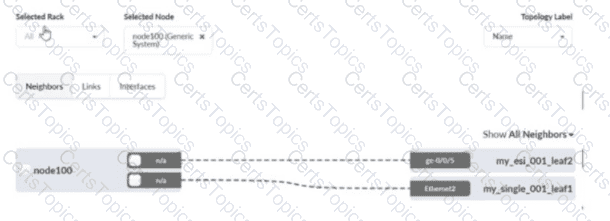
The exhibit shows node100 (Generic System) selected, with links from that generic system to two fabric leaf switches (for example, a leaf participating in an ESI pair and another leaf node). In Apstra 5.1, a Generic System represents an endpoint that is not managed as a network device by Apstra (such as a server, appliance, or host), but it is still modeled so Apstra can apply interface intent (LAG vs single link), connectivity templates, and virtual network attachments.
Because the device is shown as a generic system connected on leaf-facing ports inside the fabric topology, this aligns with an internal generic system. Internal generic systems are used for servers or endpoints that reside “inside” the rack/fabric context and consume leaf switch ports as access-facing connections. This is the common representation for endpoints in EVPN-VXLAN data center designs, where the leaf switches provide the VLAN/VNI mapping and, if required, IRB gateway services within the tenant VRF (routing zone).
An external generic system is typically used for devices outside the fabric boundary—most commonly external routers, firewalls, or upstream networks attached at border leafs—where the intent is external connectivity rather than server access. The selected node is neither a peer switch nor an access switch (those are network infrastructure roles), and the UI explicitly labels it as a Generic System, confirming the correct classification as an internal generic system.