New Year Sale 70% Discount Offer - Ends in 0d 00h 00m 00s - Coupon code: save70

MuleSoft-Integration-Architect-I Reviews Questions

Salesforce Certified MuleSoft Platform Integration Architect (Mule-Arch-202) Questions and Answers

Question 69

Refer to the exhibit.
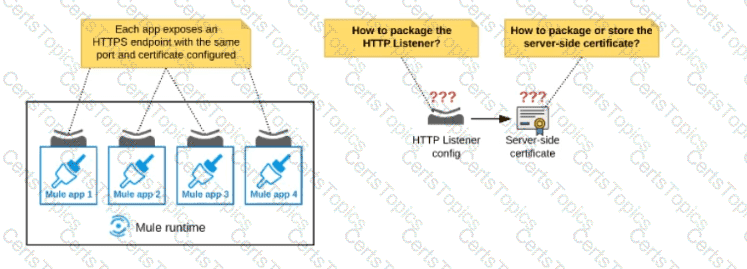
An organization deploys multiple Mule applications to the same customer -hosted Mule runtime. Many of these Mule applications must expose an HTTPS endpoint on the same port using a server-side certificate that rotates often.

What is the most effective way to package the HTTP Listener and package or store the server-side certificate when deploying these Mule applications, so the disruption caused by certificate rotation is minimized?

Options:

A.

Package the HTTPS Listener configuration in a Mule DOMAIN project, referencing it from all Mule applications that need to expose an HTTPS endpoint Package the server-side certificate in ALL Mule APPLICATIONS that need to expose an HTTPS endpoint

B.

Package the HTTPS Listener configuration in a Mule DOMAIN project, referencing it from all Mule applications that need to expose an HTTPS endpoint. Store the server-side certificate in a shared filesystem location in the Mule runtime's classpath, OUTSIDE the Mule DOMAIN or any Mule APPLICATION

C.

Package an HTTPS Listener configuration In all Mule APPLICATIONS that need to expose an HTTPS endpoint Package the server-side certificate in a NEW Mule DOMAIN project

D.

Package the HTTPS Listener configuration in a Mule DOMAIN project, referencing It from all Mule applications that need to expose an HTTPS endpoint. Package the server-side certificate in the SAME Mule DOMAIN project Go to Set

Question 70

When designing an upstream API and its implementation, the development team has been advised to not set timeouts when invoking downstream API. Because the downstream API has no SLA that can be relied upon. This is the only donwstream API dependency of that upstream API. Assume the downstream API runs uninterrupted without crashing. What is the impact of this advice?

Options:

A.

The invocation of the downstream API will run to completion without timing out.

B.

An SLA for the upstream API CANNOT be provided.

C.

A default timeout of 500 ms will automatically be applied by the Mule runtime in which the upstream API implementation executes.

D.

A load-dependent timeout of less than 1000 ms will be applied by the Mule runtime in which the downstream API implementation executes.

Question 71

As a part of project requirement, Java Invoke static connector in a mule 4 application needs to invoke a static method in a dependency jar file. What are two ways to add the dependency to be visible by the connectors class loader?

(Choose two answers)

Options:

A.

In the Java Invoke static connector configuration, configure a path and name of the dependency jar file

B.

Add the dependency jar file to the java classpath by setting the JVM parameters

C.

Use Maven command to include the dependency jar file when packaging the application

D.

Configure the dependency as a shared library in the project POM

E.

Update mule-artefact.json to export the Java package

Question 72

A marketing organization is designing a Mule application to process campaign data. The Mule application will periodically check for a file in a SFTP location and process the records in the file. The size of the file can vary from 10MB to 5GB. Due to the limited availabiltty of vCores, the Mule application is deployed to a single CloudHub worker configured with vCore size 0.2.

The application must transform and send different formats of this file to three different downstream SFTP locations.

What is the most idiomatic (used for its intended purpose) and performant way to configure the SFTP operations or event sources to process the large files to support these deployment requirements?

Options:

A.

Use an in-memory repeatable stream

B.

Use a file-stored non-repeatable stream

C.

Use an in-memory non-repeatable stream

D.

Use a file-stored repeatable stream