You have an Azure Databricks workspace that is enabled for Unity Catalog.
You need to profile a table to meet the following requirements:
The count of null values per column must be evaluated repeatedly as new records are added to the table.
Changes in the count of null values must be observable over the progression of the dataset.
Which type of profile should you create?
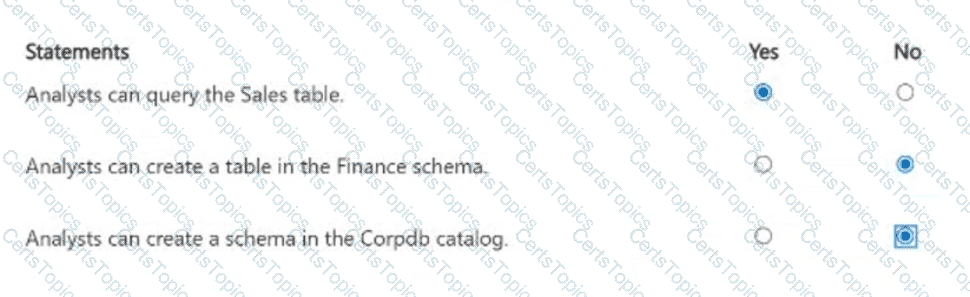
You have an Azure Databricks workspace that is enabled for Unity Catalog and contains:
A catalog named Corpdb
A schema named Finance in the Corpdb catalog
A table named Sales in the Finance schema
You have a group named Analysts.
You assign the following permissions to Analysts:
USE CATALOG on the Corpdb catalog
USE SCHEMA on the Finance schema
SELECT on the Sales table
For each of the following statements, select Yes if the statement is true. Otherwise, select No.
NOTE: Each correct selection is worth one point.

You have a Lakeflow Spark Declarative Pipelines {SDP) pipeline in Azure Databricks. The pipeline ingests transaction data into a table named Table1.
You need to ensure that in the event of an invalid record, the pipeline continues to run. The solution must meet the following requirements:
• Invalid records must NOT be written to Table 1.
• Invalid records must be preserved for review.
• Minimize development effort
What should you do?
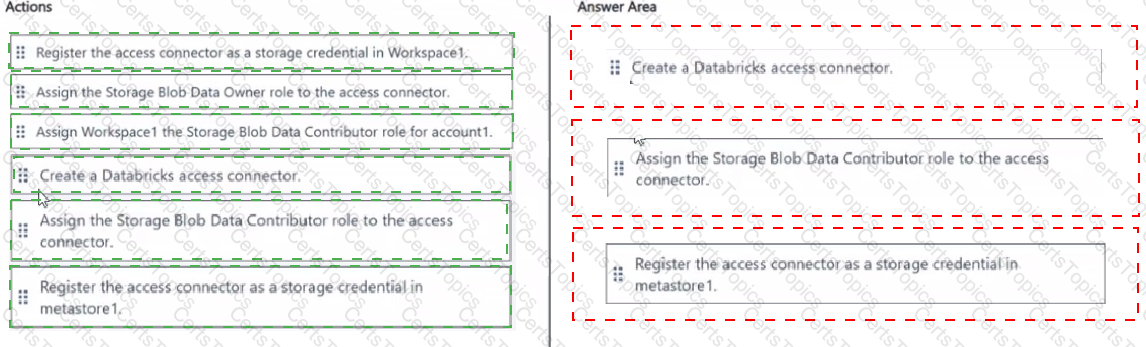
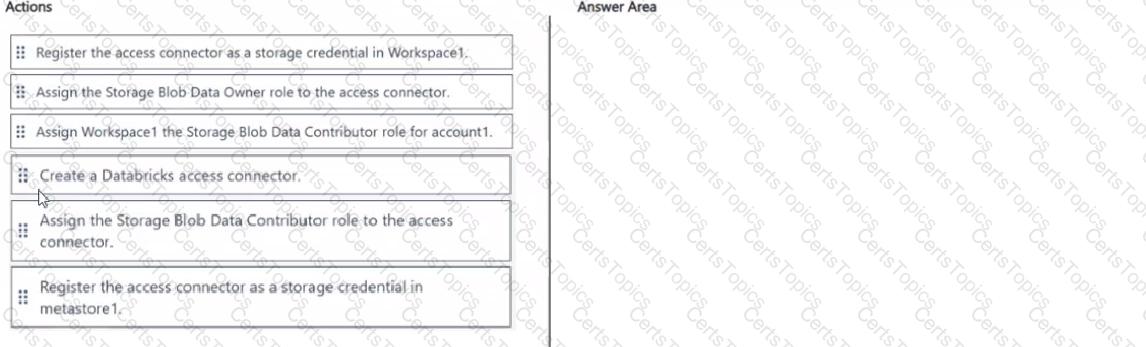
You have an Azure Databricks workspace named Workspace1 that is attached to a Unity Catalog metastore named metastore1
You need to register an Azure Storage account named account1 that has a hierarchical namespace enabled as an external location The external location must use a managed identity to authenticate to account1 and the solution must follow the principle of least privilege.
Which three actions should you perform in sequence ' To answer, move the appropriate actions from the list of actions to the answer area and arrange them in the correct order.
Copyright © 2021-2026 CertsTopics. All Rights Reserved