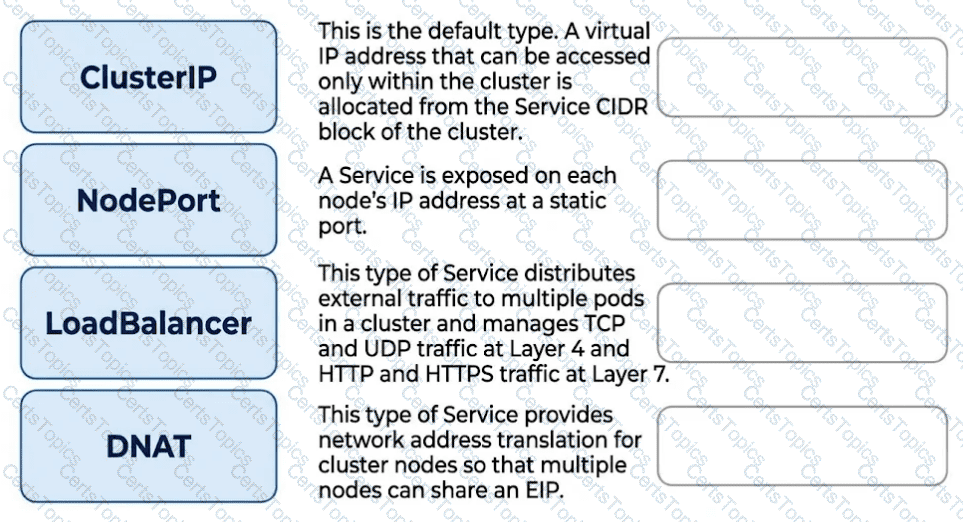
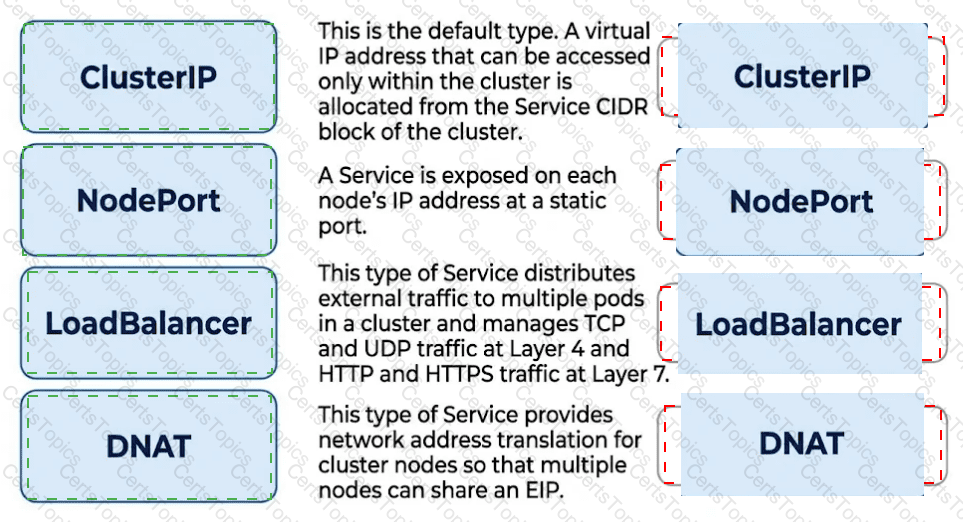
“ClusterIP: This is the default type. A virtual IP address that can be accessed only within the cluster is allocated from the Service CIDR block of the cluster.”
“NodePort: The Service is exposed on each node's IP address at a static port.”
“LoadBalancer: This type of Service adds an external load balancer on the top of a NodePort Service.”
“DNAT: This type of Service translates IP addresses for cluster nodes and enables multiple nodes to share an EIP.”
Huawei source: Training PDF pp. 458–459
Technical Deep Dive
This matching exercise tests four Huawei CCE network access modes. The first description is ClusterIP, option A: Kubernetes creates an internal virtual address from the Service CIDR range, normally usable only inside the cluster. The second is NodePort, option B: the Service is exposed on a static port of each node, allowing the relevant node address and port to reach the workload. NodePort traffic normally reaches a corresponding ClusterIP abstraction.
The third description is LoadBalancer, option C. An external load-balancing resource accepts traffic and distributes it to eligible pods; Huawei Cloud ELB supports Layer 4 and, through applicable listener implementations, Layer 7 traffic distribution. The fourth description is Huawei CCE's DNAT mode, option D. It uses network address translation to allow multiple cluster nodes to share an EIP and avoids tying the externally exposed service to a single node's directly bound EIP.
A Kubernetes Service provides a stable access mechanism even though backend pods may be scheduled, replaced or rescaled. Engineers can inspect configured Services with kubectl get services, check policy and endpoints with kubectl describe service, and verify corresponding EndpointSlices. ClusterIP, NodePort and LoadBalancer are standard Kubernetes Service types. Huawei's DNAT access mode is specific to the CCE service integration and should not be represented as an upstream Kubernetes Service.spec.type value. The original screenshot is retained with empty match boxes; the verified order is A, B, C, D.
Technical commands / calculations from the reviewed batch
kubectl get services
kubectl describe service my-service
kubectl get endpointslices
Description
Correct selection
1
A — ClusterIP
2
B — NodePort
3
C — LoadBalancer
4
D — DNAT