
Pre-Summer Sale 70% Discount Offer - Ends in 0d 00h 00m 00s - Coupon code: save70

H12-811_V2.0 Reviews Questions

HCIA-Datacom V2.0 Questions and Answers

Question 13

In the figure, both PC1 and PC2 belong to VLAN 10. Interface GE1/0/1 on SW1 is a trunk interface with the default PVID, and interface GE1/0/2 on SW1 is an access interface in VLAN 10. Which of the following statements are true about the forwarding of data frames between PC1 and PC2? (Select all that apply)
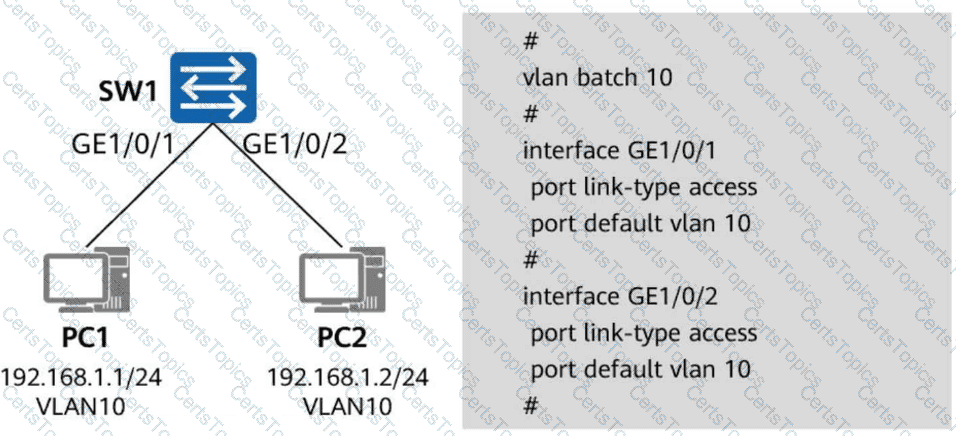
Options:

A.

After receiving the data frame sent from PC1 to PC2, SW1 adds the VLAN 10 tag to the data frame and then accepts the data frame.

B.

SW1 accepts the data frame sent from PC1 to PC2, but discards the data frame returned from PC2 to PC1.

C.

The data frame processed inside SW1 does not carry any VLAN tag.

D.

SW1 removes the VLAN 10 tag from the data frame before forwarding it from GE1/0/2 to PC2.

Question 14

With the continuous development of AI, data center application scenarios are gradually divided into general-purpose computing and intelligent computing scenarios. Data centers need to ensure service continuity of general-purpose computing clusters while unleashing the full potential of intelligent computing clusters, so as to guarantee stable and efficient operation in the AI era. Which of the following statements are true about the service requirements of data center networks in the two scenarios? (Select all that apply)

Options:

A.

The general-purpose computing network demands a well-defined hierarchy, adopting a core-aggregation-access three-layer architecture.

B.

The general-purpose computing network requires high network stability and efficiency. Technologies such as M-LAG can be used to implement fast failover, and VXLAN can be deployed to build a large Layer 2 network for VM migration.

C.

The intelligent computing network requires zero packet loss, which necessitates the deployment of various lossless network technologies such as PFC and ECN.

D.

The intelligent computing network requires ultra-low latency, including the latency of data transmission within a compute node. The latency can be further reduced by using the RoCE protocol.

Question 15

After the root bridge is elected on an STP network, which of the following parameters may be compared by ports on non-root bridge nodes to elect the root port? (Select all that apply)

Options:

A.

PID of a port on the local device

B.

Root path cost (RPC)

C.

BID of the device that sends BPDUs

D.

PID of a port on the device that sends BPDUs

Question 16

Four links between two switches establish an Eth-Trunk in manual mode, and the bandwidth of each link is 1 Gbit/s. One of the links fails. Which of the following statements are true about this scenario? (Select all that apply)

Options:

A.

The Eth-Trunk interfaces on the switches are still in the Up state.

B.

The available link bandwidth between the switches is 3 Gbit/s.

C.

The service traffic originally carried by the faulty link stops being forwarded by the switches until the faulty link recovers.

D.

All TCP sessions established over the Eth-Trunk are immediately interrupted and re-established.
