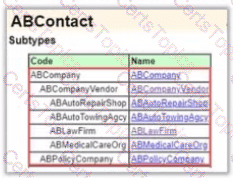
In the Guidewire Data Model, managing entity relationships through Subtyping is a core principle for maintaining a clean, performant, and logically structured database. According to the InsuranceSuite Developer Fundamentals course, subtyping should be used when a specific group of entities shares a common base but requires additional, unique attributes.
1. Leveraging the Existing Hierarchy
The prompt specifies that "other fields will come from the existing ABCompanyVendor entity." In the Guidewire ContactManager (AB) data model, the hierarchy typically flows from ABContact → ABCompany → ABCompanyVendor. By creating ABAutoRentalAgency_Ext as a subtype of ABCompanyVendor (Option A), the new entity automatically inherits all properties from the vendor level (such as Tax ID or Vendor Number) and the company level (such as Name or Address). This maximizes code and metadata reuse.
2. Why Subtyping is Better than Extension
If a developer were to follow Option D and add these three fields directly to ABCompanyVendor, every vendor in the system—including Law Firms, Doctors, and Repair Shops—would have fields for "Auto Rental License." This is known as "data model pollution." It makes the database tables wider than necessary and complicates the UI, as you would need complex "visible" expressions to hide these irrelevant fields for other vendor types.
By creating a specific subtype, Guidewire's Table-per-Subtype or Table-per-Hierarchy (depending on version and configuration) storage strategy ensures that these three specific fields are only relevant to Auto Rental Agency records. This keeps the data model logically distinct and allows for the use of Modal PCFs, where the UI automatically switches to display the correct fields based on the subtype of the contact being viewed.
Best Practice Summary: Use the _Ext suffix for the new subtype to follow Cloud Delivery Standards and place it as deep in the existing hierarchy as possible to inherit the most relevant specialized fields.