Pre-Summer Sale 70% Discount Offer - Ends in 0d 00h 00m 00s - Coupon code: save70

Fortinet Network Security Expert NSE6_SDW_AD-7.6 Syllabus Exam Questions Answers

Fortinet NSE 6 - SD-WAN 7.6 Enterprise Administrator Questions and Answers

Question 25

You want FortiGate to use SD-WAN rules to steer local-out traffic.

Which two constraints should you consider? (Choose two.)

Options:

A.

By default, FortiGate uses SD-WAN rules only for local-out traffic that corresponds to ping and traceroute.

B.

By default, local-out traffic does not use SD-WAN.

C.

You can steer local-out traffic only with SD-WAN rules that use the manual strategy.

D.

You must configure each local-out feature individually to use SD-WAN.

Question 26

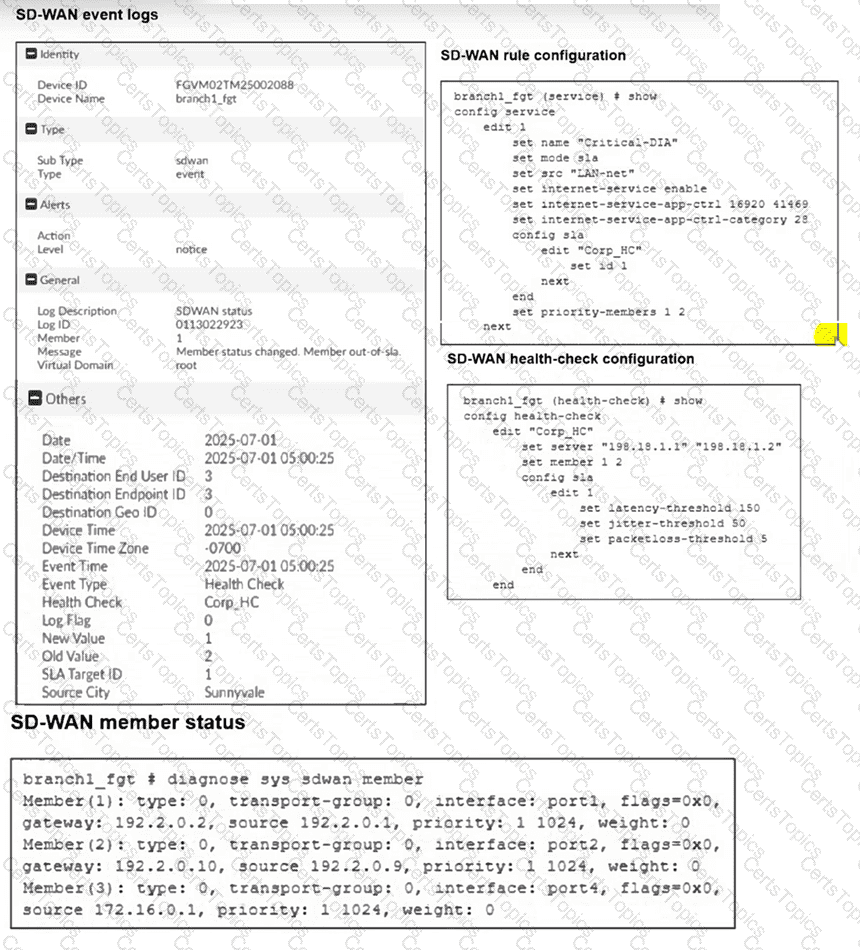
(Refer to the exhibits.

Two SD-WAN event logs, the member status, the SD-WAN rule configuration, and the health-check configuration for a FortiGate device are shown.

Immediately after the log messages are displayed, how will the FortiGate steer the traffic based on the information shown in the exhibits? Choose one answer.)

Options:

A.

FortiGate skips SD-WAN rule ID 1.

B.

FortiGate uses port2 to steer the traffic for SD-WAN rule ID 1.

C.

FortiGate uses port1 to steer the traffic for SD-WAN rule ID 1.

D.

FortiGate uses port1 or port2 to steer the traffic for SD-WAN rule ID 1.

Question 27

Refer to the exhibits, which show the configuration of an SD-WAN rule and the corresponding rule status and routing table.
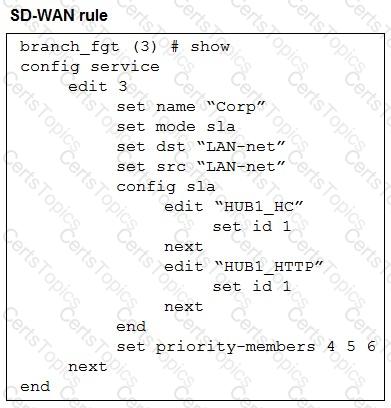
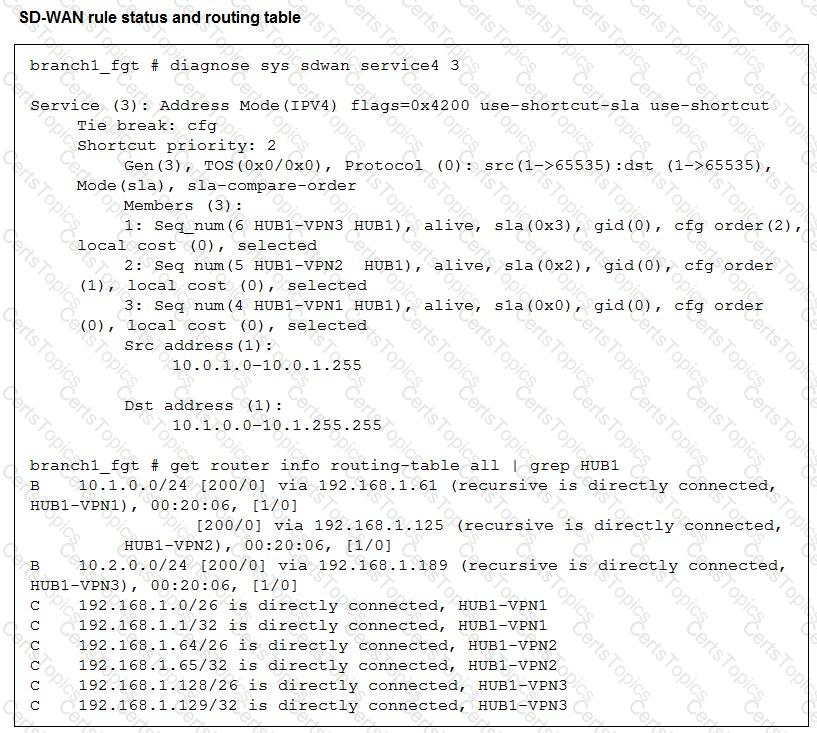
The administrator wants to understand the expected behavior for traffic matching the SD-WAN rule.

Based on the exhibits, what can the administrator expect for traffic matching the SD-WAN rule?

Options:

A.

The traffic will be routed over HUB1-VPN3.

B.

The traffic will be routed over HUB1-VPN2

C.

The traffic will be routed over HUB1-VPN1.

D.

The traffic will be load balanced across all three overlays

Question 28

(You plan a large SD-WAN deployment for a global company. You want to divide the network architecture into five geographical regions and install two hubs in each region for increased redundancy. You expect a significant amount of traffic within each region and limited traffic flow between spokes in different regions. You plan to connect the small branch sites to only the closest hub in their regions and the large branch sites to the two hubs in the regions.

Which statement about your plan is true? Choose one answer.)

Options:

A.

It is possible. You should use eBGP as the routing protocol between the regions.

B.

It is not possible. FortiOS 7.6 supports multihub topologies with up to four hubs.

C.

It is possible. You should use FortiManager and the overlay orchestrator multihub topology to simplify the deployment.

D.

It is not possible. In a region, all spokes must have either single-hub or dual-hub connectivity.