
What are two potential causes when a secondary public circuit has been added to the branch site, but the Prisma SD-WAN tunnel is not forming to the data center? (Choose two.)
Two branch sites, "Branch-A" and "Branch-B", are both behind active NAT devices (Source NAT) on their local internet circuits.
What requirement must be met for these two branches to successfully establish a direct Dynamic VPN (ION-to-ION) tunnel over the internet?
What is the basis for calculating the minimum bandwidth subscription required for branch IONs?
An engineer at a managed services provider is updating an application that allows its customers to request firewall changes to also manage SD-WAN. The application will be able to make any approved changes directly to devices via API.
What is a requirement for the application to create SD-WAN interfaces?
A network engineer is able to ping and traceroute from SD-WAN branch IP 192.168.1.123 to servers in primary data center – DC1, but is unable to ping or traceroute to a server 10.2.2.22 in the newly configured secondary data center, DC2.
The DC2 ION device is advertising the branch IP subnet 192.168.1.0/24 to the DC2 core via eBGP Core Peer. The DC2 data center site has site prefix 10.2.2.0/23 configured.
Which configuration will resolve the issue in this scenario?
An administrator is configuring a High Availability (HA) pair of ION 3000 devices at a Data Center.
Which statement accurately describes the requirement for the HA Control Interface connection between the two devices?
When configuring SASE connectivity with easy onboarding at a branch, which two options must be selected? (Choose two.)
When defining a Path Quality Profile (SLA) for a "Transactional" application group (e.g., Citrix, Oracle), the administrator sets the "Packet Loss" threshold to 1%.
What happens to the traffic for this application if all active paths currently exceed this 1% loss threshold?
A network engineer is troubleshooting a "Voice Quality" issue. They suspect that the DSCP markings are being stripped or altered by the ISP.
Which tool in the Prisma SD-WAN portal allows the engineer to capture live packets on the WAN interface and inspect the IP header ToS/DSCP field?
A network engineer is troubleshooting an ION device that is showing as "Offline" in the Prisma SD-WAN portal, despite the site reporting that local internet access is working. The engineer has console access to the device.
Which CLI command should be used to specifically validate the device's ability to resolve the controller's hostname and establish a secure connection to it over a specific interface?
In a data center (DC) with two ION devices, all of the remote branch Prisma SD-WAN VPNs are active only on DC ION-1.
Why are no VPNs active on DC ION-2?
There are periodic complaints about the poor performance of a real-time application.
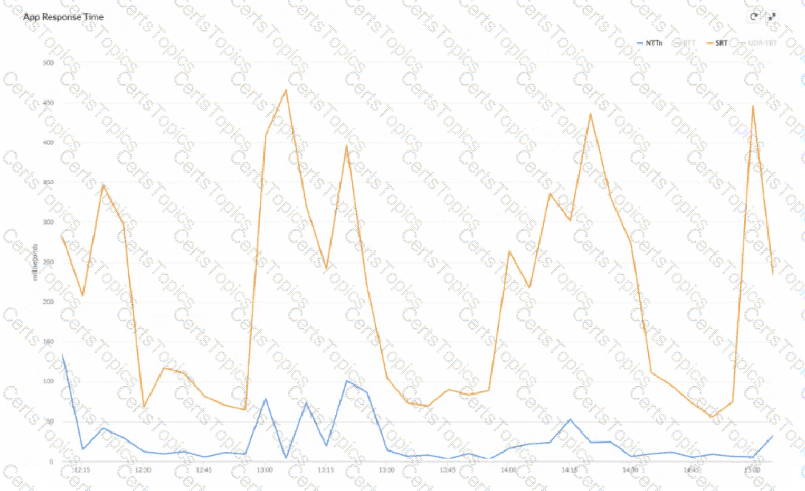
What can be inferred about the performance issue, based on the Network Transfer Time (NTT) and Server Response Time (SRT) image below?
What is the purpose of Secure Group Tag (SGT) propagation in Prisma SD-WAN?
A network administrator notices that a branch ION device is experiencing high CPU utilization due to a suspected TCP SYN Flood attack originating from a compromised host on the local LAN.
Which specific security feature should be configured and applied to the "LAN" zone to mitigate this Denial of Service (DoS) attack?
When configuring a Path Policy rule for a "Real-Time Video" application, the administrator wants to ensure the traffic uses the path with the lowest packet loss.
How does the Prisma SD-WAN ION determine the "Packet Loss" metric for a given path when there is no active user traffic flowing on that link?
An administrator needs to ensure that critical VoIP traffic is not dropped even when the branch's primary internet link is fully saturated with bulk file transfers.
Which QoS mechanism does Prisma SD-WAN automatically apply to the "Platinum" priority class to prevent starvation by lower-priority classes?
In a Prisma SD-WAN deployment, what is the defining characteristic of a "Standard VPN" compared to a "Secure Fabric Link"?
Which component of Prisma SD-WAN is responsible for distributing User-IP and user-group mappings to branch devices that match the corresponding source IPs?
Which configuration requirement must be met to allow two branch ION devices to automatically establish a direct Dynamic VPN (branch-to-branch) connection for traffic flow, bypassing the Data Center?
An ION 3000 device at a remote branch has suffered a critical hardware failure and must be replaced via the RMA process. The administrator has received the replacement unit.
What is the correct procedure to transfer the configuration and license from the defective unit to the replacement unit to ensure minimal downtime and retention of historical data?
What is the number and structure of Prisma SD-WAN QoS queues supported per WAN interface?
What does Prisma SD-WAN use for monitoring and operations to deliver flow data and application visibility?
An administrator needs to generate a monthly report showing the "Top Applications" by bandwidth usage across all branch sites to justify a bandwidth upgrade.
Which specific component of the Prisma SD-WAN interface is designed to create, schedule, and email these PDF summaries?
In the Prisma SD-WAN portal, an administrator is viewing the "Media" analytics for a branch site to troubleshoot complaints about poor voice quality.
When calculating the Mean Opinion Score (MOS) for voice traffic, which two metrics does the system prioritize active monitoring for, even when no user voice traffic is present on the link? (Choose two.)
When an ION device has been claimed, the cloud-based controller generates and communicates with the device by which method?
Copyright © 2021-2026 CertsTopics. All Rights Reserved
