Pre-Summer Sale 70% Discount Offer - Ends in 0d 00h 00m 00s - Coupon code: save70

Free and Premium Nutanix NCP-NS-7.5 Dumps Questions Answers

Page: 1 / 8
Total 106 questions

Nutanix Certified Professional - Network and Security (NCP-NS) 7.5 Questions and Answers

Question 1

While configuring a new security policy in a Nutanix microsegmentation environment, an administrator wants the policy to remain flexible even if virtual machines change subnets or obtain new IP addresses. Which configuration approach should the administrator use when defining the policy scope?

Options:

A.

Configure the policy only on specific VLAN IDs.

B.

Use VM categories to define the secured and allowed entities.

C.

Apply the policy after setting static routes for each VM.

D.

Assign IP addresses manually to all VMs included in the policy.

Buy Now
Question 2

An administrator needs to use Prism Central to identify a subnet belonging to a VPC. How can the administrator identify networks associated with a VPC within Prism Central?

Options:

A.

There will be a valid IP Prefix for the subnet.

B.

The subnet will reference multiple clusters.

C.

The subnet will have a non-zero VLAN ID.

D.

The subnet will be identified as type Overlay.

Question 3

An administrator has observed the following message: Which two statements most accurately describe the security hitlog captured above? (Choose two.)

Options:

A.

This is a security hit log on the rule name "Production-External-WebTier".

B.

The source ip address is 10.38.174.5 and source port is TCP/123.

C.

86.108.190.23 is sending a packet on UDP 123.

D.

10.38.174.57 is sending a packet destined to UDP 123.

Question 4

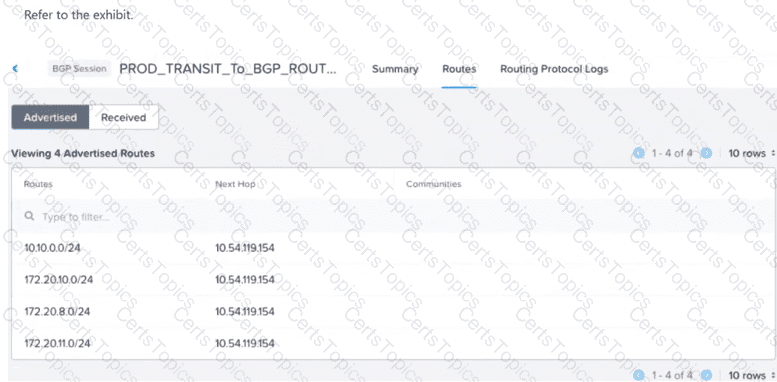
Exhibit:

A VM with IP address 172.20.9.5 resides on a subnet with CIDR 172.20.9.0/24. The VPC is successfully peered via BGP with an external router... External networks outside the VPC are unable to reach the VM. What configuration change should be made to enable reachability for the VM?

Options:

A.

Modify the ERP values within the VPC to advertise a CIDR of 172.20.8.0/22

B.

Apply a PBR rule for the VM's address forwarding traffic to the IP of the No-NAT external Gateway address

C.

Apply a default route to the VPC sending all traffic to the NAT External Network

D.

Associate a NAT external network to the VPC and apply a floating IP address to the VM

Question 5

When creating a VPC, enabling the Transit VPC toggle changes the role of the VPC. What does the Transit VPC toggle do?

Options:

A.

Forces NAT for all external subnets

B.

Creates a hub-and-spoke VPC for routing

C.

Converts all Overlay subnets into VLAN subnets

D.

Enables DHCP relay for routed subnets

Question 6

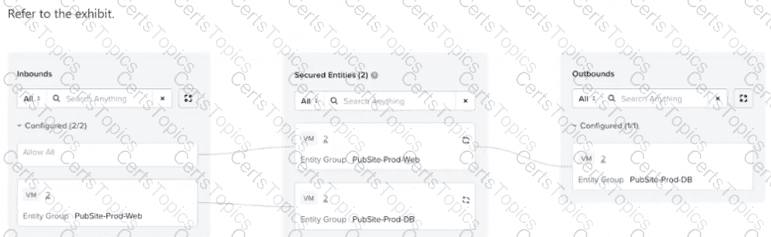
Refer to Exhibit:

An administrator is tasked with configuring an application policy for a two-tier public website with Web and DB components. The database servers need to communicate with each other for replication, but the web servers should not be able to communicate with each other. The administrator configures the policy... and sets it to Enforce mode. Later testing reveals that the web servers are able to communicate with each other. What should the administrator do to resolve this?

Options:

A.

Create an isolation policy for the PubSite-Prod-Web entity group.

B.

Edit the PubSite-Prod-Web entity group's intra-tier rule.

C.

Configure a VPC Network Policy to deny the traffic.

D.

Ensure the PubSite-Prod-Web servers are in different Subnets.

Question 7

An administrator notices that several VMs in a Nutanix AHV cluster are intermittently losing network connectivity. In Prism Central, a critical alert appears: "Network Function VM (NFVM) packet processing delays" What is the next step that the administrator should take for this issue?

Options:

A.

Review the Alerts and Events in Prism Central to confirm if the affected host shows NIC or uplink errors.

B.

Reboot the affected VMs to re-establish virtual NIC connections.

C.

Increase the MTU size on all virtual switches to improve packet throughput.

D.

Disable all Flow policies on the cluster to eliminate microsegmentation as the cause.

Question 8

An administrator is designing a new Transit VPC to service multiple Tenant VPCs. While adding subnets, the administrator must choose the correct network type supported by Flow Virtual Networking for this VPC. Which network type is supported for subnets inside a Transit VPC in Flow Virtual Networking?

Options:

A.

Overlay subnets

B.

VLAN Basic subnets

C.

VLAN subnets

D.

VXLAN subnets

Question 9

An administrator recently deployed a new set of virtual machines... 3-tier web application... restricted as follows: Only application VMs can talk to database VMs on port 3306 Frontend VMs should only communicate with application VMs on port 8080 Which action will correctly create and configure the Security Policies in Nutanix Flow to satisfy this task?

Options:

A.

Create VLANs for each tier and configure ACLs to restrict communication.

B.

Create IP-based rules for each VM category within a Security Policy.

C.

Configure a global "Allow All" Security Policy and rely on guest OS firewalls for tier-based restrictions.

D.

Create categories for each tier then define an Application Policy allowing specific ports between them.

Question 10

Flow Network Security Next-Gen is supported in which two environments? (Choose two.)

Options:

A.

On-Premises Overlay Networks

B.

NC2 VLAN Networks

C.

NC2 Overlay Networks

D.

On-Premises VLAN Basic Networks

Question 11

Which step is required before placing the Flow Network Security software bundle on a local web server?

Options:

A.

Perform an inventory on the Nutanix cluster before transferring any bundle files to the web server.

B.

Extract the downloaded bundle using 7zip and upload it directly to Prism Central.

C.

Enable Direct Upload in Life Cycle Manager so the bundles can be transferred automatically to the Nutanix cluster.

D.

Set up a local web server and download both the required software LCM bundle and compatibility bundle.

Question 12

An administrator is building a VPC... VPC CIDR: 10.10.0.0/16 Subnet CIDR: 10.10.10.0/24 "Ext_Net_Ext" (NAT): 192.168.1.0/24 "Ext_Net_Internal" (Routed): 172.16.1.0/24 The on-premises application server has an IP address of 172.16.2.50/24. A VM (10.10.10.100) in the VPC Subnet can reach the internet but cannot reach the on-premises server. Which static route needs to be added to the VPC route table to resolve this?

Options:

A.

Destination prefix: 172.16.2.0/24, Next-Hop: Ext_Net_Ext

B.

Destination Prefix: 10.10.0.0/16, Next-Hop: Ext_Net_Internal

C.

Destination prefix: 192.168.1.0/24 Next-Hop: Ext_Net_Ext

D.

Destination prefix: 172.16.2.0/24, Next-Hop: Ext_Net_Internal

Question 13

An administrator has created a VPC with the following subnets: 10.1.1.0/24 10.1.2.0/24 10.1.3.0/24 What action must be taken for these networks to be externally routable?

Options:

A.

Assign a No-NAT External Network & ERP 10.1.0.0/22

B.

Assign a No-NAT External Network & ERP 10.1.0.0/23

C.

Assign a NAT External Network & ERP 10.1.0.0/22

D.

Assign a NAT external network & ERP 10.1.0.0/23

Question 14

Users have recently reported intermittent connectivity issues and slower-than-usual application performance for a Nutanix cluster to an administrator. The administrator needs to identify the root cause of these issues by analyzing the health of the infrastructure components. What action should the administrator take first to diagnose the root cause of the problem?

Options:

A.

Review cluster health status, checking for any warnings or alerts relevant to the performance issues.

B.

Enable network QoS to prioritize the performance of critical applications.

C.

Rebalance virtual machines across the cluster to balance resource load and improve performance.

D.

Reboot the Nutanix cluster nodes to clear any potential performance-related cache or memory issues.

Question 15

An administrator receives a ticket reporting unwanted traffic between production and development servers. The administrator reviews the Flow Network Security logs and finds the following:

How can the administrator resolve the issue?

Options:

A.

Update the policy to disallow the unwanted traffic.

B.

Move the servers to separate IP subnets.

C.

Enable the Network Controller for the policy

D.

Change the enforcement mode for the policy

Question 16

An administrator manages a four-node cluster Each node has a 4 available 10GB uplinks, and all four are configured as an Active/Active bundle. They want to use Flow Virtual Networking to provide networking to the VMs in the cluster with the following requirements: VMs should be in a single VPC. VMs should be reachable by their real IP addresses. The VPC should have access to the most north/south bandwidth possible. No changes can be made to the physical infrastructure. How can this best be achieved?

Options:

A.

Create a VPC with a single No-NAT External Network with three gateway nodes.

B.

Create a VPC with four No-NAT External Networks, each with a single gateway node.

C.

Create a VPC with a single No-NAT External Network with four gateway nodes.

D.

Create a VPC with a single NAT External Network with three gateway nodes.

Question 17

An administrator wants to configure the subnet 10.1.1.0/24 to stretch across two VPCs over a Network Gateway in VXLAN mode. The VMs on this subnet need to communicate with a traffic pattern of size 2000 Bytes. What is the minimum MTU required in the underlay network to ensure communication happens without fragmentation or traffic drops?

Options:

A.

2058 Bytes

B.

2108 Bytes

C.

2116 Bytes

D.

9216 Bytes

Question 18

An administrator needs to isolate communication between VMs in Production and Development environments. Each VM is categorized by Environment and Site category values. The administrator wants this isolation to apply only to VMs located at Site: Branch-001. Which configuration best meets the requirement?

Options:

A.

Create a Quarantine Policy between Environment:Production and Environment:Development. Scope the policy to Site: Branch-001.

B.

Create a Quarantine Policy blocking traffic between (Environment: Production + Site: Branch-001) and (Environment: Development + Site: Branch-001).

C.

Create an Isolation Policy between Environment:Production and Environment:Development. Scope the policy to Site: Branch-001.

D.

Create an Isolation Policy blocking traffic between (Environment: Production + Site: Branch-001) and (Environment: Development + Site: Branch-001).

Question 19

An administrator is building a new VPC in Prism Central to isolate a test environment. The administrator plans to connect it to an external network later, but they want to complete the initial creation first. Which configuration items are the minimum required to successfully create the VPC?

Options:

A.

VPC name and one External Access VLAN

B.

VPC name and Transit VPC toggle switch

C.

VPC name and one Overlay Subnet

D.

VPC name and cluster selection

Question 20

What does placing a policy in Monitor mode accomplish?

Options:

A.

Visualizes discovered traffic that matches the policy.

B.

Blocks traffic that does not match the policy.

C.

Enables hitlogs for traffic that matches the policy.

D.

Redirects discovered traffic to a monitoring device.

Question 21

A customer wants to migrate VMs from a VLAN Basic Subnet to an Overlay Subnet with the same IP prefix. Which migration approach ensures minimal disruption?

Options:

A.

Perform cold migration, acknowledging that ingress/egress connections will not be preserved.

B.

Enable trunk mode on VLAN to allow multiple subnets on the same interface.

C.

Change IPAM mode to unmanaged to allow manual IP assignment.

D.

Create a Layer 2 connectivity between the subnets and perform live migration.

Question 22

An administrator sets up a VPN between two Nutanix VPCs in different Availability Zones. After deployment, the VPN tunnel shows as Up, but traffic between the VPCs is not flowing. Which configuration step is most likely missing?

Options:

A.

NAT policy on each of the VPC routers

B.

IPsec encryption settings on the VPN profile

C.

MTU adjustment on the AHV hosts

D.

Static routes for remote subnets on the VPC

Question 23

A customer wants to extend a VLAN subnet to a remote data center using VTEP. The administrator configures a Subnet Extension which shows UP in the Prism Interface, yet traffic fails to pass. Which setting is most likely misconfigured?

Options:

A.

Route Policy for VTEP has not been configured.

B.

VLAN ID does not match in the remote data center.

C.

Remote gateway IP address has not been configured.

D.

VXLAN UDP port is set to 4789.

Question 24

An organization plans to apply security controls based on user group membership in Active Directory. What configuration is required in Prism Central before VDI policies can be used?

Options:

A.

Map category assignments to roles using RBAC settings.

B.

Create the list of users and assign categories to them.

C.

Assign categories to identities in the Admin Center.

D.

Configure category values mapped to AD groups.

Question 25

During a security review, the administrator confirms that the existing security policy does not explicitly allow traffic from Environment: Development to Environment: Production. A VM in the Development category was still able to reach a Production VM over IPv6. What is the most likely cause of this behavior?

Options:

A.

An isolation policy was incorrectly applied instead of an application policy.

B.

The Allow All IPv6 option in the policy was selected.

C.

The policy was misconfigured and allowed all Layer 2 broadcast traffic.

D.

The VM was using a static IPv6 address.

Question 26

A new multi-tier application is being deployed across several subnets in a Nutanix environment. The security team wants to create a Flow Network Security Policy to restrict traffic between the tiers, but the complete matrix of required network ports and protocols is not fully documented. Which strategy should the team employ first to accurately capture the necessary communication patterns without risking application outage?

Options:

A.

Create an IPFIX export of all the application traffic and monitor all traffic for 48 hours.

B.

Apply a Security policy in Monitor mode to discover all traffic between the application tiers.

C.

Create broad Security Policy to permit all TCP traffic between the tiers to ensure connectivity.

D.

Apply a Security Policy in Enforce mode adding the required flows as they appear in the flow logs.

Question 27

The alert details mention a specific external network. Attempts to assign new Floating IPs to VMs fail, but existing Floating IPs continue to work. What is the cause of this alert?

Options:

A.

A firewall is blocking communication between Prism Central and the VPC's virtual router.

B.

The VPC's connection to the external network is down.

C.

A firewall is blocking communication between Prism Central and the VPC's virtual router.

D.

There are no more available IP addresses in the address pool configured for Floating IPs in that external network.

Question 28

An administrator has a VPC with multiple overlay subnets and a VPN gateway configured for site-to-site connectivity. During testing, the administrator noticed fragmented packets and poor performance. Which configuration change resolves this issue without disabling VPN?

Options:

A.

Increase MTU to 1500 on guest VMs

B.

Enable jumbo frames on VLAN subnets

C.

Reduce MTU to 1356 on guest VMs

D.

Disable Geneve encapsulation

Question 29

When configuring an Application policy, an administrator defines a VM Category Application:MySQL as a Secured Entity. The administrator wants to ensure that traffic between VMs in the Secured Entity is kept to only required replication traffic on the default mysql service port. How should the administrator best accomplish this?

Options:

A.

Create an Inter-Tier Rule specifying the mysql service as the allowed traffic.

B.

Create an Intra-Tier Rule specifying the mysql service as the allowed traffic.

C.

Create an Inbound Rule specifying the mysql service as the allowed traffic.

D.

Create an Outbound Rule specifying the mysql service as the allowed traffic.

Question 30

Which action allows an administrator to reuse a single existing policy in a different scope?

Options:

A.

Place policy in Enforce mode

B.

Clone

C.

Place policy in Monitor mode

D.

Export

Question 31

An administrator is designing a VPC for a three-tier application. The workloads must communicate with the Internet using source NAT and also communicate with on-premises networks 10.50.0.0/16 and 172.20.32.0/20 with no address translation. In the Create VPC dialog, the administrator can associate external subnets and specify destination prefixes. Which configuration satisfies the requirements?

Options:

A.

Associate a NONAT external network only; set Destination Prefixes to 0.0.0.0/0.

B.

Associate a NONAT external network for 0.0.0.0/0 and a NAT external network for 10.50.0.0/16, 172.20.32.0/20.

C.

Associate a NAT external network for 0.0.0.0/0 and a NONAT external network for 10.50.0.0/16, 172.20.32.0/20.

D.

Associate a NAT external network only; set Destination Prefixes to 0.0.0.0/0, 10.50.0.0/16, 172.20.32.0/20.

Page: 1 / 8
Total 106 questions