
Power Up Your Study Prep: Black Friday 75% Discount! Use coupon code below to save! - Ends in 0d 00h 00m 00s - Coupon code: big75certs

Free and Premium IBM C1000-171 Dumps Questions Answers

Page: 1 / 5
Total 61 questions

IBM App Connect Enterprise V12.0 Developer Questions and Answers

Question 1

Which statement characterizes unit testing in App Connect Designer?

Options:

A.

It focuses on testing individual components or modules of the application.

B.

It involves a limited number of tests against application functionality.

C.

It is only applicable for mobile applications.

D.

It is performed by end users to validate the user interface.

Buy Now
Question 2

Which two external security providers does App Connect Enterprise support?

Choose two

Options:

A.

RADIUS

B.

OAuth

C.

Lightweight Directory Access Protocol (LDAP)

D.

ADT

E.

Tivoli Federated Identity Manager (TFIM) V6.1

Question 3

Which two resources can be imported into a workspace?

Choose two

Options:

A.

.cmf

B.

.war

C.

.esql

D.

.msgflow

E.

.twx

Question 4

Which two fields in the Properties folder are used by a model-driven parser?

Choose two

Options:

A.

MessageSet

B.

Format

C.

Data

D.

SetType

E.

MessageType

Question 5

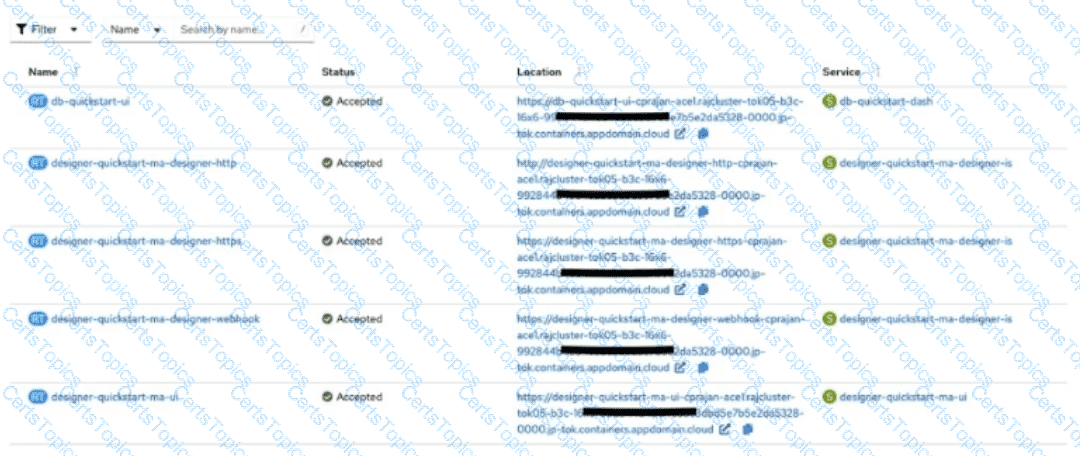
A developer has successfully deployed an App Connect Enterprise instance in OpenShift and now needs to access the Designer page to create flows. They inspect the OpenShift routes and see the following:

Which route should they choose?
Options:

A.

designer-quickstart-ma-designer-https

B.

designer-quickstart-ma-ui

C.

db-quickstart-ui

D.

designer-quickstart-ma-designer-webhook

Question 6

When message flows are divided between App Connect Enterprise and App Connect Enterprise as a Service, where is the Switch Server managed?

Options:

A.

App Connect Enterprise on-premises

B.

App Connect Enterprise as a Service

C.

App Connect Operator

D.

Cloud Pak for Integration Platform UI

Question 7

Which two message flow nodes can be used to interact with the global cache?

Choose two

Options:

A.

JavaCompute

B.

RegistryLookup

C.

HTTPRequest

D.

Mapping

E.

Route

Question 8

Which ESQL statement is used to invoke administrative operations on databases?

Options:

A.

PASSTHRU

B.

UPDATE

C.

CREATE

D.

DEFINE

Question 9

What is needed to distribute processing across independent integration servers and ensure that flows communicate securely?

Options:

A.

Configurable Parameters

B.

Switch server

C.

Policy Files

D.

Certificates

Question 10

How do you create a security profile?

Options:

A.

Using the App Connect Designer

B.

Using the App Connect Operator

C.

Using the OpenAPI 3.0 specification

D.

Using the App Connect Policy editor

Question 11

Which two transport types can be used for Web Service messaging through App Connect Enterprise SOAP nodes?

Choose two

Options:

A.

JMS

B.

FASP

C.

UDP

D.

HTTP

E.

FTP

Question 12

When a user invokes a toolkit flow from an App Connect Designer flow, in what sequence are the nodes processed?

Options:

A.

CallableFlowInvoke, CallableReply, CallableInput

B.

CallableFlowInvoke, CallableInput, CallableReply

C.

CallableInput, CallableFlowInvoke, CallableReply

D.

CallableReply, CallableInput, CallableFlowInvoke

Question 13

What is a certified container for App Connect Enterprise?

Options:

A.

An IBM App Connect Enterprise software product that requires IBM Cloud Pak for Integration.

B.

An IBM App Connect Enterprise software product that can only be deployed in the Red Hat OpenShift Container Platform.

C.

An image of App Connect Enterprise that is offered as a package that can be deployed and run within containerized environments.

D.

An IBM product that has been certified by the Kubernetes community.

Question 14

What is the function of the App Connect Enterprise Policy editor?

Options:

A.

Allows adding, renaming, and deleting input and output terminals.

B.

Allows the names in the Property column to be edited.

C.

Shows all the resources in a workspace.

D.

Displays the properties that can be configured in a tabular view.

Question 15

Which two object types can be created and implemented as user-defined extensions?

Choose two

Options:

A.

User-defined exits

B.

node.conf.yaml

C.

ACE Configuration CR

D.

User-defined parsers

E.

User-defined MQ exits

Question 16

A developer needs ESQL data to be cached in memory so that it survives for the life of the message flow and is shared by all of the threads that run the flow. Which keyword on the DECLARE statement creates this type of variable?

Options:

A.

EXTERNAL

B.

SHARED

C.

CONSTANT

D.

NAMESPACE

Question 17

What action is recommended after an image has been pulled from the IBM image repository?

Options:

A.

Re-tag the image and push it to the IBM Cloud Container Registry.

B.

Encrypt the image and push it to the preferred registry.

C.

Scan the image, add an MQ client library, and then push it to the preferred registry.

D.

Re-tag the image appropriately and then push it to the preferred registry.

Question 18

Which message-flow node splits processing asynchronously across callable message flows?

Options:

A.

CallableFlowInvoke

B.

CallableFlowAsyncInvoke

C.

AsyncInvoke

D.

It is not possible

Page: 1 / 5
Total 61 questions
