
Month End Special - 75% Discount Offer - Ends in 0d 00h 00m 00s - Coupon code: big75certs

Free and Premium Huawei H13-811_V3.5 Dumps Questions Answers

HCIA-Cloud Service V3.5 Questions and Answers

Question 1

Which of the following are included in the HUAWEI CLOUD security service system?

Options:

A.

Application security

B.

Network security

C.

Computing security and security management

D.

Data security

Buy Now
Question 2

The underlying physical resources of an Elastic Cloud Server (ECS) can be shared between users, but those of a Bare Metal Server (BMS) are exclusive to a single user.

Options:

A.

TRUE

B.

FALSE

Question 3

An ECS group logically groups ECSs. ECSs in the same ECS group are created on the same physical server by default.

Options:

A.

TRUE

B.

FALSE

Question 4

Hybrid cloud is a flexible cloud computing model. It may contain two cloud architectures: public cloud and private cloud, or even more. The infrastructure of a hybrid cloud is owned and operated by a single organization. Therefore, user services can switch between these clouds as required.

Options:

A.

TRUE

B.

FALSE

Question 5

HUAWEI CLOUD Virtual Private Network (VPN) does not support communications between two Virtual Private Clouds (VPCs) in different regions.

Options:

A.

TRUE

B.

FALSE

Question 6

Which of the following statements about IAM projects and enterprise projects are incorrect?

Options:

A.

An enterprise project can contain resources from multiple regions.

B.

Enterprise projects group and physically isolate resources in the same region.

C.

IAM projects group and logically isolate resources.

D.

Resources can be added to or removed from enterprise projects.

Question 7

An enterprise plans to use Huawei Cloud Elastic Cloud Server (ECS) to run large-memory datasets and services with high network requirements. There are large data volumes and many data access requests, and the data needs to be rapidly transferred and processed. In this scenario, which of the following ECS types is suitable?

Options:

A.

Ultra-high I/O

B.

High-performance computing

C.

Large-memory

D.

Memory-optimized

Question 8

Which of the following statements about subnet planning is incorrect?

Options:

A.

Once a subnet has been created, its CIDR block cannot be modified.

B.

Subnets in a VPC can overlap with each other.

C.

A subnet is a range of IP addresses in your Virtual Private Cloud (VPC). All of the resources in a VPC must be deployed in subnets.

D.

A subnet CIDR block must be in the range of the VPC.

Question 9

Which of the following statements about security group configurations are correct?

Options:

A.

When creating an Elastic Cloud Server (ECS), users must select a security group.

B.

When selecting a security group, users can select the default security group or create one manually.

C.

Security groups protect ECSs and only support allow rules.

D.

The inbound and outbound rules of the default security group cannot be modified, but those of custom security groups can.

Question 10

Which of the following statements is incorrect about the relationship between Bare Metal Server (BMS) and other cloud services?

Options:

A.

With Auto Scaling (AS), users can flexibly scale in and out BMSs by customizing AS configurations and policies, reducing resource consumption and saving money on O & M.

B.

With Cloud Eye, users can monitor BMSs. After Agent is installed on a BMS, the Agent will report monitoring data to Cloud Eye.

C.

With Elastic Volume Service (EVS), users can attach EVS disks to a BMS and expand their capacity at any time.

D.

With Image Management Service (IMS), users can use images to batch create identical BMSs, improving service deployment efficiency.

Question 11

Which of the following are major functions of Cloud Trace Service (CTS)?

Options:

A.

Trace transfer

B.

Trace query

C.

OS monitoring

D.

Trace recording

Question 12

Which of the following problems can be resolved by HUAWEI CLOUD Content Delivery Network (CDN)?

Options:

A.

Low server utilization

B.

Slow download speed

C.

Slow site access

D.

Large pressure on the backbone network

Question 13

In the Object Storage Service (OBS), you can use versioning to retain multiple versions of an object in the same bucket. Which of the following statements about OBS versioning is false?

Options:

A.

After versioning is enabled, it cannot be disabled directly. You need to manually delete historical versions before you can disable or suspend versioning.

B.

Objects with the same name are stored in the OBS as objects with different version IDs.

C.

You can use the OBS Console, APIs, and SDKs to configure versioning for a bucket.

D.

Versioning is disabled by default. You need to enable it manually.

Question 14

Which of the following are functions of Cloud Trace Service (CTS)?

Options:

A.

Trace file encryption

B.

Trace recording

C.

Trace transfer

D.

Trace query

Question 15

Cloud computing is a product of the Internet and computing technology development. Therefore, cloud computing is indispensable to networks.

Options:

A.

TRUE

B.

FALSE

Question 16

The three cloud computing service models are continuously being improved. Match the acronyms of the three models with their respective functions:
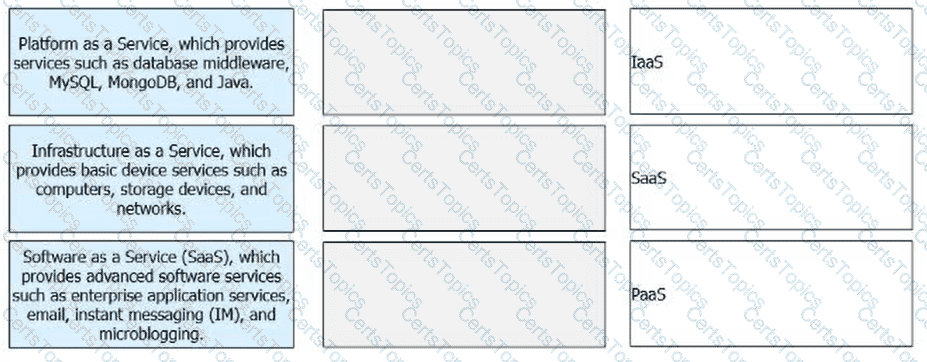
Options:

Question 17

Which of the following statements is incorrect about Image Management Service (IMS)?

Options:

A.

Users need to pay for OS licenses and storage used for private images.

B.

Images are classified as public, private, and shared.

C.

IMS is not a free cloud service.

D.

An image contains an OS, pre-installed public applications, and users' personal applications. Images can be used to create Elastic Cloud Servers (ECSs).

Question 18

Which of the following statements about Object Storage Service (OBS) versioning is incorrect?

Options:

A.

When versioning is enabled for a bucket, multiple versions of the same object can be stored in a bucket.

B.

Users can enable or disable versioning as needed.

C.

Deleting one version of an object does not affect any other versions of the object.

D.

By default, versioning is not enabled for newly created OBS buckets. In such case, new objects will overwrite the existing objects with the same name.
