ACME retail has 38 locations spread out across Ave US states and two provinces in Canada. They are looking to grow 20% over the next two years. They have an HO with a staff of 200 employees. The organization has eight Regional Managers and two VPs who work from home and the road. Stores typically have 17 employees on average per location.
The two warehouses have a remote loading system and 20 employees each to load the trucks and fulfill the online orders. The warehouse has 40-foot ceilings and large metal racks to store inventory. The main location is 240K sq ft (22300 st) m) and the Canadian warehouse Is 130K sq ft (12100 sq ml. The forkllfts on the loading docks are equipped with a wireless tablet on board.
A typical store Is reportedly about 60.000 sq ft (5575 sqm) and smaller stores are planned at 25.000 sq ft '2320 sq mi. The locations need to expand the abilities to vendors that need to add setup displays or Interactive kiosks in the stores. The current Infrastructure was installed In 2015 and used wireless N technology in a coverage model. The wiring is CatS. and they are unsure of the fiber connections. The inventory is all placed on the floor when it is delivered to the local store.
Inventory control is handled through Zebra barcode scanners, and they have had a lot of issues in getting signals throughout the stores and this makes monthly inventory difficult. The organization has a small help desk to troubleshoot issues that happen at the retail locations and PC support for the office. The company is looking to upgrade away from the current pbx system later this year. With the need to grow and cut costs, they are interested in moving the data to the cloud but need to get almost real-time inventory control for the online service to function.
The network has all been wired over the last ten years, but with the new systems being all wireless, they have seen the trend to offer wireless to all the vendors for their needs but also would like to allow employees, guests, and contractors all to use it. With the new IT director starting next week, the project has been set by the CTO of the company. The marketing group has asked how they can interact with the customers and get more info, while the IT support desk needs to cut staff in halt.
The. office has an MDF and two IDFs located on floors one and two. The HOF is in the basement, and you have multiple WAN circuits for the HO links. Each store has a local handoff from the cable company (ethernet) In the middle of the store in the office, so distance for the wiring is not an issue.
The customer has budget concerns but does want something that could last 7+ years.
Which two projects does the customer have in the planning state? (Select two)
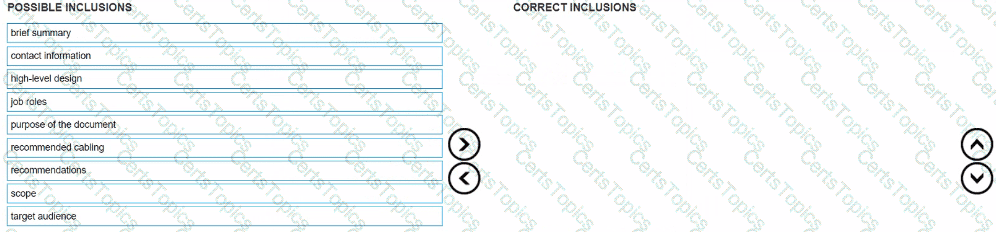
What should be Included in an Executive Summary? (Place the correct Items into the let at the right Order is no: Important Not all cottons win be used)
During the Stakeholder interview, an agenda is built where customer expectations are clarified. The customer is worried about future business requirements where network scalability and flexibility are key.
Which expectations can be considered for solving upcoming business problems? (Select two).
A global cruise line company needs to refresh its current fleet. They win refresh the insides' of the ship to be cost-effective and increase their sustain ability. They Mill replace the complete WLAN/LAN hardware of the ship. In this refresh, the company will not refresh Us current security requirements. The CIO also wants to limit the number of unused ports in the switches. Future expansion will always mean a refresh of hardware. They start with the smallest ship with a maximum of 800 guests
Each ship has a LAN infrastructure consisting of two core switches, up to 10 redundant distribution switches, and up to 500 access switches (400 cabins. 100 technical rooms). The Core switches are located in the MDF of the ship and the distribution switches are located in the IDFs of the ship. Each cabin and technical room gets one single access switch.
The cabling structure of the ship will not be refreshed. Each IDF is connected to the MDF by SMF. of which two pairs are available for the interconnect between the core and distribution. The length of SM fiber between MDF and IDF is less than 300 meters (930 ft) and the type used is 0S1. Each cabin is connected by a single 0M2 pair to the IDF. the maximum length is 60 meters (200 ft). Each technical room is connected by a single 0M2 pail to the IDF. with lengths between 100 and 150 meters (320 and 500 ft).
For each cabin/technical room the customer is looking to replace their current fan-less 2530/2540 without changing the requirements, except they need to upgrade the uplink to distribution switch to 10GbEto handle the increased network traffic, and the technical rooms need redundant power.
The WLAN infrastructure will be 1:1 refreshed without new cabling or new AP locations. Their WLAN Infrastructure is based on the 200/300 series Indoor and outdoor APs running instantOS (less than 300 APs). the customer has no change in WLAN requirements.
The cruise line company will replace its current Internet connection before the LAN/WLAN refresh. The new Internet connection will provide a 99.8% uptime, which is needed to ensure the paid guest Wi-Fi is always operational. With this new internet connection, the CIO of the cruise line wants to base the design on the ESP architecture from Aruba because Internet connection is guaranteed.
The week after the presentation of your design to the CIO of the cruise line company, the CIO calls you to discuss increasing trie security of the wired network Infrastructure. Since one of their competitors had one of their cruise ships cyber hacked, the CSO of the cruise line has mandated increased security on the wired network. They nave heard about dynamic segmentation and central and decentral overlay networks.
What would you advise as the most cost-efficient solution?
'Don't Buy at Us' is a US-based retail company that is expanding Into Europe. They are expanding into EMEA with a regional headquarters called HQ2 inside The Netherlands.
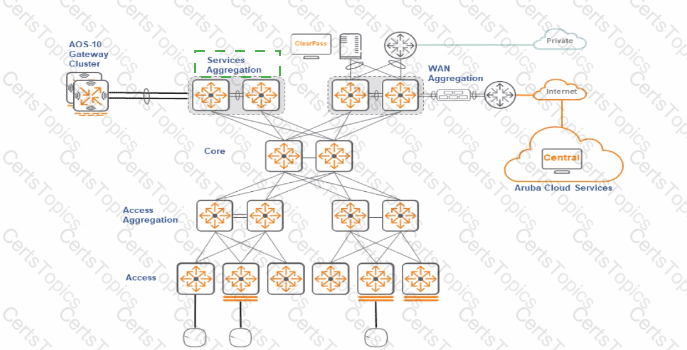
Their US-based headquarters HQ1 was refreshed last year based on the Aruba ESP architecture. You have treated the design for HQ? based on the same design as HQ1. a two-tier architecture. The high level is shown below.
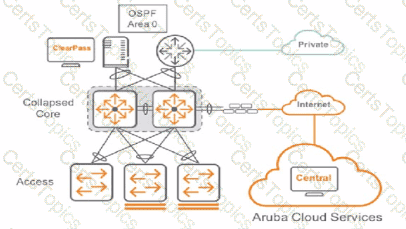
Switch BOM for this project based on Two Tier:
Collapsed Core: 2 x Aruba 8360-16Y2C in VSX (ISL 2» ICOG0E DAC)
Access Slack: 10 x Slack of Aruba 6200F 48G Class4 PoE 4SFP- 740W each stack has A members. VSF
with 10GbE VSF links) 12 x 10GbE uplink pet stack)
During the presentation of your design to the CTO of 'Don't Buy at Us' you were informed about the updated fiber infrastructure that Don't Buy at Us' has installed in HQ2.
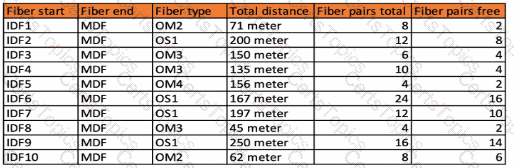
The core stack is Installed in the MDF and per IOF there is one access stack installed. Based on best practice, what is the most cost-effective update to the switch BOM?
Match the deployment type to the estimated number of APs.

The current IT staff is used to working with legacy Aruba OS-S (ProCurve> equipment. They are worried that they cannot handle Aruba OS-CX switches due to the different command syntax. What are two ways to make the transition easier for them? (Select two.)
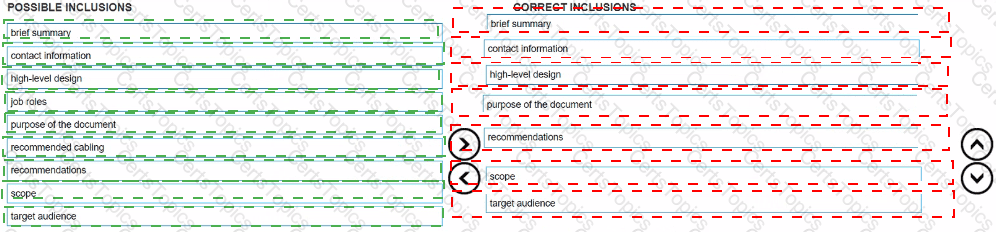
What documents should be included in the solution proposal? (Place the correct items into the list at the right. Order is not important. Not all options will be used)

Match the deployment type with the usage scenario.

ACME retail has 38 locations spread out across Ave US states and two provinces in Canada. They are looking to grow 20% over the next two years. They have an HO with a staff of 200 employees. The organization has eight Regional Managers and two VPs who work from home and the road. Stores typically have 17 employees on average per location.
The two warehouses have a remote loading system and 20 employees each to load the trucks and fulfill the online orders. The warehouse has 40-foot ceilings and large metal racks to store inventory. The main location is 240K sq ft (22300 st) m) and the Canadian warehouse Is 130K sq ft (12100 sq ml. The forkllfts on the loading docks are equipped with a wireless tablet on board.
A typical store Is reportedly about 60.000 sq ft (5575 sqm) and smaller stores are planned at 25.000 sq ft '2320 sq mi. The locations need to expand the abilities to vendors that need to add setup displays or Interactive kiosks in the stores. The current Infrastructure was installed In 2015 and used wireless N technology in a coverage model. The wiring is CatS. and they are unsure of the fiber connections. The inventory is all placed on the floor when it is delivered to the local store.
Inventory control is handled through Zebra barcode scanners, and they have had a lot of issues in getting signals throughout the stores and this makes monthly inventory difficult. The organization has a small help desk to troubleshoot issues that happen at the retail locations and PC support for the office. The company is looking to upgrade away from the current pbx system later this year. With the need to grow and cut costs, they are interested in moving the data to the cloud but need to get almost real-time inventory control for the online service to function.
The network has all been wired over the last ten years, but with the new systems being all wireless, they have seen the trend to offer wireless to all the vendors for their needs but also would like to allow employees, guests, and contractors all to use it. With the new IT director starting next week, the project has been set by the CTO of the company. The marketing group has asked how they can interact with the customers and get more info, while the IT support desk needs to cut staff in halt.
The. office has an MDF and two IDFs located on floors one and two. The HOF is in the basement, and you have multiple WAN circuits for the HO links. Each store has a local handoff from the cable company (ethernet) In the middle of the store in the office, so distance for the wiring is not an issue.
The customer has budget concerns but does want something that could last 7+ years.
What should the architect be concerned about regarding the solution? (Select two.)
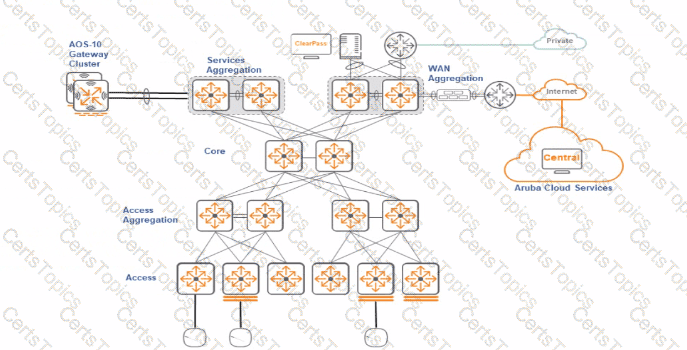
Based on this campus design, click on the layer that is the most appropriate to be designed as a Stub Persona, considering an EVPN VXLAN Fabric?
XYZ Regional Hospital is an integrated healthcare system of hospitals, neighborhood health centers, and small doctor offices. XYZ Regional Hospital has recently merged with 4x neighborhood health centers and 125 doctor branch offices. The wireless, wired access, and AAA
solutions are outdated and need to be replaced
XYZ Regional Hospital is looking to future-proof and improve efficiency across all sites by enhancing wired and wireless access and migrating to a centralized and unified wired/wireless and policy management that can provide uninterrupted availability of all systems.
Locations:
- XYZ Regional Hospital is located in New York City
- Dila Health Center is located in City A
- Mount Health Center is located in City B
- Rock Health Center is located in City C
- Branch clinics are located at different locations across the United States
Requirements:
- Provide, via management software, one single pane of glass to manage wired and wireless IANs. and VPNs across campus, branch, and remote via web/cloud architecture providing near real-time Insight. troubleshooting tools, and Service Level performance reporting.
- Seamless integration across wired, wireless. WAN. SD-Branch. loT
- Provide secure wireless access to all the employees of the Regional Hospital and partners, as well as provide wireless Internet access to medical citizens when they visit our facilities.
- All-access points must support the following features and specifications: 802.11ax (Wi-Fi 6E Certified)
- Security options including WP2/WPA3. 802.1X with Radius secure authentication
- Identify and authenticate every wireless and wired device
- End-to-end role-based security
- Seamless mobility across the hospital for medical learns, patients, and visitors
- Cuts Wi-Fi deployment times from days to hours and enables Zero-Touch deployments across the site
- Establishes a resilient, future-ready network infrastructure with the intelligence, scalability, and intuitive toolsets to meet emerging needs
- Fully redundant branch solution with dynamic path selection to the hospital
The hospital CIO is interested in reviewing the phase 1 approach and framework that will be used to achieve the goals of the network refresh project.
What is the phase 1 task?
You are designing a solution with Aruba OS10-based access points and redundant gateways and these are the requirements:
• W1-F16E based access points
• support for tunneled traffic
• application visibility
• rogue APs
• live upgrades
• Air Slice
• Cloud Guest Authentication
• Ai insights
Which licenses are needed? (Select two.)
A global cruise line company needs to refresh its current fleet. They win refresh the insides' of the ship to be cost-effective and increase their sustain ability. They Mill replace the complete WLAN/LAN hardware of the ship. In this refresh, the company will not refresh Us current security requirements. The CIO also wants to limit the number of unused ports in the switches. Future expansion will always mean a refresh of hardware. They start with the smallest ship with a maximum of 800 guests
Each ship has a LAN infrastructure consisting of two core switches, up to 10 redundant distribution switches, and up to 500 access switches (400 cabins. 100 technical rooms). The Core switches are located in the MDF of the ship and the distribution switches are located in the IDFs of the ship. Each cabin and technical room gets one single access switch.
The cabling structure of the ship will not be refreshed. Each IDF is connected to the MDF by SMF. of which two pairs are available for the interconnect between the core and distribution. The length of SM fiber between MDF and IDF is less than 300 meters (930 ft) and the type used is 0S1. Each cabin is connected by a single 0M2 pair to the IDF. the maximum length is 60 meters (200 ft). Each technical room is connected by a single 0M2 pail to the IDF. with lengths between 100 and 150 meters (320 and 500 ft).
For each cabin/technical room the customer is looking to replace their current fan-less 2530/2540 without changing the requirements, except they need to upgrade the uplink to distribution switch to 10GbEto handle the increased network traffic, and the technical rooms need redundant power.
The WLAN infrastructure will be 1:1 refreshed without new cabling or new AP locations. Their WLAN Infrastructure is based on the 200/300 series Indoor and outdoor APs running instantOS (less than 300 APs). the customer has no change in WLAN requirements.
The cruise line company will replace its current Internet connection before the LAN/WLAN refresh. The new Internet connection will provide a 99.8% uptime, which is needed to ensure the paid guest Wi-Fi is always operational. With this new internet connection, the CIO of the cruise line wants to base the design on the ESP architecture from Aruba because Internet connection is guaranteed.
Based on best practices, what should you recommend as the correct optic type for the connection between the IDF and the technical rooms?
A global cruise line company needs to refresh its current fleet. They will refresh the 'insides' of the ship to be cost-effective and increase their sustainability. They will replace the complete WLAN/LAN hardware of the ship. In this refresh, the company will not refresh its current security requirements. The CIO also wants to limit the number of unused ports in the switches. Future expansion will always mean a refresh of hardware. They start with the smallest ship with a maximum of 800 guests.
Each ship has a LAN infrastructure consisting of two core switches, up to 10 redundant distribution switches, and up to 500 access switches (400 cabins, 100 technical rooms). The core switches are located in the MDF of the ship and the distribution switches are located in the IDFs of the ship. Each cabin and technical room gets one single access switch.
The cabling structure of the ship will not be refreshed. Each IDF is connected to the MDF by SMF, of which two pairs are available for the interconnect between the core and distribution. The length of SM fiber between MDF and IDF is less than 300 meters (980 ft) and the type used is OS1. Each cabin is connected by a single OM2 pair to the IDF, the maximum length is 60 meters (200 ft). Each technical room is connected by a single OM2 pair to the IDF, with lengths between 100 and 150 meters (320 and 500 ft).
For each cabin/technical room the customer is looking to replace their current fan-less 2530/2540 without changing the requirements, except they need to upgrade the uplink to distribution switch to 10 GbE to handle the increased network traffic, and the technical rooms need redundant power.
The WLAN infrastructure will be 1:1 refreshed without new cabling or new AP locations. Their WLAN infrastructure is based on the 200/300 series indoor and outdoor APs running InstantOS (less than 300 APs), the customer has no change in WLAN requirements.
The cruise line company will replace its current Internet connection before the LAN/WLAN refresh. The new Internet connection will provide a 99.8% uptime, which is needed to ensure the paid guest Wi-Fi is always operational. With this new Internet connection, the CIO of the cruise line wants to base the design on the ESP architecture from Aruba because the Internet connection is guaranteed.
Based on best practices, what should you recommend as the correct optic type for the connection between the IDF and the cabins?
ACME Retail has 38 locations spread out across five US states and two provinces in Canada. They are looking to grow 20% over the next two years. They have a head office (HO) with a staff of 200 employees. The organization has eight regional managers and two VPs who work from home and on the road. Stores typically have 17 employees on average per location.
The two warehouses have a remote loading system and 20 employees each to load the trucks and fulfill the online orders. The warehouse has 40-foot ceilings and large metal racks to store inventory. The main warehouse is 240,000 sq ft (≈22,300 sqm), and the Canadian warehouse is 130,000 sq ft (≈12,100 sqm). Forklifts on the loading docks are equipped with wireless tablets onboard.
A typical store is about 60,000 sq ft (≈5,575 sqm), and smaller stores are planned at 25,000 sq ft (≈2,320 sqm). The locations need to expand wireless access to vendors who set up displays or interactive kiosks.
The current infrastructure was installed in 2015 using wireless N technology in a coverage model. Wiring is Cat5, and fiber connections are uncertain. Inventory is placed directly on the floor when delivered.
Inventory control is handled through Zebra barcode scanners, but poor coverage and signal issues have made monthly inventory counts difficult.
The organization has a small help desk for store support and PC support for the office. The company plans to move away from the current PBX system later this year. They want to cut costs, move services to the cloud, and achieve real-time inventory control for online order fulfillment.
The network has been wired over the last 10 years, but new systems are trending wireless. They want to provide wireless access for employees, guests, vendors, and contractors. The new IT director will start next week, and the CTO has prioritized this project.
Additional context:
Marketing wants to interact with customers and collect more data.
The IT support desk needs to reduce staff by half.
The HO has an MDF and two IDFs (floors 1 and 2).
WAN circuits exist for HO.
Each store has a local Ethernet handoff from the cable provider in the office.
Budget is a concern, but the solution must last 7+ years.
Based on best practices and customer requirements, what is the correct WLAN approach?
A customer wants to have the ability to show network usage. Which product would allow them to have this visibility?
What is one use case for designing a 2-tier campus LAM instead of using a 3-tier?
A global cruise line company needs to refresh its current fleet. They win refresh the insides' of the ship to be cost-effective and increase their sustain ability. They Mill replace the complete WLAN/LAN hardware of the ship. In this refresh, the company will not refresh Us current security requirements. The CIO also wants to limit the number of unused ports in the switches. Future expansion will always mean a refresh of hardware. They start with the smallest ship with a maximum of 800 guests
Each ship has a LAN infrastructure consisting of two core switches, up to 10 redundant distribution switches, and up to 500 access switches (400 cabins. 100 technical rooms). The Core switches are located in the MDF of the ship and the distribution switches are located in the IDFs of the ship. Each cabin and technical room gets one single access switch.
The cabling structure of the ship will not be refreshed. Each IDF is connected to the MDF by SMF. of which two pairs are available for the interconnect between the core and distribution. The length of SM fiber between MDF and IDF is less than 300 meters (930 ft) and the type used is 0S1. Each cabin is connected by a single 0M2 pair to the IDF. the maximum length is 60 meters (200 ft). Each technical room is connected by a single 0M2 pail to the IDF. with lengths between 100 and 150 meters (320 and 500 ft).
For each cabin/technical room the customer is looking to replace their current fan-less 2530/2540 without changing the requirements, except they need to upgrade the uplink to distribution switch to 10GbEto handle the increased network traffic, and the technical rooms need redundant power.
The WLAN infrastructure will be 1:1 refreshed without new cabling or new AP locations. Their WLAN Infrastructure is based on the 200/300 series Indoor and outdoor APs running instantOS (less than 300 APs). the customer has no change in WLAN requirements.
The cruise line company will replace its current Internet connection before the LAN/WLAN refresh. The new Internet connection will provide a 99.8% uptime, which is needed to ensure the paid guest Wi-Fi is always operational. With this new internet connection, the CIO of the cruise line wants to base the design on the ESP architecture from Aruba because Internet connection is guaranteed.
Based on the best practices and customer requirements, what is the correct WUN approach?
What is the simple difference between a main distribution framework (MOF) closet and an intermediate distribution framework (IDF) closet?
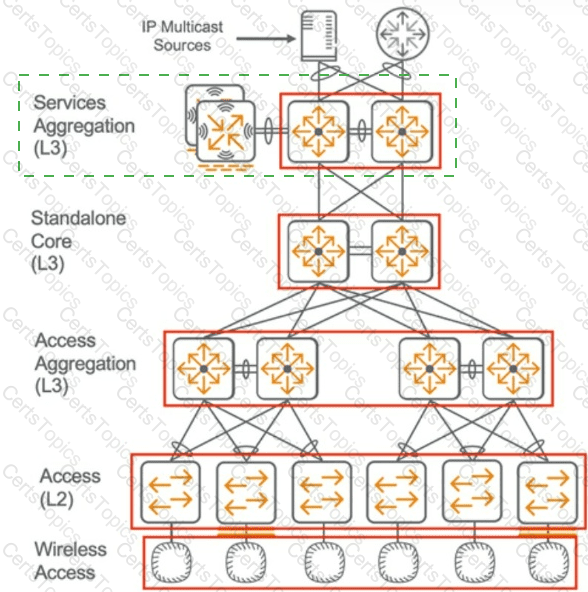
Place the + in the layer where IGMP Snooping should be activated. The correct area encompasses the entire layer Anywhere in the layer will be marked correctly.
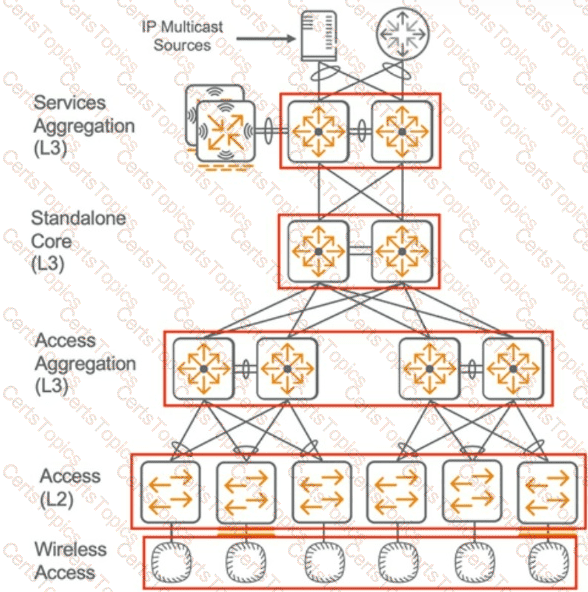
What possible issue with the cote switch selection do you see in regards to the customers’ requirements?
XYZ Regional Hospital is an integrated healthcare system of hospitals, neighborhood health centers, and small doctor offices. XYZ Regional Hospital has recently merged with 4x neighborhood health centers and 125 doctor branch offices. The wireless, wired access, and AAA
solutions are outdated and need to be replaced
XYZ Regional Hospital is looking to future-proof and improve efficiency across all sites by enhancing wired and wireless access and migrating to a centralized and unified wired/wireless and policy management that can provide uninterrupted availability of all systems.
Locations:
- XYZ Regional Hospital is located in New York City
- Dila Health Center is located in City A
- Mount Health Center is located in City B
- Rock Health Center is located in City C
- Branch clinics are located at different locations across the United States
Requirements:
- Provide, via management software, one single pane of glass to manage wired and wireless I ANs. and VPNs across campus, branch, and remote via web/cloud architecture providing near real-time Insight. troubleshooting tools, and Service Level performance reporting.
- Seamless integration across wired, wireless. WAN. SD-Branch. loT
- Provide secure wireless access to all the employees of the Regional Hospital and partners, as well as provide wireless Internet access to medical citizens when they visit our facilities.
- All-access points must support the following features and specifications: 802.11ax (Wi-Fi 6E Certified)
- Security options including WP2/WPA3. 802.1X with Radius secure authentication
- Identify and authenticate every wireless and wired device
- End-to-end role-based security
- Seamless mobility across the hospital tor medical learns, patients, and visitors
- Cuts Wi-Fi deployment times from days to hours and enables Zero-Touch deployments across the site
- Establishes a resilient, future-ready network infrastructure with the intelligence, scalability, and intuitive toolsets to meet emerging needs
- Fully redundant branch solution with dynamic path selection to the hospital
The customer states that the hospital has approximately 35.000 devices connected to its network. Unfortunately, they do not have a tool to accurately determine the device count.
Select the best option to obtain an accurate device count
A global furniture retail company called 'No-Stair Inc.' requests you design their new WLAN infrastructure for a global footprint. Each location of No-Stair Inc.' has a similar layout: three small manager offices, a warehouse, and a 'retail' area. The 'retail' area and the warehouse together amount to 95% of the location. The IT department of the company Is minimally engaged In their LAN refresh so the CTO of the company has shared the information below
Current WLAN Infrastructure Is based on the 802.1 In "WlF14Less" access-points series (both model 2013-INT (2.4 only Internal antenna) and model 2019-EXT (dual-band external antenna only)). These AP models are standalone without any centralized management. Last year 'No-Stair InC ran a project called secure. It' ensuring that all needed network security was Implemented to be fully compliant with their security standards. During this project, they also upgraded the AAA infrastructure to handle the Increased AAA requests. No additional Wi-Fi or security requirements are listed for this WLAN refresh, which means that 'No-Stair Inc.' will continue to use bridged SSIDs. with local breakout into different VLANs.
The CTO of No-Stair Inc.' understands the need for you to ask additional questions to deliver the design The questions may be sent in written form and will be answered within two weeks.
What additional question needs to be answered in order to collect needed information for tie WLAN design?
Which documentation resources can be used for finding validated information on HPE Aruba Networking products that assist the architect in building the solution design? (Choose three.)
You hired a junior engineer to assist you with a large-scale network infrastructure project. The engineer has never worked on such a complex project before and wants to better understand the role that each stakeholder will play in the project.
What is the role of the Network Designer/Architect in this project?
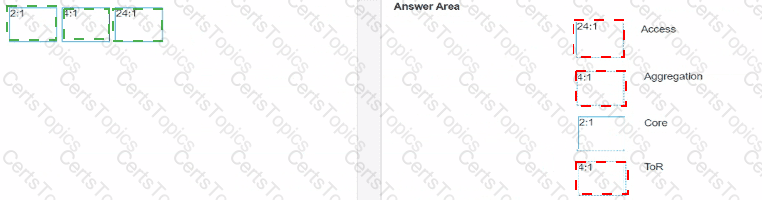
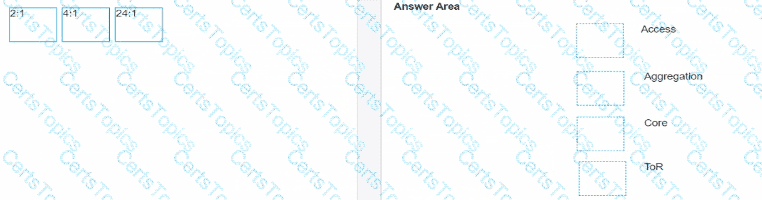
You are going with a 3-tier design and need to calculate the oversubscription ratio on the Access. Distribution. Core, and ToR Layer. What is a suitable oversubscription ratio for each layer?
A customer wants to have the ability to show network usage. Which product would allow them to have this visibility?
Copyright © 2021-2026 CertsTopics. All Rights Reserved