
Summer Certification Sale 70% Discount Offer - Ends in 0d 00h 00m 00s - Coupon code: save70

Free and Premium HashiCorp HCVA0-003 Dumps Questions Answers

Page: 1 / 24
Total 324 questions

HashiCorp Certified: Vault Associate (003) Exam Questions and Answers

Question 1

Which is not a capability that can be used when writing a Vault policy?

Options:

A.

delete

B.

modify

C.

create

D.

list

E.

read

F.

update

Buy Now
Question 2

The Vault Agent provides which of the following benefits? (Select three)

Options:

A.

Token renewal

B.

Authentication to Vault

C.

Client-side caching of responses

D.

Automatically creates secrets in the desired storage backend

Question 3

What type of Vault token does not have a TTL (Time to Live)?

Options:

A.

Child tokens

B.

Parent tokens

C.

Service tokens

D.

Root tokens

E.

Batch tokens

Question 4

Christy has created a token and needs to use that token to access Vault. What command can she use to authenticate and access secrets stored in Vault?

$ vault token create -policy=christy

Key Value

--- -----

token hvs.hxDIPd8RPVtxu4AzSGS1lArP

token_accessor AxwxpDs6LbdFQbWGmBDnwIK3

token_duration 24h

token_renewable true

token_policies [ " christy " " default " ]

identity_policies []

policies [ " christy " " default " ]

Options:

A.

vault login hvs.hxDIPd8RPVtxu4AzSGS1lArP

B.

vault login -method=password

C.

vault login -method=token christy

D.

vault login -accessor=AxwxpDs6LbdFQbWGmBDnwIK3

Question 5

Without logging into another interface, what feature can Chad use to execute a simple CLI command to enable a new secrets engine?
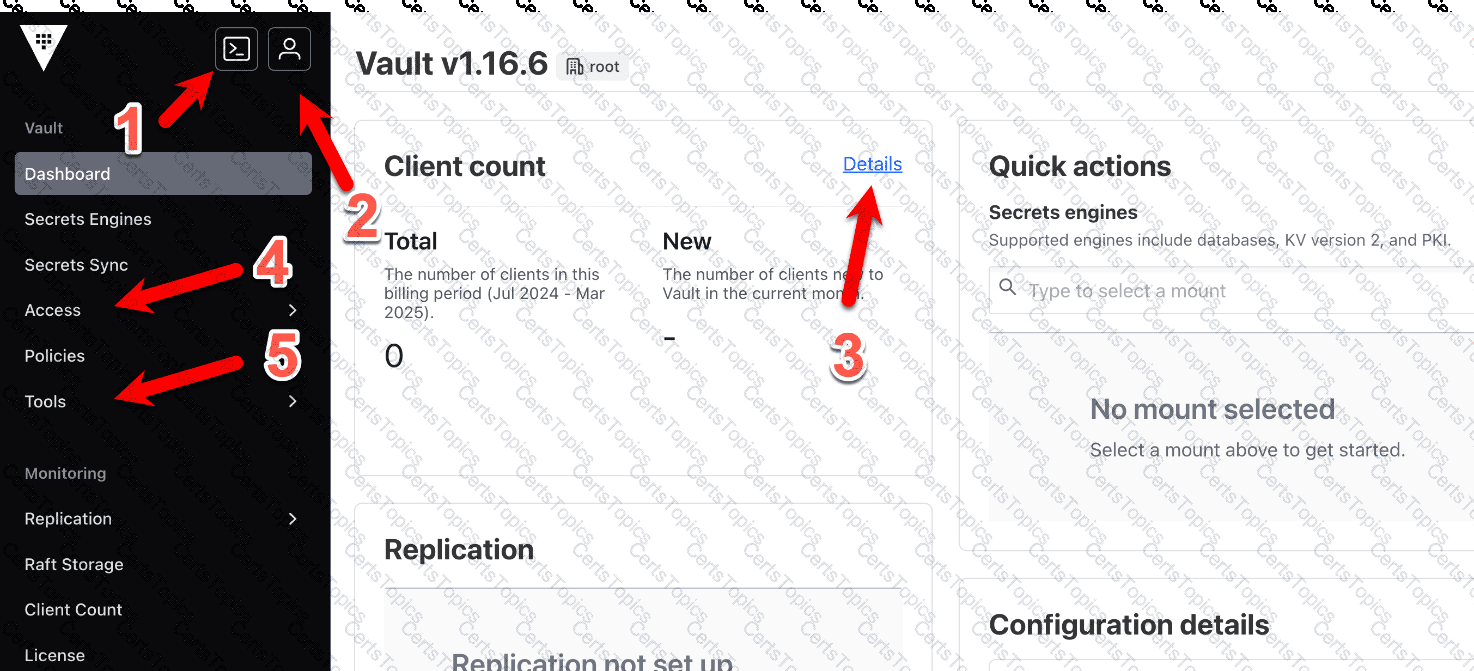
Options:

A.

CLI emulation in the Vault UI (Feature 1)

B.

User information button (Feature 2)

C.

Client count details (Feature 3)

D.

Access management link (Feature 4)

Question 6

You have a legacy application that requires secrets from Vault that must be written to a local configuration file. However, you cannot refactor the application to communicate directly with Vault. What solution should you implement to satisfy the requirements?

Options:

A.

Run the Vault Agent and use the templating feature

B.

Use the Vault Proxy with Auto-Auth to authenticate with Vault

C.

Use the Vault Proxy to act as a proxy for the Vault API

D.

Use the Vault Agent and cache the newly created tokens and leases

Question 7

You are using Azure Key Vault for the auto-unseal configuration on your cluster. After the Vault service restarts, what command must you run to unseal Vault?

Options:

A.

You don’t need to run a command when using auto-unseal

B.

vault operator members

C.

vault operator unseal

D.

vault operator init

Question 8

An application has authenticated to Vault and has obtained dynamic database credentials with a lease of 4 hours. Four hours later, the credentials expire, and the application can no longer communicate with the backend database, so the application goes down. What should the developers instruct the application to do to prevent this from happening again while maintaining the same level of security?

Options:

A.

Go back to using static credentials

B.

Renew the lease before expiration

C.

Revoke the lease before expiration

D.

Use a different auth method

Question 9

A new Vault administrator is writing a CURL command (shown below) to retrieve a secret stored in a KV v2 secrets engine at secret/audio/soundbooth but is receiving an error. What could be the cause of the error?

$ curl \

--header " X-Vault-Token: hvs.rffHw0iXqkRo19b2cjf93DM39WjpbN3J " \

Options:

A.

The VAULT_ADDR environment variable wasn’t set, so it should be configured: export VAULT_ADDR= " https://vault.unlimited.com:8200 "

B.

The request is being made on the incorrect endpoint and should be:

$ curl \

--header " X-Vault-Token: hvs.rffHw0iXqkRo19b2cjf93DM39WjpbN3J " \

https://vault.unlimited.com:8200/v1/secret/data/audio/soundbooth

C.

The user’s token doesn’t permit access to the Vault API, only the UI

D.

The endpoint should point to v2 since this is a KV v2 secrets engine:

$ curl \

--header " X-Vault-Token: hvs.rffHw0iXqkRo19b2cjf93DM39WjpbN3J " \

https://vault.unlimited.com:8200/v2/secret/audio/soundbooth

Question 10

Which of the following best describes a token accessor?

Options:

A.

A value that describes which clients have access to the attached token

B.

Describes the value associated with the token’s TTL

C.

A token used for clients to access Vault secrets engines

D.

A value that acts as a reference to a token which can be used to perform limited actions against the token

Question 11

When generating a dynamic secret, what value is returned that a user can use to renew or revoke the lease?

Options:

A.

renewable

B.

token_ttl

C.

lease_max

D.

lease_id

Question 12

Which of the following unseal options can automatically unseal Vault upon the start of the Vault service? (Select four)

Options:

A.

HSM

B.

Azure KMS

C.

AWS KMS

D.

Transit

E.

Key Shards

Question 13

You need to write a Vault operator policy and give the users access to perform administrative actions in Vault. What path is used for Vault backend functions?

Options:

A.

/security

B.

/admin

C.

/vault

D.

/system

E.

/sys

F.

/backend

Question 14

True or False? The command vault lease revoke -prefix aws/ will revoke all leases associated with the secret engine mounted at /aws.

Options:

A.

True

B.

False

Question 15

Which statement most accurately describes how the response wrapping feature functions in Vault?

Options:

A.

Vault takes the response it would have sent to an HTTP client and instead inserts it into the cubbyhole of a single-use token, returning that single-use token instead.

B.

Vault encrypts the response with a dedicated key and sends it directly to the client, never storing it on the server or using single-use tokens for additional security.

C.

Vault divides the response into separate parts and stores each part in different tokens, requiring all tokens to be combined before disclosing the secret to the requesting client.

D.

Vault duplicates the response within a persistent token and allows multiple unwraps, ensuring that any user with the correct token can retrieve the secret repeatedly without time restrictions.

Question 16

After creating a dynamic credential on a database, the DBA accidentally deletes the credentials on the database itself. When attempting to remove the lease, Vault returns an error stating that the credential cannot be found. What command can be run to make Vault remove the secret?

Options:

A.

vault lease revoke -force -prefix < lease_path >

B.

vault lease -renew

C.

vault lease revoke -enforce

D.

vault revoke -apply

Question 17

What is the result of the following Vault command?

$ vault auth enable kubernetes

Options:

A.

Allows Vault to access usernames and passwords stored in a Kubernetes cluster

B.

Mounts the Kubernetes auth method to the default path of kubernetes/

C.

Imports Kubernetes secrets to the local KV database

D.

Enables Vault to host an IdP for Kubernetes workloads

Question 18

What is the correct order that Vault uses to protect data?

Options:

A.

root key -- > encryption key -- > data

B.

unseal keys -- > root key -- > data

C.

root key -- > data

D.

encryption key -- > root key -- > data

Question 19

Using the Vault CLI, there are several ways to create a new policy. Select the valid commands (Select three)

Options:

A.

vault policy write my-policy - < < EOF

path " secret/data/* " {

capabilities = [ " create " , " update " ]

}

EOF

B.

vault policy create my-policy /tmp/policy.hcl

C.

vault policy write my-policy /tmp/policy.hcl

D.

$ cat user.hcl | vault policy write my-policy -

Question 20

Your application cannot manage authentication with Vault, but it can communicate with a local service to retrieve secrets. What solution can enable your app to generate dynamic credentials from Vault?

Options:

A.

Vault Proxy with caching feature enabled

B.

Vault Agent with environment variable secret injection

C.

Vault Proxy with Auto-Auth feature enabled

D.

Vault Agent with the templating feature configured

Question 21

Hanna is working with Vault and has been assigned a namespace called integration, where she stores all her secrets. Hanna configured her application to use the following API request, but the request is failing. What changes below will help Hanna correctly retrieve the secret? (Select two)

$ curl \

--header " X-Vault-Token:hvs.lzrmRe5Y3LMcDRmOttEjWoag " \

--request GET \

Options:

A.

$ curl --header " X-Vault-Token:hvs.lzrmRe5Y3LMcDRmOttEjWoag " --request GET\integration https://vault.example.com:8200/v1/secret/data/my-secret

B.

$ curl --header " X-Vault-Token:hvs.lzrmRe5Y3LMcDRmOttEjWoag " --request GET --namespace " integration " https://vault.example.com:8200/v1/secret/data/my-secret

C.

$ curl --header " X-Vault-Token:hvs.lzrmRe5Y3LMcDRmOttEjWoag " --request GET https://vault.example.com:8200/v1/integration/secret/data/my-secret

D.

$ curl --header " X-Vault-Token:hvs.lzrmRe5Y3LMcDRmOttEjWoag " --header " X-Vault-Namespace:integration " --request GET https://vault.example.com:8200/v1/secret/data/my-secret

Question 22

Jarrad is an AWS engineer and has provisioned a new EC2 instance running MySQL since his application requires a specific MySQL version. He wants to integrate Vault into his workflow but is new to Vault. What secrets engine should Jarrad use to integrate this new database running in AWS?

Options:

A.

azure

B.

database

C.

kv

D.

aws

Question 23

Select the two paths below that would be permitted for read access based on the following Vault policy:

path " secret/+/training/* " {

capabilities = [ " create " , " read " ]

}

Options:

A.

secret/business/training

B.

secret/cloud/training/test/exam

C.

secret/departments/certification/api

D.

secret/departments/training/vault

Question 24

Your organization has many applications needing heavy read access to Vault. As these applications integrate with Vault, the primary Vault cluster’s performance is negatively impacted. What feature can you use to scale the cluster and improve performance?

Options:

A.

Add additional standby nodes

B.

Enable multiple secrets engines for the applications

C.

Enable control groups

D.

Add performance standby nodes

Question 25

Based on the output below, how many policies have been added to Vault?

$ vault policy list

base

default

root

web-app-1

automation-team

Options:

A.

3

B.

4

C.

1

D.

2

Question 26

A DevOps engineer has set up LDAP and GitHub auth methods. The engineer must ensure user Sarah, who authenticates via either method, has consistent access permissions. Which approach correctly describes how to achieve this in Vault?

Options:

A.

Create an entity for Sarah and map both her LDAP and GitHub identities as entity aliases to this single entity

B.

Create an external group and add the LDAP and GitHub providers as members of the group

C.

Create separate policies for each auth method and manually ensure they remain synchronized

D.

Configure a trust relationship between the LDAP and GitHub providers to ensure Sarah’s account is synced

Question 27

You have multiple Kubernetes pods that need frequent access to Vault to retrieve credentials for establishing connectivity to a backend database. You enable the Kubernetes auth method in Vault. What resource do you need to create within Kubernetes to complete this configuration?

Options:

A.

Username and password for kubectl

B.

k8s service account token

C.

A Vault token for authentication

D.

An AppRole role_id and secret_id

Question 28

True or False? A token can be renewed up until the max TTL, even if the TTL has been reached.

Options:

A.

True

B.

False

Question 29

What header must be included in an API request in order to provide authentication validation?

Options:

A.

X-Token-Vault

B.

X-Vault-Token

C.

X-Token-Creds

D.

X-Vault-Creds

Question 30

Tanner manages a data processing application and needs to be sure the data being processed is encrypted so it is securely stored post-processing. Which secrets engines can encrypt data? (Select three)

Options:

A.

transit

B.

KMIP

C.

SSH

D.

transform

Question 31

Which of the following tokens are representative of a batch token? (Select two)

Options:

A.

hvr.AAAAAQL_tyer_gNuQqvQYPVQgsNxjap_YW1NB2m4CDHHadQo7rF2XLFGdwNJplAZNKbfloOvifrbpRCGdgG1taTqmC7Da_qftN64zeL10SmNwEoDTiPzC_1aS1KExbtVftU3Sx16cBVqaynwsYRDfVnfTAffE

B.

hvb.CAESIKOOSODDNGUJQe3EmsS8EQthulLjxRDhan_Axte2OrmPGiAKHGh2cy5KVnNhM25JdG82cDB0a1ZDbWhPTlAyekMQHg

C.

hvb.AAAAAQJnAGuRT_z8FD_jOwP26zYaNzJ456_SVqse0oXtaqrpaLUC3LlHrUoJhQPylGX7A6K_dcS0shiql6g5-BVpz0QIkCm7ePFQVjDT2HcIf8C6FNgkW313vYgBGP8lzQHebtspC0pqK64cfyU_qPKIka2u4ng-jsoy

D.

hvs.493n55sZp2lX2zyQfpkHTkL4

Question 32

Which of the following features in Vault will replicate service tokens between clusters?

Options:

A.

Disaster Recovery Replication

B.

Performance Replication

C.

Vault Agent

D.

Integrated Storage

Question 33

Vault operators can create two types of groups in Vault. What are the two types?

Options:

A.

External groups

B.

Security groups

C.

Policy groups

D.

Internal groups

Question 34

What is the default TTL for tokens in Vault if one is not specified?

Options:

A.

24 hours (1 day)

B.

15 minutes

C.

768 hours (32 days)

D.

60 minutes (1 hour)

Question 35

You are enabling a secrets engine in Vault using the CLI. What subcommands are available when using the vault secrets command? (Select five)

Options:

A.

update

B.

migrate

C.

tune

D.

enable

E.

move

F.

disable

G.

list

Question 36

Suzy is a Vault user that needs to create and replace values at the path secrets/automation/apps/chef. Does the following policy permit her the permissions to do so?

text

CollapseWrapCopy

path " secrets/automation/apps/chef " {

capabilities = [ " create " , " read " , " list " ]

}

Options:

A.

No, the policy would deny Suzy from performing certain actions

B.

Yes, the policy has appropriate permissions

Question 37

You need to create a limited-privileged token that isn’t impacted by the TTL of its parent. What type of token should you create?

Options:

A.

Service token with a use limit

B.

Orphan token

C.

Periodic token

D.

Root token

Question 38

Tom needs to set the proper environment variable so he doesn’t need to first authenticate to Vault to retrieve dynamically generated credentials for a database server. What environment variable does Tom need to set first before running commands?

Options:

A.

VAULT_NAMESPACE

B.

VAULT_TOKEN

C.

VAULT_CAPATH

D.

VAULT_CLIENT_KEY

Question 39

Which of the following are valid types of tokens available in Vault? (Select five)

Options:

A.

Primary token

B.

Batch token

C.

Orphan service token

D.

Service token

E.

Root token

F.

Periodic service token

Question 40

After setting up a new HashiCorp Vault server with the default configurations, which method can be used to unseal Vault?

Options:

A.

Log on to each Vault node and provide the root token

B.

Running vault operator init to regenerate unseal keys and automatically unseal the Vault

C.

Submit a threshold of unseal keys to reconstruct the root key

D.

Restart the Vault service, which will automatically unseal it

Question 41

The Vault encryption key is stored in Vault ' s backend storage.

Options:

A.

True

B.

False

Question 42

When an auth method is disabled all users authenticated via that method lose access.

Options:

A.

True

B.

False

Question 43

When unsealing Vault, each Shamir unseal key should be entered:

Options:

A.

Sequentially from one system that all of the administrators are in front of

B.

By different administrators each connecting from different computers

C.

While encrypted with each administrators PGP key

D.

At the command line in one single command

Question 44

You have a 2GB Base64 binary large object (blob) that needs to be encrypted.

How will the Transit secrets engine manage the encryption lifecycle for a large blob?

Options:

A.

A data key encrypts the blob locally, and the same key decrypts the blob locally.

B.

Vault will store the blob permanently. Be sure to run Vault on a compute-optimized machine.

C.

The Transit engine is not a good solution for binaries of this size.

D.

To process such a large blob, Vault will temporarily store it in the storage backend.

Question 45

Which of the following describes usage of an identity group?

Options:

A.

Limit the policies that would otherwise apply to an entity in the group

B.

When they want to revoke the credentials for a whole set of entities simultaneously

C.

Audit token usage

D.

Consistently apply the same set of policies to a collection of entities

Question 46

HCP Vault Dedicated automatically enables cross-region disaster recovery replication.

Options:

A.

True

B.

False

Question 47

You would like to provision virtual machines (VMs) using infrastructure as code (IaC). The VMs require an OAuth token to access GCP services during provisioning. You are required to use tokens that can be generated and revoked automatically.

Which secrets engine would meet this need?

Options:

A.

Identity secrets engine

B.

Key/Value secrets engine version 2

C.

Google Cloud secrets engine

D.

SSH secrets engine

Question 48

The Vault CLI can output to formats such as JSON, YAML, and Table.

Options:

A.

True

B.

False

Question 49

An organization would like to use a scheduler to track & revoke access granted to a job (by Vault) at completion. What auth-associated Vault object should be tracked to enable this behavior?

Options:

A.

Token accessor

B.

Token ID

C.

Lease ID

D.

Authentication method

Question 50

Use this screenshot to answer the question below:
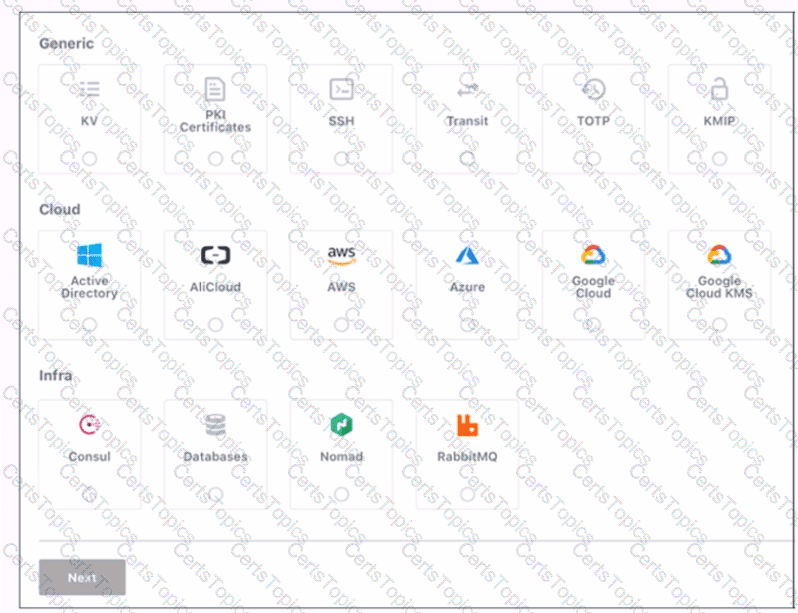
When are you shown these options in the GUI?

Options:

A.

Enabling policies

B.

Enabling authentication engines

C.

Enabling secret engines

D.

Enabling authentication methods

Question 51

Data protected by the Vault cryptographic barrier is encrypted with:

Options:

A.

A PGP key.

B.

PKI certificates.

C.

The encryption key.

D.

A long-lived token.

Question 52

Security requirements demand that no secrets appear in the shell history. Which command does not meet this requirement?

Options:

A.

generate-password | vault kv put secret/password value

B.

vault kv put secret/password value-itsasecret

C.

vault kv put secret/password value=@data.txt

D.

vault kv put secret/password value-SSECRET_VALUE

Question 53

You have a requirement that an application needs to implement AES encryption.

What parameter must you use to meet this requirement when defining a new key in a Transit secrets engine for this app?

Options:

A.

exportable

B.

convergent_encryption

C.

type

D.

name

Question 54

What information do you need to collect to use an entity alias in an ACL policy?

Options:

A.

Auth method path

B.

Group name

C.

Auth method mount accessor

D.

Metadata key

Question 55

You are using the Vault userpass auth method mounted at auth/userpass. How do you create a new user named " sally " with password " h0wN0wB4r0wnC0w " ? This new user will need the power-users policy.

Options:

A.

B.

C.

D.

Question 56

You are performing a high number of authentications in a short amount of time. You ' re experiencing slow throughput for token generation. How would you solve this problem?

Options:

A.

Increase the time-to-live on service tokens

B.

Implement batch tokens

C.

Establish a rate limit quota

D.

Reduce the number of policies attached to the tokens

Question 57

You are using Vault ' s Transit secrets engine to encrypt your data. You want to reduce the amount of content encrypted with a single key in case the key gets compromised. How would you do this?

Options:

A.

Use 4096-bit RSA key to encrypt the data

B.

Upgrade to Vault Enterprise and integrate with HSM

C.

Periodically re-key the Vault ' s unseal keys

D.

Periodically rotate the encryption key

Question 58

To make an authenticated request via the Vault HTTP API, which header would you use?

Options:

A.

The X-Vault-Token HTTP Header

B.

The x-Vault-Request HTTP Header

C.

The Content-Type HTTP Header

D.

The X-Vault-Namespace HTTP Header

Question 59

Which of the following are benefits of Vault Agent Caching?

Pick the 2 correct responses below.

Options:

A.

Reduces the number of Vault secrets engines which must be mounted.

B.

Renders secrets using the Consul Template markup.

C.

Reduces the latency to retrieve secrets from Vault.

D.

Secret requests may be handled by the local cache, reducing load on the Vault servers.

E.

Eliminates the need for disaster recovery clusters.

Question 60

Which of these is not a benefit of dynamic secrets?

Options:

A.

Supports systems which do not natively provide a method of expiring credentials

B.

Minimizes damage of credentials leaking

C.

Ensures that administrators can see every password used

D.

Replaces cumbersome password rotation tools and practices

Question 61

You are using an orchestrator to deploy a new application. Even though the orchestrator creates a new AppRole secret ID, security requires that only the new application has the combination of the role ID and secret ID. What feature can you use to meet these requirements?

Options:

A.

Have the application authenticate with the role ID to retrieve the secret ID

B.

Use response wrapping and provide the application server with the unwrapping token instead

C.

Use a batch token instead of a traditional service token

D.

Secure the communication between the orchestrator and Vault using TLS

Question 62

Which scenario most strongly indicates a need to run a self-hosted Vault cluster instead of using HCP Vault Dedicated?

Options:

A.

Your organization doesn’t require any custom security policies or intricate network topologies

B.

You want to offload all operational tasks and rely on HashiCorp to manage patching, upgrades, and infrastructure

C.

You prefer a fully managed environment that is readily scalable with minimal configuration overhead

D.

You must maintain specific compliance or custom integration requirements that demand full control over the Vault environment, including infrastructure provisioning and plugin development

Question 63

What command would have created the token displayed below?

$ vault token lookup hvs.nNeZ2I64ALCxuO7dqQEJGPrO

Key: policies Value: [default dev], num_uses: 5, ttl: 767h59m49s

    Key Value

    --- -----

    accessor mfvaVMFgOcXHIeqlRasroSOn

    creation_time 1604610457

    creation_ttl 768h

    display_name token

    entity_id n/a

    expire_time 2024-12-07T16:07:37.7540672-05:00

    explicit_max_ttl 0s

    id hvs.nNeZ2I64ALCxuO7dqQEJGPrO

    issue_time 2024-11-05T16:07:37.7540672-05:00

    meta < nil >

    num_uses 5

    orphan false

    path auth/token/create

    policies [default dev]

    renewable true

    ttl 767h59m49s

    type service

Options:

A.

vault token create -policy=dev -use-limit=5

B.

vault token create -policy=dev -ttl=768h

C.

vault token create -policy=dev -policy=default -ttl=768h

D.

vault token create -policy=dev

Question 64

Given the following screenshot, how many secrets engines have been enabled by a Vault user?
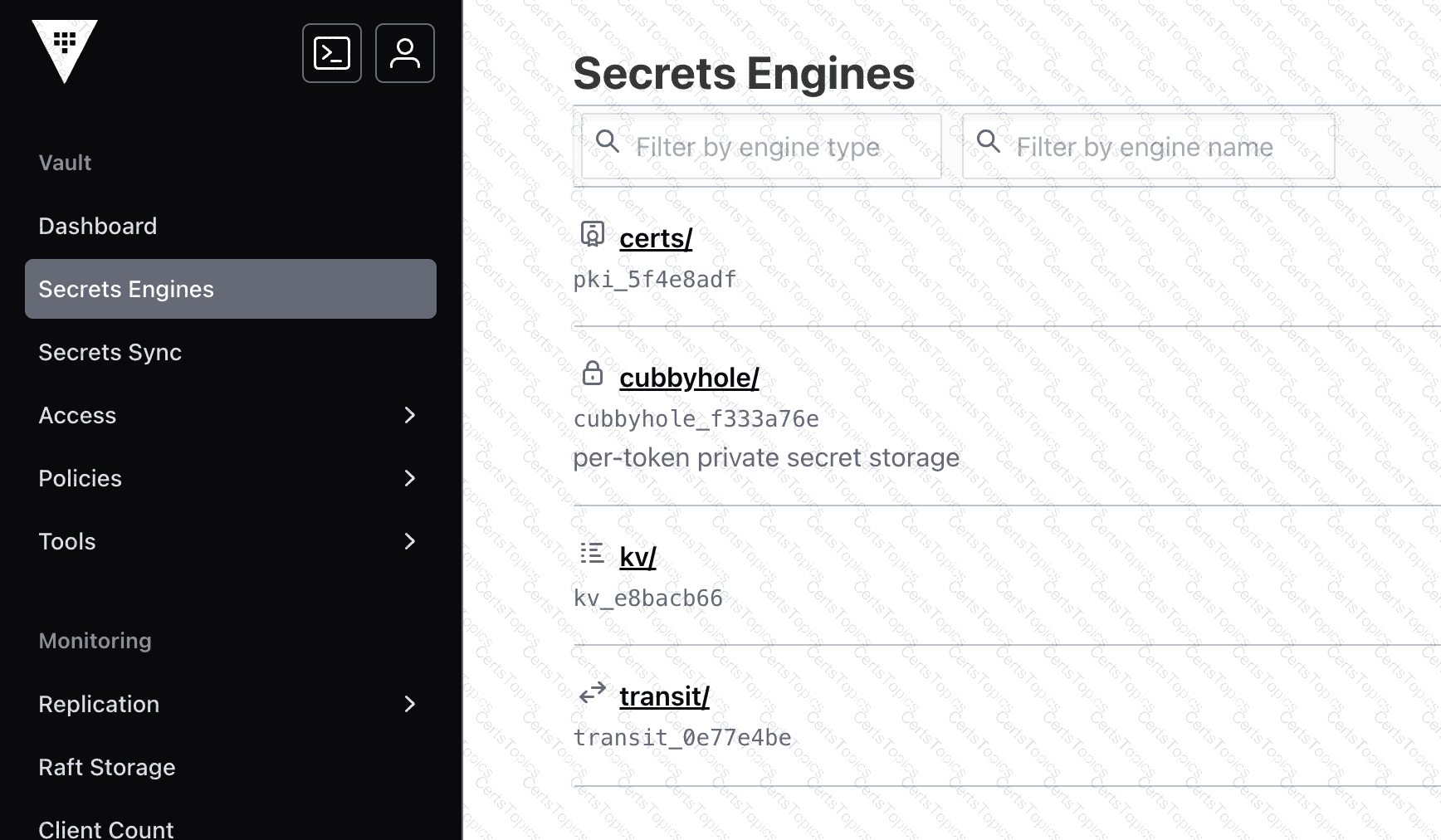
Options:

A.

2

B.

3

C.

4

D.

5

Question 65

Which of the following secrets engines does NOT issue a lease upon a read request?

Options:

A.

KV

B.

Consul

C.

Database

D.

AWS

Question 66

True or False? All dynamic secrets in Vault are required to have a lease.

Options:

A.

True

B.

False

Question 67

Select the policies below that permit you to create a new entry of environment=prod at the path /secrets/apps/my_secret (select three).

Options:

A.

path " secrets/+/my_secret " { capabilities = [ " create " ] allowed_parameters = { " * " = [] } }

B.

path " secrets/apps/my_secret " { capabilities = [ " update " ] }

C.

path " secrets/apps/my_secret " { capabilities = [ " create " ] allowed_parameters = { " environment " = [] } }

D.

path " secrets/apps/* " { capabilities = [ " create " ] allowed_parameters = { " environment " = [ " dev " , " test " , " qa " , " prod " ] } }

Question 68

You want to integrate a third-party application to retrieve credentials from the HashiCorp Vault API. How can you accomplish this without having direct access to the source code?

Options:

A.

You cannot integrate a third-party application with Vault without being able to modify the source code

B.

Put in a request to the third-party application vendor

C.

Instead of the API, have the application use the Vault CLI to retrieve credentials

D.

Use the Vault Agent to obtain secrets and provide them to the application

Question 69

According to the screenshot below, what auth method did this client use to log in to Vault?

(Screenshot shows a lease path: auth/userpass/login/student01)

Options:

A.

Userpass

B.

Auth

C.

Root token

D.

Child token

Question 70

What is the difference between the TTL and the Max TTL (select two)?

Options:

A.

The TTL defines when the token will expire and be revoked

B.

The TTL defines when another token will be generated

C.

The Max TTL defines the timeframe for which a token cannot be used

D.

The Max TTL defines the maximum timeframe for which a token can be renewed

Question 71

What is true about the output of the following command (select three)?

Options:

A.

The admin never sees all the unseal keys and cannot unseal Vault by themselves

B.

All three users, Jane/John/Student01, will receive all unseal keys and can unseal Vault

C.

The admin will receive the unseal keys and be able to unseal Vault themselves

D.

The keys will be returned encrypted

E.

Each individual can only decrypt their own unseal key using their private PGP key

Question 72

Jason has enabled the userpass auth method at the path users/. What path would Jason and other Vault operators use to interact with this new auth method?

Options:

A.

users/auth/

B.

authentication/users

C.

auth/users

D.

users/

Question 73

True or False? When using the Transit secrets engine, setting the min_decryption_version will determine the minimum key length of the data key (i.e., 2048, 4096, etc.).

Options:

A.

True

B.

False

Question 74

During a service outage, you must ensure all current tokens and leases are copied to another Vault cluster for failover so applications don’t need to authenticate. How can you accomplish this?

Options:

A.

Have Vault write all the tokens and leases to a file so you have a second copy of them

B.

Configure all applications to use the auto-auth feature of the Vault Agent

C.

Configure Disaster Recovery replication and promote the secondary cluster during an outage

D.

Replicate to another cluster using Performance Replication and promote the secondary cluster during an outage

Question 75

What is the proper command to enable the AWS secrets engine at the default path?

Options:

A.

vault enable aws secrets engine

B.

vault secrets enable aws

C.

vault secrets aws enable

D.

vault enable secrets aws

Question 76

From the unseal options listed below, select the options you can use if you ' re deploying Vault on-premises (select four).

Options:

A.

Certificates

B.

Transit

C.

AWS KMS

D.

HSM PKCS11

E.

Key shards

Question 77

From the options below, select the benefits of using a batch token over a service token (select four).

Options:

A.

Often used for ephemeral, high-performance workloads

B.

Can be a root token

C.

Can be used on performance replication clusters (if orphan)

D.

Has accessors

E.

Lightweight and scalable

F.

No storage cost for token creation

Question 78

What could you do with the feature found in the screenshot below (select two)?
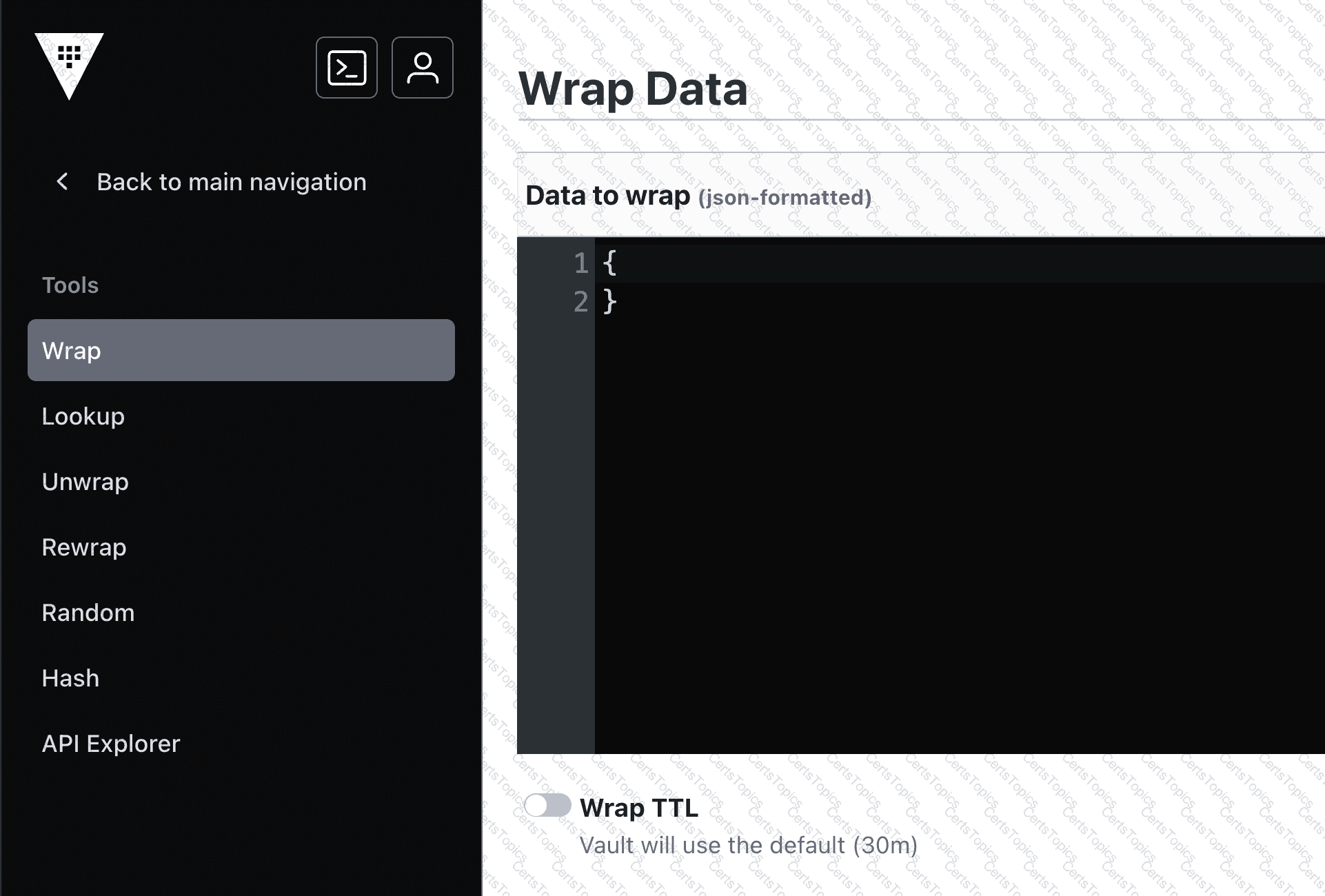
Options:

A.

Using a short TTL, you could encrypt data in order to place only the encrypted data in Vault

B.

Encrypt the Vault master key that is stored in memory

C.

Encrypt sensitive data to send to a colleague over email

D.

Use response-wrapping to protect data

Question 79

After encrypting data using the Transit secrets engine, you’ve received the following output. Which of the following is true based on the output displayed below?

Key: ciphertext Value: vault:v2:45f9zW6cglbrzCjI0yCyC6DBYtSBSxnMgUn9B5aHcGEit71xefPEmmjMbrk3

Options:

A.

The original encryption key has been rotated at least once

B.

The data is stored in Vault using a KV v2 secrets engine

C.

This is the second version of the encrypted data

D.

Similar to the KV secrets engine, the Transit secrets engine was enabled using the transit v2 option

Question 80

What API endpoint is used to manage secrets engines in Vault?

Options:

A.

/secret-engines/

B.

/sys/mounts

C.

/sys/capabilities

D.

/sys/kv

Question 81

A MySQL server has been deployed on Google Cloud Platform (GCP) to support a legacy application. You want to generate dynamic credentials against this MySQL server rather than use static credentials. What Vault secrets engine would you use to accomplish this?

Options:

A.

The GCP secrets engine

B.

The Identity secrets engine

C.

The database secrets engine

D.

The Cubbyhole secrets engine

Question 82

Which of the following capabilities can be used when writing a Vault policy? (Select four)

Options:

A.

list

B.

deny

C.

apply

D.

root

E.

create

F.

write

Question 83

There are a few ways in Vault that can be used to obtain a root token. Select the valid methods from the answers below. (Select three)

Options:

A.

Generating a root token using a quorum of recovery keys when using Vault auto unseal

B.

Initializing Vault when first creating the cluster by using vault operator init

C.

Using a batch DR operation token to create a new root token in the event of an emergency

D.

Running the command vault token create when using a valid root token

Question 84

Your team uses the Transit secrets engine to encrypt all data before writing it to a MySQL database server. During testing, you manually retrieve ciphertext from the database and decrypt it to ensure the data can be read. After decrypting the data, you are worried something is wrong because the plaintext data isn’t legible. Why can you not read the original plaintext data after decrypting the ciphertext?

    $ vault write transit/decrypt/krausen-key ciphertext=vault:v1:8SDd3WHDOjf7mq69C.....

    Key Value

    --- -----

    plaintext Zml2ZSBzdGFyIHByYWN0aWNlIGV4YW1zIGJ5IGJyeWFuIGtyYXVzZW4=

Options:

A.

The incorrect key was selected when decrypting the ciphertext. Use the correct key to successfully read the data

B.

The incorrect key version was used to decrypt the data. Update the ciphertext and change the v1 to v3 to use the latest key version

C.

The plaintext is Base64 encoded. Decode the plaintext to see the original data

D.

The data was also encrypted on the database. Therefore Vault cannot decrypt the original data

Question 85

You have a CI/CD pipeline using Terraform to provision AWS resources with static privileged credentials. Your security team requests that you use Vault to limit AWS access when needed. How can you enhance this process and increase pipeline security?

Options:

A.

Enable the SSH secrets engine and have Terraform generate dynamic credentials when deploying resources in AWS

B.

Enable the Transit secrets engine to encrypt the AWS credentials and have Terraform retrieve these credentials when needed

C.

Store the AWS credentials in the Vault KV store and use the Vault provider to obtain these credentials on each terraform apply

D.

Enable the aws secrets engine and configure Terraform to dynamically generate a short-lived AWS credential on each terraform apply

Question 86

Your organization runs workloads on both AWS and Azure for production applications. The security team has requested that a single Vault authentication mechanism be enabled to support applications on both public cloud platforms. Which of the following would be a valid auth method you can use?

Options:

A.

AWS

B.

GitHub

C.

AppRole

D.

Azure

Question 87

A large organization uses Vault for various use cases with multiple auth methods enabled. A user can authenticate via LDAP, OIDC, or a local userpass account, but they receive different policies for each method and often need to log out and back in for different actions. What can be configured in Vault to ensure users have consistent policies regardless of their authentication method?

Options:

A.

Enable the SSH secrets engine and instruct the user to obtain credentials using the new secrets engine

B.

Create a new entity and map the aliases from each of the available auth methods

C.

Assign the default policy to the user ' s policy used by each auth method

D.

Provide the user with an AppRole role-id and secret-id for authentication

Question 88

Over a few years, you have a lot of data that has been encrypted by older versions of a Transit encryption key. Due to compliance regulations, you have to re-encrypt the data using the newest version of the encryption key. What is the easiest way to complete this task without putting the data at risk?

Options:

A.

Rotate the encryption key used to encrypt the data

B.

Decrypt the data manually and encrypt it with the latest version

C.

Use the transit rewrap feature

D.

Create a new master key used by Vault

Question 89

You are planning the deployment of your first Vault cluster and have decided to use Integrated Storage as the storage backend. Where do you configure the storage backend to be used by Vault?

Options:

A.

In the systemd service file

B.

Inside the Vault service once Vault is up and running

C.

In the Vault configuration file

D.

In the Vault Agent sink file

Question 90

Your organization audited an essential application and found it isn’t securely storing data. For added security, auditors recommended encrypting all data before storing it in a backend database, and the application server should not store encryption keys locally. Which secrets engine meets these requirements?

Options:

A.

PKI secrets engine

B.

SSH secrets engine

C.

Transit secrets engine

D.

Cubbyhole secrets engine

Question 91

You have enabled the Transit secrets engine and want to start encrypting data to store in Azure Blob storage. What is the next step that needs to be completed before you can encrypt data? (Select two)

Options:

A.

Export the encryption key and upload it to the application server

B.

Enable the Transit secrets engine API

C.

Create an encryption key for the application to use

D.

Write a policy that permits the application to use the encryption key

Question 92

A security architect is designing a solution to address the " Secret Zero " problem for a Kubernetes-based application that needs to authenticate to HashiCorp Vault. Which approach correctly leverages Vault features to solve this challenge?

Options:

A.

Store the Vault root token in a ConfigMap and mount it to all containers that require access to sensitive information

B.

Generate a long-lived token during deployment and store it as an environment variable within each container that needs to access Vault

C.

Configure the Kubernetes auth method in Vault and enable applications to authenticate without pre-shared secrets

D.

Implement a custom sidecar container that uses AppRole role-id and secret-id each time the application needs to access Vault

Question 93

Which of the following is true about the token authentication method in Vault? (Select three)

Options:

A.

The token auth method is automatically enabled in Vault and cannot be disabled

B.

External authentication mechanisms, such as GitHub, are used to dynamically create tokens

C.

The token auth method is used as the first method of authentication for Vault for a newly initialized Vault node/cluster

D.

Tokens cannot be used directly; they must be used in conjunction with one of Vault’s many auth methods

Question 94

You are using the Vault API to test authentication before modifying your CI/CD pipeline to properly authenticate to Vault. You manually authenticate to Vault and receive the response below. Based on the provided options, which of the following are true? (Select four)

    $ curl \

    --request POST \

    --data @payload.json \

    | jq


    *******************************************************************************

    ******* RESPONSE BELOW ********************************************************

    *******************************************************************************


    {

    " request_id " : " f758e8da-11b6-8341-d404-56f0c370a7fa " ,

    " lease_id " : " " ,

    " renewable " : false,

    " lease_duration " : 0,

    " data " : null,

    " wrap_info " : null,

    " warnings " : null,

    " auth " : {

    " client_token " : " hvs.CbzCNJCVWt63jyzyaJakgDwz " ,

    " accessor " : " rffwXzKFcxvaQi6Vgo8tY4Lt " ,

    " policies " : [

    " training " ,

    " default "

    ],

    " token_policies " : [

    " training " ,

    " default "

    ],

    " metadata " : {

    " username " : " bryan.krausen "

    },

    " lease_duration " : 84600,

    " renewable " : true,

    " entity_id " : " f1795f6a-c576-d619-b2d5-74c0aee08edb " ,

    " token_type " : " service " ,

    " orphan " : true

    }

    }

Options:

A.

The token required to retrieve a secret is hvs.CbzCNJCVWt63jyzyaJakgDwz

B.

The returned token is a batch token

C.

The user needs to retrieve .auth.client_token in order to perform other actions

D.

The accessor will be used to authenticate to Vault to retrieve secrets

E.

The user is using the userpass auth method

F.

The user’s password is stored in a file named payload.json

Question 95

By default, what methods of authentication does Vault support? (Select four)

Options:

A.

SSH

B.

Kubernetes

C.

VMware

D.

LDAP

E.

AppRole

F.

JWT

Question 96

You are configuring your application to retrieve a new PKI certificate upon provisioning. The Vault admins have given you an AppRole role-id and secret-id to inject into the CI/CD pipeline job that provisions your app. The application uses the credentials to successfully authenticate to Vault using the API. Which of the following is true about the step next required after authenticating to Vault?

Options:

A.

The client token needs to be retrieved from the API response before requesting the new PKI certificate

B.

The initial API response should include the new PKI certificate and no further action is required

C.

The app still needs to use the role-id and secret-id to request the new PKI certificate via API

D.

Now that the app is authenticated, it can simply make another API request for the PKI certificate

Question 97

You have logged into the Vault UI and see this screen. What Vault component is being enabled in the screenshot below?
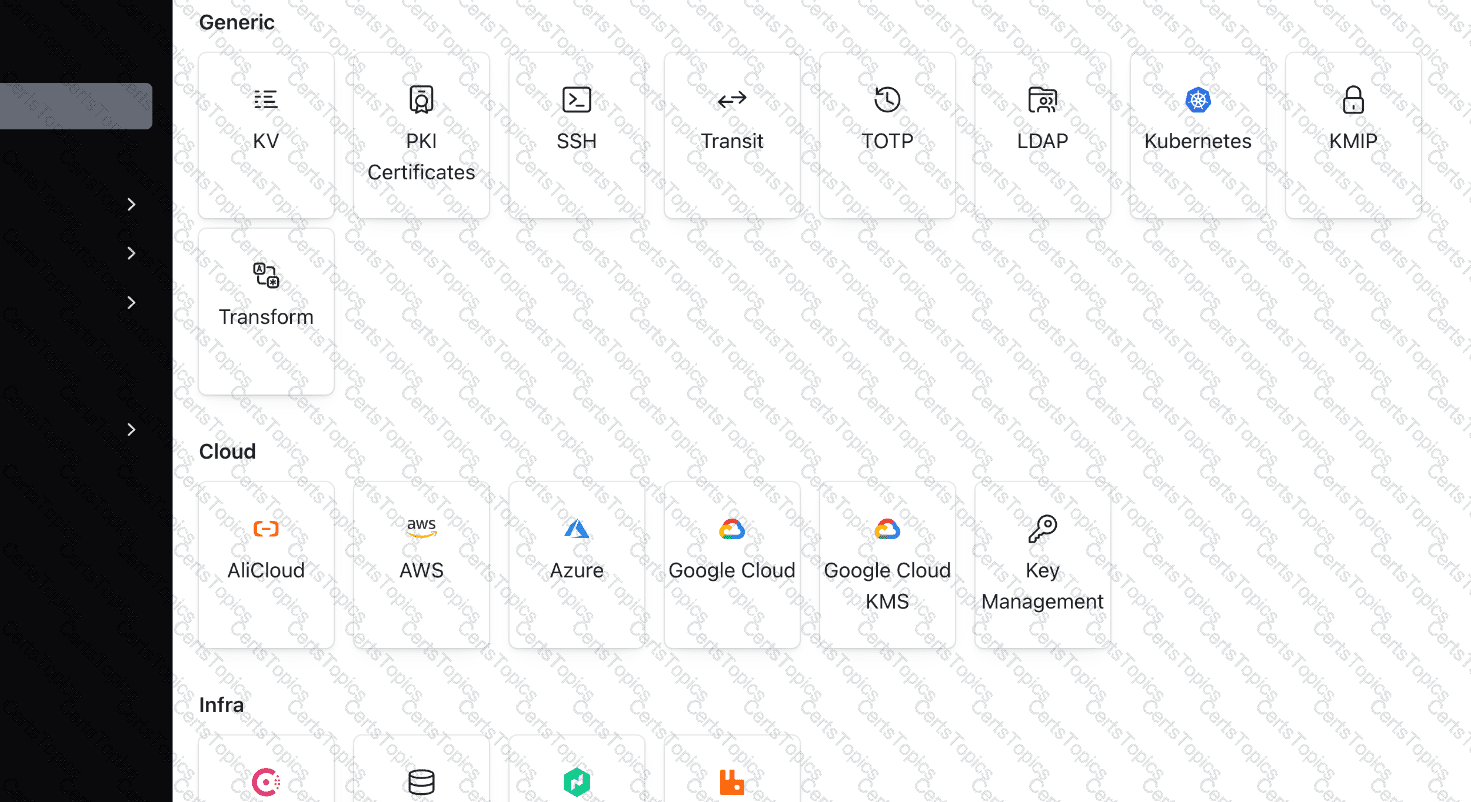
Options:

A.

Storage Backends

B.

Secrets Engine

C.

Auth Methods

D.

Audit Devices

Page: 1 / 24
Total 324 questions
