New Year Sale 70% Discount Offer - Ends in 0d 00h 00m 00s - Coupon code: save70

Free and Premium Fortinet NSE7_SSE_AD-25 Dumps Questions Answers

Fortinet NSE 7 - FortiSASE 25 Enterprise Administrator Questions and Answers

Question 1

Which two settings are automatically pushed from FortiSASE to FortiClient in a new FortiSASE deployment with default settings? (Choose two answers)

Options:

A.

FortiSASE certificate authority (CA) certificate

B.

Tunnel profile

C.

Real-time protection

D.

Zero trust network access (ZTNA) tags1

Buy Now
Question 2

A company must provide access to a web server through FortiSASE secure private access for contractors. What is the recommended method to provide access? (Choose one answer)

Options:

A.

Configure a TCP access proxy forwarding rule and push it to the contractor FortiClient endpoint.

B.

Publish the web server URL on a bookmark portal and share it with contractors.

C.

Update the PAC file with the web server URL and share it with contractors.

D.

Update the DNS records on the endpoint to access private applications.

Question 3

A Fortinet customer is considering integrating FortiManager with FortiSASE. What are two prerequisites they should consider? (Choose two answers)

Options:

A.

Adding a FortiManager connection add-on license to FortiSASE.

B.

Placing FortiManager in the same FortiCloud account as FortiSASE.

C.

Reducing the number of FortiSASE PoPs that support FortiManager.

D.

Running a FortiManager version that is supported by FortiSASE.

Question 4

A FortiSASE administrator is receiving reports that some users have travelled overseas and cannot establish their agent-based VPN tunnels, although they can authenticate with their SSO credentials to access O365 and SFDC directly. The administrator reviewed the firewall policies and ZTNA tags of some users and could not find anything unusual. Which action can the administrator take to resolve this problem? (Choose one answer)

Options:

A.

Create a dedicated firewall policy for the users.

B.

Instruct the users to restart their laptops and log in again.

C.

Ensure that the countries the users are visiting are not listed under the Deny list in the Geofencing settings.

D.

Instruct the users to install the updated version of the agent-based client.

Question 5

Which policy type is used to control traffic between the FortiClient endpoint to FortiSASE for secure internet access?

Options:

A.

VPN policy

B.

thin edge policy

C.

private access policy

D.

secure web gateway (SWG) policy

Question 6

Refer to the exhibit.

An SPA service connection is experiencing connectivity problems. Which configuration setting should the administrator verify and correct first? (Choose one answer)

Options:

A.

Remote Gateway

B.

BGP Peer IP

C.

Network overlay ID

D.

Authentication Method

Question 7

Which service is included in a secure access service edge (SASE) solution, but not in a security service edge (SSE) solution? (Choose one answer)

Options:

A.

SWG

B.

SD-WAN1

C.

CASB

D.

ZTNA

Question 8

You are designing a new network, and the cybersecurity policy mandates that all remote users working from home must always be connected and protected. Which FortiSASE component facilitates this always-on security measure? (Choose one answer)

Options:

A.

Unified FortiClient

B.

SDWAN on-ramp2

C.

Secure web gateway

D.

Thin-branch SASE extension

Question 9

What are the two key features and benefits of Fortinet SOCaaS when integrated with FortiSASE? (Choose two answers)

Options:

A.

Fortinet SOCaaS offers monitoring only during standard business hours, uses AI without human analysis, and provides annual reports without dashboards or FortiSASE integration.

B.

Fortinet SOCaaS monitors only remote users, does not support log forwarding, and provides threat notifications without response guidance or expert meetings.

C.

Fortinet SOCaaS allows for consistent security monitoring through log forwarding, offers rapid threat notifications and response guidance, and includes intuitive dashboards.

D.

Fortinet SOCaaS provides 24x7x365 cloud-based monitoring by Fortinet experts using AI, machine learning, and human analysis.

E.

Fortinet SOCaaS is a standalone service that monitors only FortiGate environments, provides automated patching without human analysis, and does not integrate with FortiSASE.

Question 10

An administrator must restrict endpoints from certain countries from connecting to FortiSASE. Which configuration can achieve this? (Choose one answer)

Options:

A.

A network lockdown policy on the endpoint profiles

B.

Source IP anchoring to restrict access from the specified countries

C.

A geography address object as the source for a deny policy

D.

Geofencing to restrict access from the required countries

Question 11

Which FortiSASE feature ensures least-privileged user access to all applications?

Options:

A.

secure web gateway (SWG)

B.

SD-WAN

C.

zero trust network access (ZTNA)

D.

thin branch SASE extension

Question 12

What happens to the logs on FortiSASE that are older than the configured log retention period? (Choose one answer)

Options:

A.

The logs are deleted from FortiSASE.1

B.

The logs are compressed and archived.

C.

The logs are backed up on FortiCloud.

D.

The logs are indexed and can be stored in a SQL database.

Question 13

To complete their day-to-day operations, remote users require access to a TCP-based application that is hosted on a private web server. Which FortiSASE deployment use case provides the most efficient and secure method for meeting the remote users' requirements?

Options:

A.

SD-WAN private access

B.

inline-CASB

C.

zero trust network access (ZTNA) private access

D.

next generation firewall (NGFW)

Question 14

What action must a FortiSASE customer take to restrict organization SaaS access to only FortiSASE-connected users? (Choose one answer)

Options:

A.

Implement a CNAPP solution to allowlist the users under the FortiSASE egress IP

B.

Implement ZTNA for their private apps and allow list them under SaaS portals or grant them conditional access.

C.

Connect FortiSASE to an SPA hub for private access to an allowlisted connecting IP.

D.

Retrieve the PoPs of the users' public IP addresses from the FortiSASE region IP list and whitelist the IP under SaaS portals, or grant them conditional access.

Question 15

An organization needs to resolve internal hostnames using its internal rather than public DNS servers for remotely connected endpoints. Which two components must be configured on FortiSASE to achieve this? (Choose two.)

Options:

A.

SSL deep inspection

B.

Split DNS rules

C.

Split tunnelling destinations

D.

DNS filter

Question 16

Which secure internet access (SIA) use case minimizes individual workstation or device setup, because you do not need to install FortiClient on endpoints or configure explicit web proxy settings on web browser-based end points?

Options:

A.

SIA for inline-CASB users

B.

SIA for agentless remote users

C.

SIA for SSLVPN remote users

D.

SIA for site-based remote users

Question 17

Which authentication method overrides any other previously configured user authentication on FortiSASE?

Options:

A.

Local

B.

SSO

C.

RADIUS

D.

MFA

Question 18

When configuring the DLP rule in FortiSASE using Regex format, what would be the correct order for the configuration steps? (Place the four correct steps in order)

Options:

Question 19

You have configured FortiSASE Secure Private Access (SPA) deployment. Which statement is true about traffic flows? (Choose two answers)

Options:

A.

When using SD-WAN private access, traffic goes from an endpoint directly to an SPA hub.

B.

When using zero trust network access, traffic goes from an endpoint to a FortiSASE POP, and then to a ZTNA access proxy.

C.

When using zero trust network access (ZTNA) traffic goes from an endpoint directly to a ZTNA access proxy.

D.

When using SD-WAN private access, traffic goes from an endpoint to a FortiSASE POP, and then to an SPA hub.

Question 20

How does FortiSASE address the market trends of multicloud and Software-as-a-Service (SaaS) adoption, hybrid workforce, and zero trust? (Choose one answer)

Options:

A.

It focuses solely on securing on-premises networks, ignoring cloud and remote work challenges.

B.

It prioritizes legacy VPN connections for hybrid workforces, bypassing modern cloud and zero-trust security measures.

C.

It provides visibility and control for multicloud and SaaS environments, ensures secure and seamless access for hybrid workforces, and implements zero-trust principles.1

D.

It supports only zero-trust frameworks without addressing multicloud or hybrid workforce needs.

Question 21

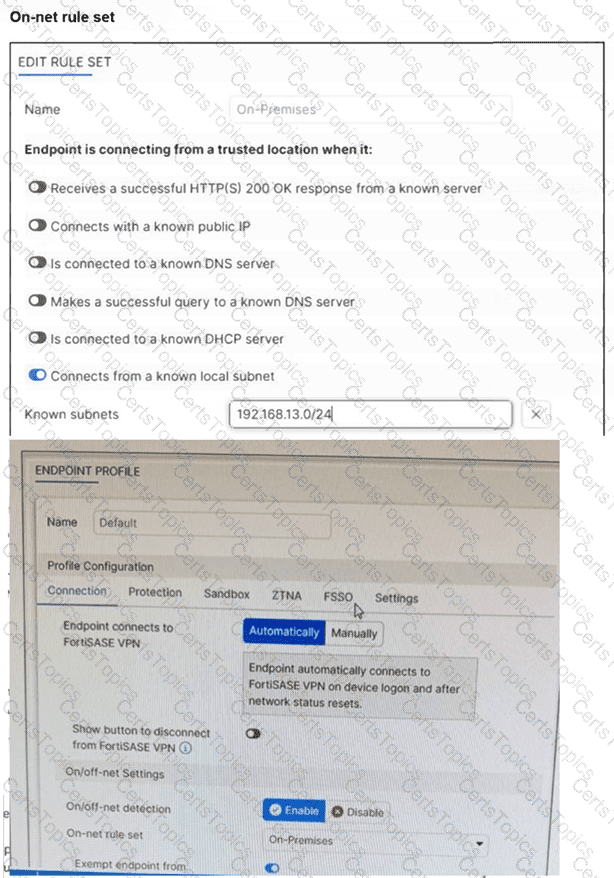
A customer configured the On/off-net detection rule to disable FortiSASE VPN auto-connect when users are inside the corporate network. The rule is set to Connects with a known public IP using the company’s public IP address. However, when the users are on the corporate network, the FortiSASE VPN still auto-connects. The customer has confirmed that traffic is going to the internet with the correct IP address.

Which configuration is causing the issue? (Choose one answer)

Options:

A.

The On-net rule set configuration is incorrect.

B.

Allow local LAN access when endpoint is on-net is disabled when it should be enabled.

C.

Exempt endpoint from FortiSASE auto-connect is disabled when it should be enabled.

D.

Is connected to a known DNS server should be enabled and configured.

Question 22

Your FortiSASE customer has a small branch office in which ten users will be using their personal laptops and mobile devices to access the internet. Which deployment should they use to secure their internet access with minimal configuration? (Choose one answer)

Options:

A.

FortiClient endpoint agent to secure internet access

B.

FortiAP to secure internet access

C.

SD-WAN on-ramp to secure internet access

D.

FortiGate as a LAN extension to secure internet access

Question 23

Which two statements about FortiSASE Geofencing with regional compliance are true? (Choose two answers)

Options:

A.

You can configure regional compliance on the security POP or the on-premises device, not both.1

B.

If no regional compliance rule is configured, the connection is made to the closest security POP.

C.

A regional compliance rule can connect only to an on-premises device or only to a security POP.2

D.

The connection order for a regional compliance rule is always the security POP first, followed by the on-premises device.

Question 24

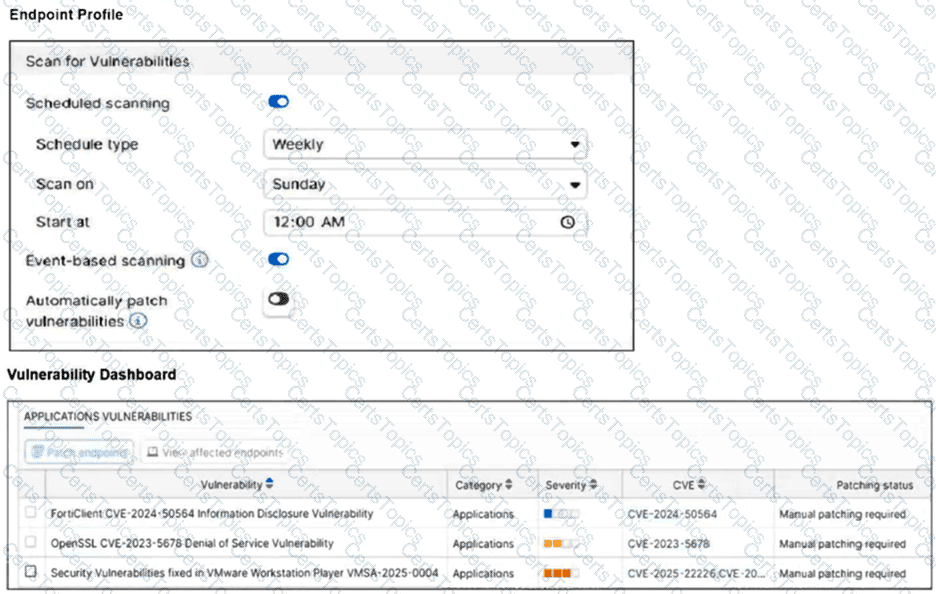
Refer to the exhibit.

Which type of information or actions are available to a FortiSASE administrator from the following output? (Choose one answer)

Options:

A.

Administrators can view and configure endpoint profiles and ZTNA tags.

B.

Administrators can view and configure automatic patching of endpoints, and first detected date for applications.

C.

Administrators can view latest application version available and push updates to managed endpoints.

D.

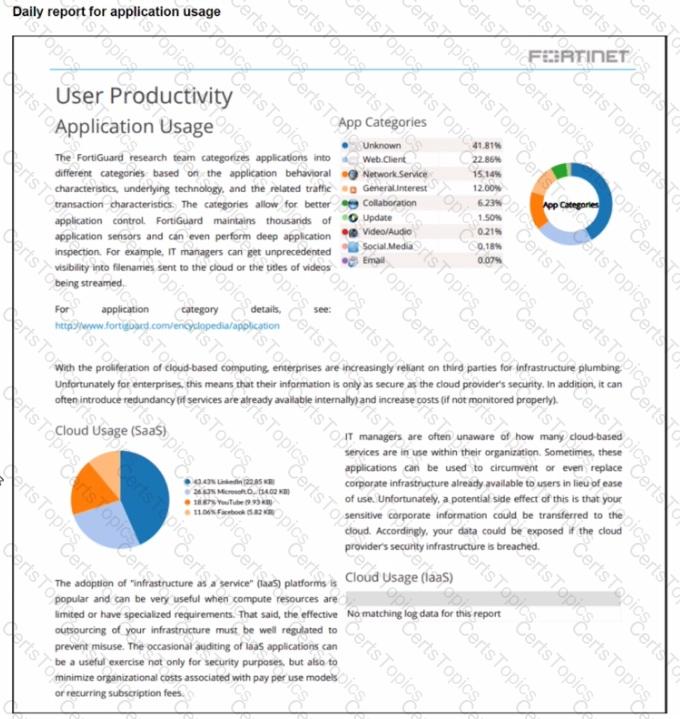
Administrators can view application details, such as vendor, version, and installation dates to identify unwanted or outdated software.