
Refer to the exhibit.
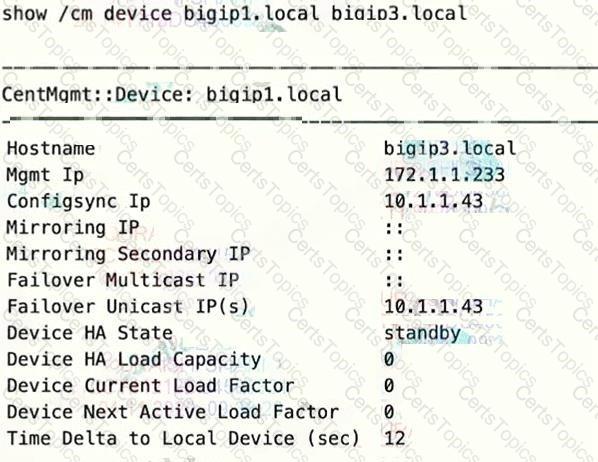
The BIG-IP Administrator runs the command shown and observes a device trust issue between BIG-IP devices in a device group. The issue prevents config sync on device bigip3.local. What is preventing the config sync?
In which of the following log files would log events pertaining to pool members being marked “UP” or “DOWN” by their Health Monitors be written? (Choose one answer)
A user needs to generate a QKView to upload to iHealth to determine any issues with upgrading TMOS. Where can the user generate the QKView in the Configuration Utility?
A configuration change is made on the standby member of a device group. What is displayed as " Recommended Action " on the Device Management Overview screen?
Which TMSH command initiates a manual configuration synchronization to the specified device group ? (Choose one answer)
A BIG-IP Administrator needs to check the memory utilization on a BIG-IP system. Which two methods can the BIG-IP Administrator use? (Choose two.)
A BIG-IP Administrator needs to load a UCS file but must exclude the license file .
How should the administrator perform this task? (Choose one answer)
As an organization grows, more people have to log into the BIG-IP. Instead of adding more local users, the BIG-IP Administrator is asked to configure remote authentication against a central authentication server.
Which two types of remote server can be used here? (Choose two answers)
New Syslog servers have been deployed in an organization. The BIG-IP Administrator must reconfigure the BIG-IP system to send log messages to these servers.
In which location in the Configuration Utility can the BIG-IP Administrator make the needed configuration changes to accomplish this? (Choose one answer)
A BIG-IP Administrator plans to resolve a non-critical issue with a BIG-IP device in 2 weeks. What Severity level should be assigned to this type of F5 support ticket?
A BIG-IP Administrator must determine if a Virtual Address is configured to fail over to the standby member of a device group. In which area of the Configuration Utility can this be confirmed?
A BIG-IP Administrator is setting up a new BIG-IP device. The network administrator reports that the interface has an incompatible media speed. The BIG-IP Administrator needs to change this setting manually. From which location should the BIG-IP Administrator perform this task?14
Users are unable to reach an application. The BIG-IP Administrator checks the Configuration Utility and observes that the Virtual Server has a red diamond in front of the status.
What is causing this issue? (Choose one answer)
A BIG-IP Administrator runs the initial configuration wizard and learns that the NTP servers were invalid .
In which area of the Configuration Utility should the BIG-IP Administrator update the list of configured NTP servers? (Choose one answer)
A BIG-IP Administrator receives an RMA replacement for a failed F5 device. The Administrator tries to restore a UCS taken from the previous device, but the restore fails. The following error appears in the /var/log/ltm:
insufficient pool members. 01070608:3: License is not operational
(expired, digital signature does not match contents)
What should the BIG-IP Administrator do to avoid this error ? (Choose one answer)
One of the two members of a device group has been decommissioned. The BIG-IP Administrator tries to delete the device group, but is unsuccessful.
Prior to removing the device group, which action should be performed? (Choose one answer)
A local user account (Users) on the BIG-IP device is assigned the User Manager role. User1 attempts to modify the properties of another account (User2), but the action fails. The BIG-IP Administrator can successfully modify the User2 account. Assuming the principle of least privilege, what is the correct way to allow User1 to modify User2 properties?
A BIG-IP device sends out the following SNMP trap: big-ipo.f5.com - bigipExternalLinkChange Link: 1.0 is DOWN. Where in the BIG-IP Configuration utility should the BIG-IP Administrator verify the current status of Link 1.0?
A BIG-IP Administrator needs to update the list of configured NTP servers. In which area of the Configuration Utility should the BIG-IP Administrator perform this update?
One of the two members of a device group has been decommissioned. The BIG-IP Administrator tries to delete the device group, but is unsuccessful. Prior to removing the device group, which action should be performed?
Which two log files can be used to identify hardware issues? (Choose two answers)
Copyright © 2021-2026 CertsTopics. All Rights Reserved
