
The BIG-IP appliance fails to boot. The BIG-IP Administrator needs to run the End User Diagnostics (EUD) utility to collect data to send to F5 Support. Where can the BIG-IP Administrator access this utility?
Active connections to pool members are unevenly distributed. The load balancing method is Least Connections (member). Priority Group Activation is disabled. What is a potential cause of the uneven traffic distribution?
A BIG-IP Administrator assigns thedefault HTTP health monitorto a pool that has three members listening on port 80. When the administrator connects to each pool member using thecurlutility, two of the members respond with a status of404 Not Found, while the third responds with200 OK. What will the pool show for member availability? (Choose one answer)
What is the result when a BIG-IP Administratormanually disables a pool member? (Choose one answer)
A BIG-IP Administrator explicitly creates a traffic group on a BIG-IP device. Which two types of configuration objects can be associated with this traffic group? (Choose two.)
A BIG-IP Administrator needs to have a BIG-IP linked to two upstream switches for resilience of the external network. The network engineer who is going to configure the switch instructs the BIG-IP Administrator to configure interface binding with LACP. Which configuration should the administrator use?
The BIG-IP Administrator wants to provide quick failover between the F5 LTM devices that are configured in an HA Pair with a single traffic-group. The BIG-IP Administrator wants to implement the Mac Masquerade feature for this quick failover and run this command: tmsh modify /cm traffic-group traffic-group-1 mac 02:12:34:56:00:00. However, the Network Operations team has identified an issue with the use of the same MAC address being used within different VLANs. As a result of this, the BIG-IP Administrator must implement the Per-VLAN Mac Masquerade in order to have a unique MAC address on each VLAN: tmsh modify /sys db tm.macmasqaddr_per_vlan value true. What would be the resulting MAC address on a tagged VLAN of 1501?
Active connections to pool members are unevenly distributed. The load balancing method isLeast Connections (member).Priority Group Activation is disabled.
What is a potential cause of the uneven distribution? (Choose one answer)
Whichvirtual server typeis being configured in the screenshot? (Choose one answer.)
A BIG-IP system receives a client connection destined to1.0.0.10:8080. Multiple virtual servers are configured on the system. Which virtual server will process the connection? (Choose one answer)
A development team needs to apply a software fix and troubleshoot one of its servers. The BIG-IP Administrator needs to immediately remove all connections from the BIG-IP system to the back-end server. The BIG-IP Administrator checks the Virtual Server configuration and finds that a persistence profile is assigned to it. What should the BIG-IP Administrator do to meet this requirement?
The BIG-IP Administrator wants to provide quick failover between the F5 LTM devices that are configured as an HA pair with a single Self IP using the MAC Masquerade feature. The administrator configures MAC masquerade for traffic-group-1 using the following command:
`tmsh modify /cm traffic-group traffic-group-1 mac 02:12:34:56:00:00`
However, the Network Operations team identifies an issue with using the same MAC address across multiple VLANs. As a result, the administrator enables Per-VLAN MAC Masquerade to ensure a unique MAC address per VLAN by running:
`tmsh modify /sys db tm.macmasqaddr_per_vlan value true`
What would be the resulting MAC address on a tagged VLAN with ID 1501? (Choose one answer)
What type of virtual server has a destination of 0.0.0.0 and listens on a specific VLAN? (Choose one answer)
Which statement is true concerning cookie persistence?
Refer to the exhibit.
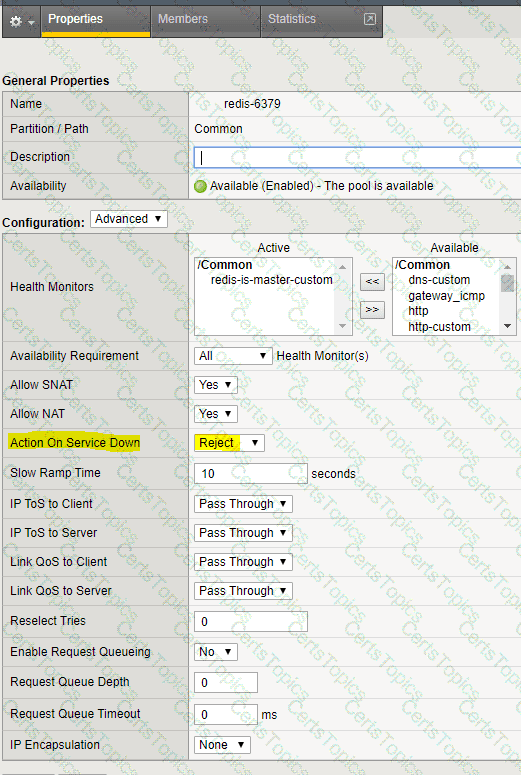
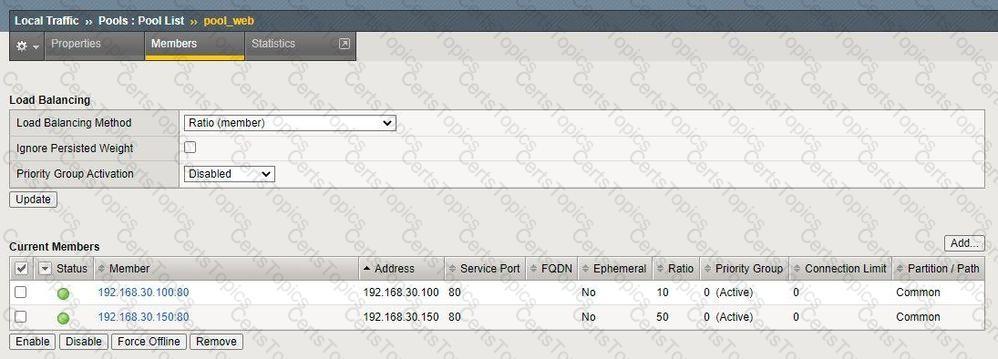
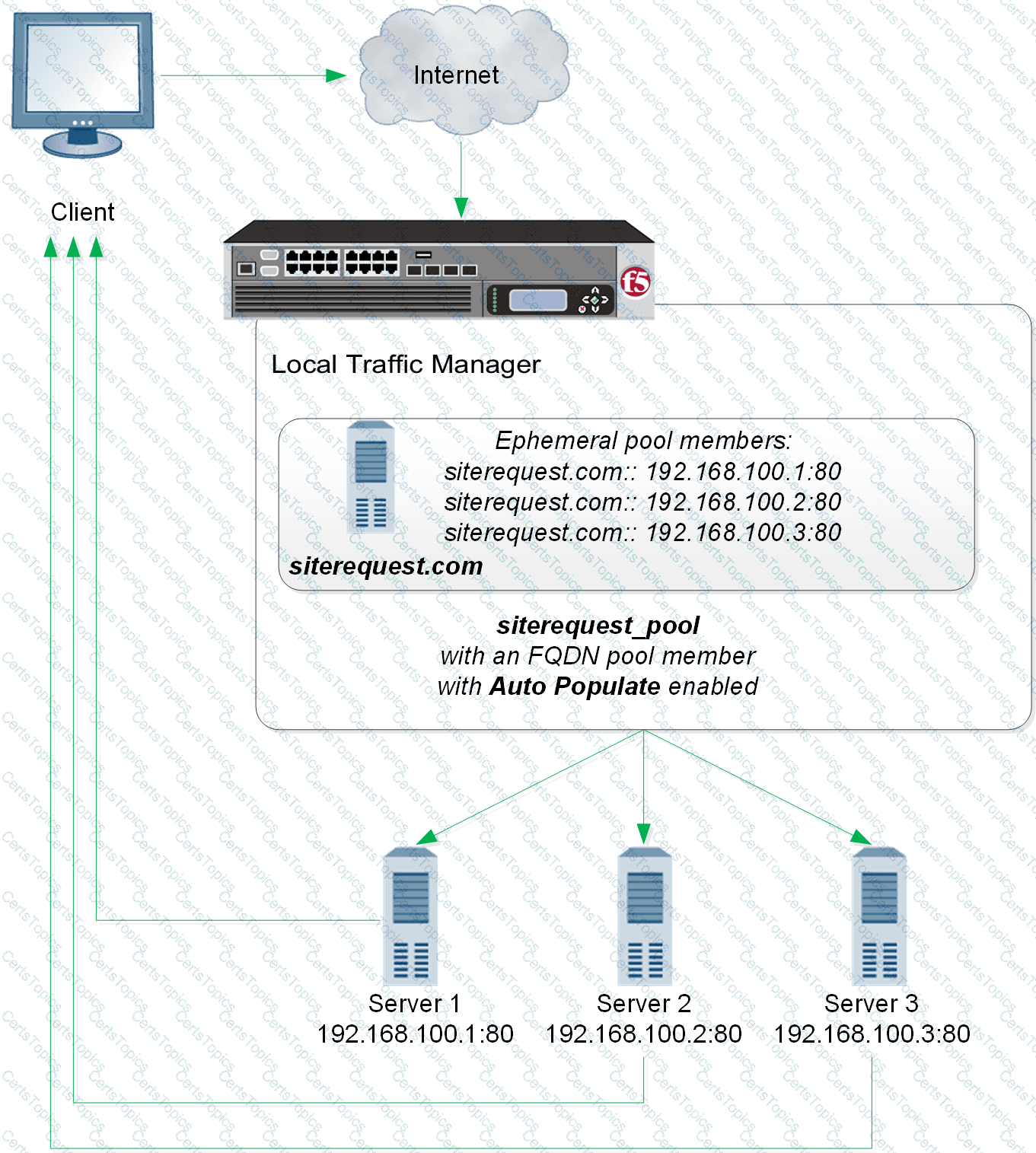
The BIG-IP Administrator needs toavoid overloading any of the pool members with connections when they become active. What should the BIG-IP Administrator configure to meet this requirement? (Choose one answer)
A BIG-IP Administrator configures remote authentication and needs to make sure that users can still login even when the remote authentication server is unavailable. Which action should the BIG-IP Administrator take in the remote authentication configuration to meet this requirement?
What should a BIG-IP Administrator configure to minimize impact during a failover?
What should a BIG-IP Administrator configure tominimize impact during a failover? (Choose one answer)
A standard virtual server has been associated with a pool with multiple members. Assuming all other settings are left at their defaults, which statement is always true concerning traffic processed by the virtual server?
Copyright © 2021-2026 CertsTopics. All Rights Reserved
