
Summer Certification Sale 70% Discount Offer - Ends in 0d 00h 00m 00s - Coupon code: save70

Free and Premium Databricks Databricks-Certified-Data-Analyst-Associate Dumps Questions Answers

Databricks Certified Data Analyst Associate Exam Questions and Answers

Question 1

Which of the following commands will return the location of database customer360?

Options:

A.

DESCRIBE LOCATION customer360;

B.

DROP DATABASE customer360;

C.

DESCRIBE DATABASE customer360;

D.

ALTER DATABASE customer360 SET DBPROPERTIES ( ' location ' = ' /user ' );

E.

USE DATABASE customer360;

Buy Now
Question 2

The stakeholders.customers table has 15 columns and 3,000 rows of data. The following command is run:

After running SELECT * FROM stakeholders.eur_customers, 15 rows are returned. After the command executes completely, the user logs out of Databricks.

After logging back in two days later, what is the status of the stakeholders.eur_customers view?

Options:

A.

The view remains available and SELECT * FROM stakeholders.eur_customers will execute correctly.

B.

The view has been dropped.

C.

The view is not available in the metastore, but the underlying data can be accessed with SELECT * FROM delta. `stakeholders.eur_customers`.

D.

The view remains available but attempting to SELECT from it results in an empty result set because data in views are automatically deleted after logging out.

E.

The view has been converted into a table.

Question 3

A data analyst has created a Delta table sales that is used by the entire data analysis team. They want help from the data engineering team to implement a series of tests to ensure the data is clean. However, the data engineering team uses Python for its tests rather than SQL.

Which command could the data engineering team use to access sales in PySpark?

Options:

A.

SELECT * FROM sales

B.

spark.table( " sales " )

C.

spark.sql( " sales " )

D.

spark.delta.table( " sales " )

Question 4

A data analyst needs to create an empty managed table table_name in database database_name with a specific schema. The table needs to be recreated and empty, regardless of whether or not the table already exists.

Which command can the analyst use to complete the task?

Options:

A.

CREATE TABLE database_name.table_name USING (width INT, length INT, height INT);

B.

CREATE OR REPLACE TABLE database_name.table_name USING (width INT, length INT, height INT);

C.

CREATE OR REPLACE TABLE database_name.table_name (width INT, length INT, height INT);

D.

CREATE OR REPLACE TABLE table_name FROM database_name USING (width INT, length INT, height INT);

Question 5

What describes Partner Connect in Databricks?

Options:

A.

it allows for free use of Databricks partner tools through a common API.

B.

it allows multi-directional connection between Databricks and Databricks partners easier.

C.

It exposes connection information to third-party tools via Databricks partners.

D.

It is a feature that runs Databricks partner tools on a Databricks SQL Warehouse (formerly known as a SQL endpoint).

Question 6

A data engineer wants to create a relational object by pulling data from two tables. The relational object does not need to be used by other data engineers in other sessions. In order to save on storage costs, the data engineer wants to avoid copying and storing physical data.

Which of the following relational objects should the data engineer create?

Options:

A.

Spark SQL Table

B.

View

C.

Database

D.

Temporary view

E.

Delta Table

Question 7

Which of the following Structured Streaming queries is performing a hop from a Silver table to a Gold table?

Options:

A.

( spark.readStream.load(rawSalesLocation) .writeStream .option( " checkpointLocation " , checkpointPath) .outputMode( " append " ) .table( " newSales " ))

B.

( spark.table( " sales " ) .withColumn( " avgPrice " , col( " sales " ) / col( " units " )) .writeStream .option( " checkpointLocation " , checkpointPath) .outputMode( " append " ) .table( " newSales " ))

C.

( spark.table( " sales " ) .withColumn( " avgPrice " , col( " sales " ) / col( " units " )) .writeStream .option( " checkpointLocation " , checkpointPath) .outputMode( " append " ) .table( " newSales " ))

D.

( spark.table( " sales " ) .filter(col( " units " ) > 0) .writeStream .option( " checkpointLocation " , checkpointPath) .outputMode( " append " ) .table( " newSales " ))

E.

( spark.table( " sales " ) .groupBy( " store " ) .agg(sum( " sales " )) .writeStream .option( " checkpointLocation " , checkpointPath) .outputMode( " complete " ) .table( " newSales " ))

F.

Option A

G.

Option B

Question 8

Which of the following statements describes descriptive statistics?

Options:

A.

A branch of statistics that uses summary statistics to quantitatively describe and summarize data.

B.

A branch of statistics that uses a variety of data analysis techniques to infer properties of an underlying distribution of probability.

C.

A branch of statistics that uses quantitative variables that must take on a finite or countably infinite set of values.

D.

A branch of statistics that uses summary statistics to categorically describe and summarize data.

E.

A branch of statistics that uses quantitative variables that must take on an uncountable set of values.

Question 9

A data engineering team has created a Structured Streaming pipeline that processes data in micro-batches and populates gold-level tables. The microbatches are triggered every minute.

A data analyst has created a dashboard based on this gold-level data. The project stakeholders want to see the results in the dashboard updated within one minute or less of new data becoming available within the gold-level tables.

Which of the following cautions should the data analyst share prior to setting up the dashboard to complete this task?

Options:

A.

The required compute resources could be costly

B.

The gold-level tables are not appropriately clean for business reporting

C.

The streaming data is not an appropriate data source for a dashboard

D.

The streaming cluster is not fault tolerant

E.

The dashboard cannot be refreshed that quickly

Question 10

Which of the following should data analysts consider when working with personally identifiable information (PII) data?

Options:

A.

Organization-specific best practices for Pll data

B.

Legal requirements for the area in which the data was collected

C.

None of these considerations

D.

Legal requirements for the area in which the analysis is being performed

E.

All of these considerations

Question 11

How can a data analyst determine if query results were pulled from the cache?

Options:

A.

Go to the Query History tab and click on the text of the query. The slideout shows if the results came from the cache.

B.

Go to the Alerts tab and check the Cache Status alert.

C.

Go to the Queries tab and click on Cache Status. The status will be green if the results from the last run came from the cache.

D.

Go to the SQL Warehouse (formerly SQL Endpoints) tab and click on Cache. The Cache file will show the contents of the cache.

E.

Go to the Data tab and click Last Query. The details of the query will show if the results came from the cache.

Question 12

A data analysis team has noticed that their Databricks SQL queries are running too slowly when connected to their always-on SQL endpoint. They claim that this issue is present when many members of the team are running small queries simultaneously. They ask the data engineering team for help. The data engineering team notices that each of the team’s queries uses the same SQL endpoint.

Which of the following approaches can the data engineering team use to improve the latency of the team’s queries?

Options:

A.

They can increase the cluster size of the SQL endpoint.

B.

They can increase the maximum bound of the SQL endpoint’s scaling range.

C.

They can turn on the Auto Stop feature for the SQL endpoint.

D.

They can turn on the Serverless feature for the SQL endpoint.

E.

They can turn on the Serverless feature for the SQL endpoint and change the Spot Instance Policy to “Reliability Optimized.”

Question 13

A data analyst has created a user-defined function using the following line of code:

CREATE FUNCTION price(spend DOUBLE, units DOUBLE)

RETURNS DOUBLE

RETURN spend / units;

Which of the following code blocks can be used to apply this function to the customer_spend and customer_units columns of the table customer_summary to create column customer_price?

Options:

A.

SELECT PRICE customer_spend, customer_units AS customer_price FROM customer_summary

B.

SELECT price FROM customer_summary

C.

SELECT function(price(customer_spend, customer_units)) AS customer_price FROM customer_summary

D.

SELECT double(price(customer_spend, customer_units)) AS customer_price FROM customer_summary

E.

SELECT price(customer_spend, customer_units) AS customer_price FROM customer_summary

Question 14

Which of the following describes how Databricks SQL should be used in relation to other business intelligence (BI) tools like Tableau, Power BI, and looker?

Options:

A.

As an exact substitute with the same level of functionality

B.

As a substitute with less functionality

C.

As a complete replacement with additional functionality

D.

As a complementary tool for professional-grade presentations

E.

As a complementary tool for quick in-platform Bl work

Question 15

A data analyst needs to use the Databricks Lakehouse Platform to quickly create SQL queries and data visualizations. It is a requirement that the compute resources in the platform can be made serverless, and it is expected that data visualizations can be placed within a dashboard.

Which of the following Databricks Lakehouse Platform services/capabilities meets all of these requirements?

Options:

A.

Delta Lake

B.

Databricks Notebooks

C.

Tableau

D.

Databricks Machine Learning

E.

Databricks SQL

Question 16

Which of the following layers of the medallion architecture is most commonly used by data analysts?

Options:

A.

None of these layers are used by data analysts

B.

Gold

C.

All of these layers are used equally by data analysts

D.

Silver

E.

Bronze

Question 17

A data analyst has been asked to configure an alert for a query that returns the income in the accounts_receivable table for a date range. The date range is configurable using a Date query parameter.

The Alert does not work.

Which of the following describes why the Alert does not work?

Options:

A.

Alerts don ' t work with queries that access tables.

B.

Queries that return results based on dates cannot be used with Alerts.

C.

The wrong query parameter is being used. Alerts only work with Date and Time query parameters.

D.

Queries that use query parameters cannot be used with Alerts.

E.

The wrong query parameter is being used. Alerts only work with drogdown list query parameters, not dates.

Question 18

A data scientist wants to tune a set of hyperparameters for a machine learning model. They have wrapped a Spark ML model in the objective function objective_function, and they have defined the search space search_space.

As a result, they have the following code block:

num_evals = 100

trials = SparkTrials()

best_hyperparam = fmin(

fn=objective_function,

space=search_space,

algo=tpe.suggest,

max_evals=num_evals,

trials=trials

)

Which of the following changes do they need to make to the above code block in order to accomplish the task?

Options:

A.

Change SparkTrials() to Trials()

B.

Reduce num_evals to be less than 10

C.

Change fmin() to fmax()

D.

Remove the trials=trials argument

E.

Remove the algo=tpe.suggest argument

Question 19

Which location can be used to determine the owner of a managed table?

Options:

A.

Review the Owner field in the table page using Catalog Explorer

B.

Review the Owner field in the database page using Data Explorer

C.

Review the Owner field in the schema page using Data Explorer

D.

Review the Owner field in the table page using the SQL Editor

Question 20

A data analyst is attempting to drop a table my_table. The analyst wants to delete all table metadata and data.

They run the following command:

DROP TABLE IF EXISTS my_table;

While the object no longer appears when they run SHOW TABLES, the data files still exist.

Which of the following describes why the data files still exist and the metadata files were deleted?

Options:

A.

The table ' s data was larger than 10 GB

B.

The table did not have a location

C.

The table was external

D.

The table ' s data was smaller than 10 GB

E.

The table was managed

Question 21

Which statement about subqueries is correct?

Options:

A.

Subqueries are not available in Databricks SQL

B.

Subqueries can be used like other user-defined functions to transform data into different data types.

C.

Subqueries can retrieve data without requiring the creation of a table or view.

D.

Subqueries can be used like other built-in functions to transform data into different data types.

Question 22

What is a benefit of using Databricks SQL for business intelligence (Bl) analytics projects instead of using third-party Bl tools?

Options:

A.

Computations, data, and analytical tools on the same platform

B.

Advanced dashboarding capabilities

C.

Simultaneous multi-user support

D.

Automated alerting systems

Question 23

A data analyst wants to create a dashboard with three main sections: Development, Testing, and Production. They want all three sections on the same dashboard, but they want to clearly designate the sections using text on the dashboard.

Which of the following tools can the data analyst use to designate the Development, Testing, and Production sections using text?

Options:

A.

Separate endpoints for each section

B.

Separate queries for each section

C.

Markdown-based text boxes

D.

Direct text written into the dashboard in editing mode

E.

Separate color palettes for each section

Question 24

Which of the following approaches can be used to ingest data directly from cloud-based object storage?

Options:

A.

Create an external table while specifying the DBFS storage path to FROM

B.

Create an external table while specifying the DBFS storage path to PATH

C.

It is not possible to directly ingest data from cloud-based object storage

D.

Create an external table while specifying the object storage path to FROM

E.

Create an external table while specifying the object storage path to LOCATION

Question 25

A data analyst wants to create a Databricks SQL dashboard with multiple data visualizations and multiple counters. What must be completed before adding the data visualizations and counters to the dashboard?

Options:

A.

All data visualizations and counters must be created using Queries.

B.

A SQL warehouse (formerly known as SQL endpoint) must be turned on and selected.

C.

A markdown-based tile must be added to the top of the dashboard displaying the dashboard ' s name.

D.

The dashboard owner must also be the owner of the queries, data visualizations, and counters.

Question 26

A data analyst has created a Query in Databricks SQL, and now they want to create two data visualizations from that Query and add both of those data visualizations to the same Databricks SQL Dashboard.

Which of the following steps will they need to take when creating and adding both data visualizations to the Databricks SQL Dashboard?

Options:

A.

They will need to alter the Query to return two separate sets of results.

B.

They will need to add two separate visualizations to the dashboard based on the same Query.

C.

They will need to create two separate dashboards.

D.

They will need to decide on a single data visualization to add to the dashboard.

E.

They will need to copy the Query and create one data visualization per query.

Question 27

Data professionals with varying titles use the Databricks SQL service as the primary touchpoint with the Databricks Lakehouse Platform. However, some users will use other services like Databricks Machine Learning or Databricks Data Science and Engineering.

Which of the following roles uses Databricks SQL as a secondary service while primarily using one of the other services?

Options:

A.

Business analyst

B.

SQL analyst

C.

Data engineer

D.

Business intelligence analyst

E.

Data analyst

Question 28

An analyst writes a query that contains a query parameter. They then add an area chart visualization to the query. While adding the area chart visualization to a dashboard, the analyst chooses " Dashboard Parameter " for the query parameter associated with the area chart.

Which of the following statements is true?

Options:

A.

The area chart will use whatever is selected in the Dashboard Parameter while all or the other visualizations will remain changed regardless of their parameter use.

B.

The area chart will use whatever is selected in the Dashboard Parameter along with all of the other visualizations in the dashboard that use the same parameter.

C.

The area chart will use whatever value is chosen on the dashboard at the time the area chart is added to the dashboard.

D.

The area chart will use whatever value is input by the analyst when the visualization is added to the dashboard. The parameter cannot be changed by the user afterwards.

E.

The area chart will convert to a Dashboard Parameter.

Question 29

A data analyst has written and saved a series of queries that reveal trends that need to be monitored by several stakeholders.

Which tool should the data analyst use to share the results of all of the queries to be viewed at once?

Options:

A.

A SQL warehouse

B.

A Query History page

C.

A dashboard

D.

A data visualization tab on a Query page

Question 30

What does Partner Connect do when connecting Power Bl and Tableau?

Options:

A.

Creates a Personal Access Token. downloads and installs an ODBC driver, and downloads a configuration file for connection by Power Bl or Tableau to a SQL Warehouse (formerly known as a SQL Endpoint).

B.

Creates a Personal Access Token for authentication into Databricks SQL and emails it to you.

C.

Downloads a configuration file for connection by Power Bl or Tableau to a SQL Warehouse (formerly known as a SQL Endpoint).

D.

Downloads and installs an ODBC driver.

Question 31

Which of the following SQL keywords can be used to convert a table from a long format to a wide format?

Options:

A.

TRANSFORM

B.

PIVOT

C.

SUM

D.

CONVERT

E.

WHERE

Question 32

A data analyst runs the following command:

INSERT INTO stakeholders.suppliers TABLE stakeholders.new_suppliers;

What is the result of running this command?

Options:

A.

The suppliers table now contains both the data it had before the command was run and the data from the new suppliers table, and any duplicate data is deleted.

B.

The command fails because it is written incorrectly.

C.

The suppliers table now contains both the data it had before the command was run and the data from the new suppliers table, including any duplicate data.

D.

The suppliers table now contains the data from the new suppliers table, and the new suppliers table now contains the data from the suppliers table.

E.

The suppliers table now contains only the data from the new suppliers table.

Question 33

Which of the following is an advantage of using a Delta Lake-based data lakehouse over common data lake solutions?

Options:

A.

ACID transactions

B.

Flexible schemas

C.

Data deletion

D.

Scalable storage

E.

Open-source formats

Question 34

A data analyst is working in an organization that utilizes a multi-hop, medallion architecture. They have been tasked with creating a new Gold table from an existing Silver table.

Which query is performing a hop from a Silver table to a Gold table?

A)
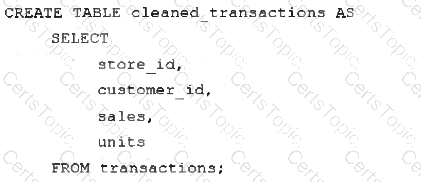
B)

C)
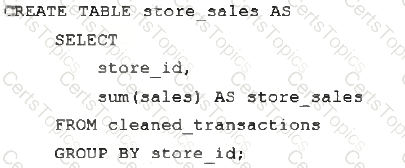
D)
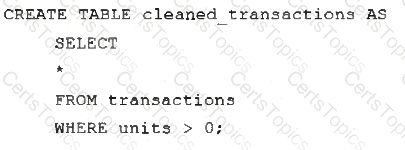
Options:

A.

Option A

B.

Option B

C.

Option C

D.

Option D

Question 35

A data analyst has two data sources that are providing similar but complementary information. The analyst wants to combine these sources of data into a single, comprehensive dataset for ongoing use for their team in a variety of different projects.

Which term is used to describe this type of work?

Options:

A.

Last-mile ETL

B.

Ad-hoc improvements

C.

Data testing

D.

Data blending
