Which of the following is required first in order to send a prompt query and response in a language model (LLM) system when authentication is enabled?
An AI security administrator receives an inquiry about an unusually high monthly bill from the AI solution provider. The administrator thinks the majority of staff might be using the most powerful model available.
Which of the following AI measures should the administrator implement to lower costs?
For which of the following situations would a human-in-the-loop be most recommended?
A customer-facing, AI-powered chatbot has been jailbroken through prompt injections. As a result, the AI model is offering a 99% discount on the purchase of a new vehicle.
Which of the following should be implemented to enhance the model ' s robustness against such attacks?
A data scientist investigates reports that a production machine learning (ML) model no longer performs with accuracy.
The data scientist finds the following pipeline log entries:

Which of the following should the security team do to mitigate future occurrences?
A threat intelligence team wants to automate the analysis and summary of its in-depth reports for multiple target audiences. Which of the following is the best solution?
A security analyst who is reviewing logs notices the following:
• Suspicious inputs are present and contain character look-alikes.
• Strange character substitutions
• Odd spacing
• Inputs that appear to be broken sentence structures
Which of the following best explains what the user was utilizing?
An organization develops a chatbot that does not provide harmful or explicit responses, must use clean and professional language, and ensures that responses are accurate.
Which of the following should the organization conduct after the chatbot is fully developed but before a customer-facing deployment?
A line of business wants to onboard an application that uses a custom AI model for employee assessments. The Chief Information Officer (CIO) agrees to allow the engagement to proceed but first wants a threat model.
Which of the following is the most appropriate to use for an AI threat model?
Which of the following certifies an organization in the use of responsible AI?
Which of the following improves the observability and auditing of an AI system?
Which of the following is the most concerning risk for a company that allows corporate end users to use public-facing large language models (LLMs)?
Which of the following is the most impactful security risk associated with the use of a generative AI chatbot?
A legal firm permits employees to use a company-authorized chatbot for their research and reporting. In the past year, the firm had to retract some of its released documents because of incorrect references.
Which of the following best describes the weakness that caused this issue?
Which of the following strengthens the performance of a large language model (LLM) for malicious reconnaissance?
Which of the following attacks would be the best to automate with AI during dynamic application software testing (DAST)?
A company uses human review for software development validation and wants to add another validation layer.
Which of the following should a security administrator use to accomplish this task?
An organization deploys an application programming interface (API) to allow external customers to perform tasks supported by internally developed AI models. Some customers require limited use of sensitive data. After the API is deployed, customers report that the API returns sensitive data to all customers. Which of the following is the best action to take with the API?
Security analysts want to track potential user behavior anomalies over time. Which of the following is the most comprehensive approach?
A user interface engineer adds new graphics to the latest release of an AI-integrated application. During the update, the engineer accidentally causes the model to retrain on unverified data. After the update, the model begins to return many errors.
Which of the following is the best way to mitigate future errors?
Which of the following describe the practice of providing examples in a prompt? (Choose two.)
A developer is proposing a new AI application for human resources systems. Which of the following are the most important considerations?
Which of the following best describes the risk of too many epochs on the same data?
During the selection of a machine learning (ML)-based threat classification model, a cybersecurity administrator verifies that label distribution is highly unbalanced.
Which of the following processing techniques should the engineer use to balance the model?
A cybersecurity administrator must examine the cost of AI and implement controls so the research environment operates within a specified budget.
Which of the following controls is best for this situation?
A security analyst notices that regardless of user-submitted prompts, an AI model always returns unsanitized responses. These responses are then passed to multiple plug-ins. The analyst is concerned with the potential security implications.
Which of the following Open Worldwide Application Security Project (OWASP) categories addresses this vulnerability?
Which of the following is the best example of an AI model that is trained to identify multiple points from input using a neural network to provide output for authentication?
A team of data scientists is ready to release a model for enterprise use. The team wants to protect the model from unintentional changes or tampering.
Which of the following is the most appropriate action?
A social media company with more than a million lines of code wants to reduce the mean time to fix bugs and issues.
Which of the following is the most balanced AI strategy to automate the vulnerability management flow?
Which of the following attacks is most enabled by AI-generated content?
A company introduces a large language model (LLM) in an application in order to monitor for a potential denial-of-service attack.
Which of the following should the company use to measure the utilization of the LLM?
After the deployment of an AI system, an organization is unable to identify who approved the system and the method of validation. Which of the following governance failures occurred?
Customer feedback for an AI chatbot has a high-rate of non-answers, which is causing higher central processing unit (CPU) utilization.
Which of the following should be implemented?
A security architect performs threat modeling of an AI system. The architect needs to determine which attacks can be performed against the system.
Which of the following actions should the architect take next?
An architect is using the firm ' s recommended large language model (LLM) to find an internal solution for content management.
Given the following:

Which of the following controls is the best for mitigating this issue?
Instructions: Click the (+) to assign each threat category into its appropriate framework.
An architect is modeling an agentic system to meet security standards.

A manufacturing company wants to use AI within its operations to improve the efficiency and accuracy of its processes.
Which of the following should the organization do first to enable adoption and achieve the business objectives?
A security analyst is preparing a presentation for the sales team that describes the most common vulnerabilities that are specific to AI applications.
Which of the following is the best source for the analyst to consult?
A developer is selecting authentication controls for an AI system.
Which of the following is the best way to prevent threat actor replay attacks?
After the latest software update, a developer receives reports that the system no longer requires reauthentication to display account balances because this issue was present in a previous release. Which of the following should the developer do to best mitigate the risk of recurrence?
Which of the following should an auditor reference when reviewing a company ' s human resources AI systems for legal non-compliance?
Developers introduce new features to their generative AI product in an effort to stand out from the competition and offer more value to customers.
Which of the following most accurately explains the risks when enabling more functionality?
A recently deployed AI system becomes persistently unavailable. A restart temporarily fixes the issue, but the issue happens again. Upon examination of API logs, an analyst finds that external calls continued to use system resources after the action completed.
Which of the following is the best way to improve availability of the system?
Which of the following is an example of how a security analyst uses generative AI in the triage process?
A data scientist is working with unlabeled data and wants to build a clustering model.
Which of the following techniques should a data scientist use?
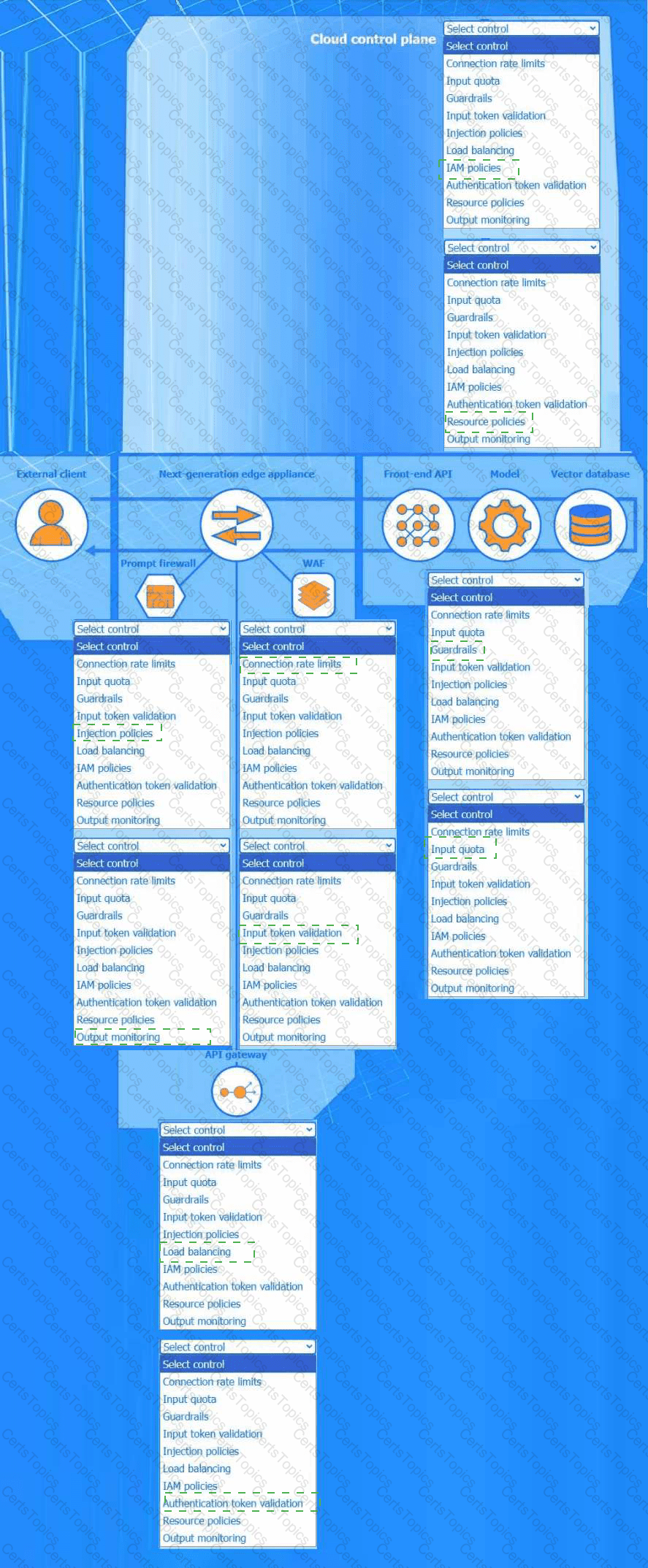
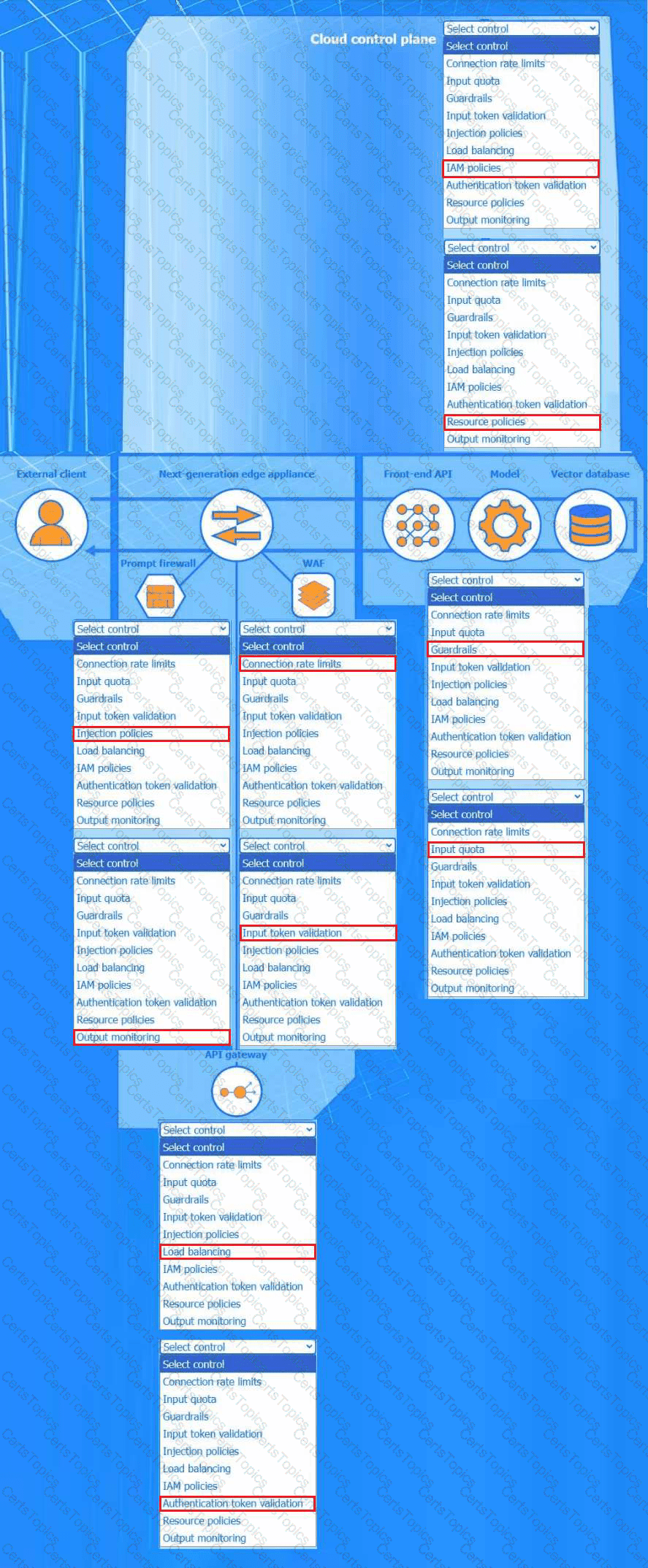
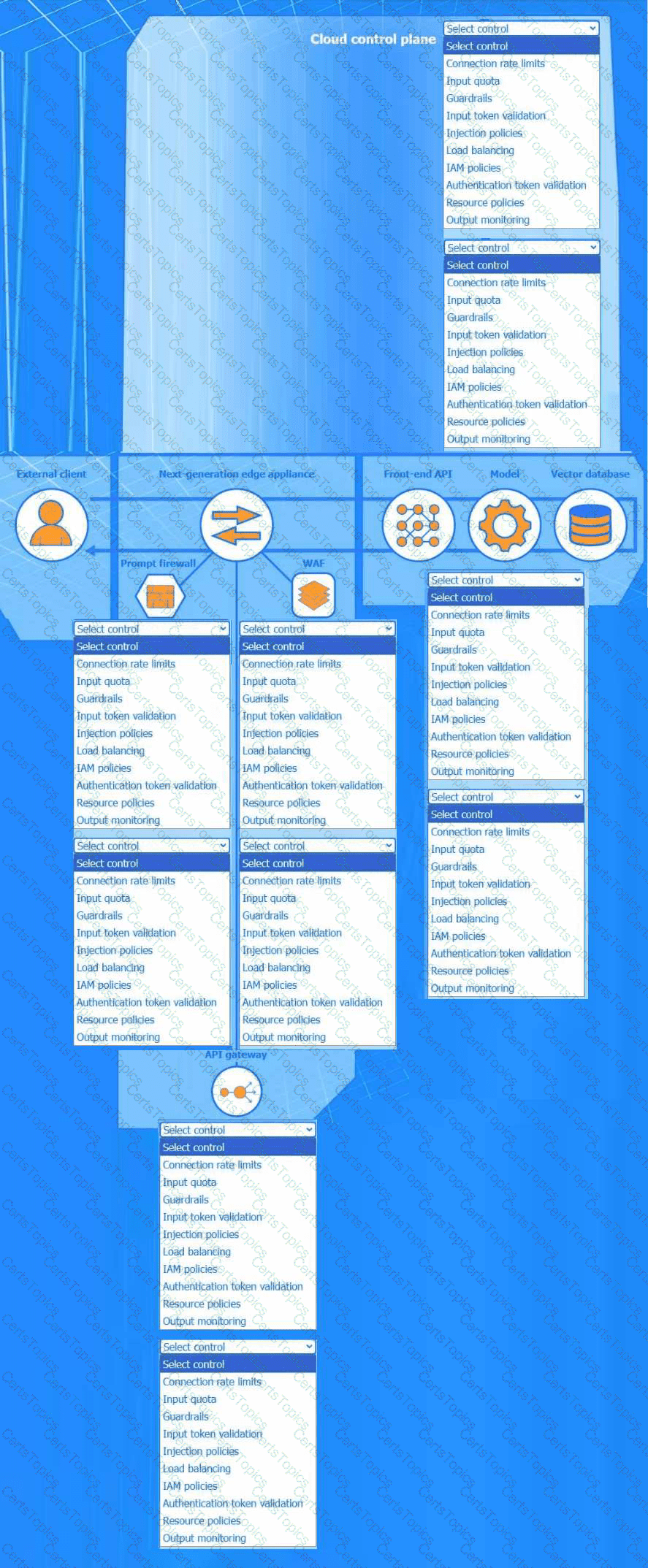
Instructions: Use the drop-down menus to define two appropriate security controls for each component of the AI system. Each control may be used only once.
An engineer is deploying a new AI system and wants to integrate it into the core system through an API.
Copyright © 2021-2026 CertsTopics. All Rights Reserved