New Year Sale 70% Discount Offer - Ends in 0d 00h 00m 00s - Coupon code: save70

Free and Premium ARDMS AE-Adult-Echocardiography Dumps Questions Answers

AE Adult Echocardiography Examination Questions and Answers

Question 1

Which coronary artery is identified by the arrow on this image?

Options:

A.

Right

B.

Left main

C.

Circumflex

D.

Left anterior descending

Buy Now
Question 2

Which pathology is demonstrated in this video clip?
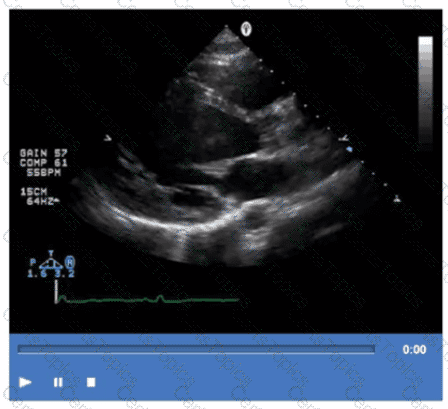
Options:

A.

Amyloidosis

B.

Sarcoidosis

C.

Apical hypertrophic cardiomyopathy

D.

Isolated left ventricular noncompaction

Question 3

Which finding is most commonly associated with Ebstein anomaly?

Options:

A.

Ventricular septal defect

B.

Atrial septal defect

C.

Pulmonary stenosis

D.

Tricuspid stenosis

Question 4

When should a patient's systemic blood pressure be documented on an echocardiogram?

Options:

A.

With every echocardiogram

B.

When significant aortic stenosis is present

C.

When significant mitral regurgitation is present

D.

When evidence of pulmonary hypertension is detected

Question 5

Which type of mass is typically attached to the fossa ovalis of the left atrium?

Options:

A.

Myxoma

B.

Fibroelastoma

C.

Sarcoma

D.

Lipoma

Question 6

Which wall is indicated by the arrows on this image?
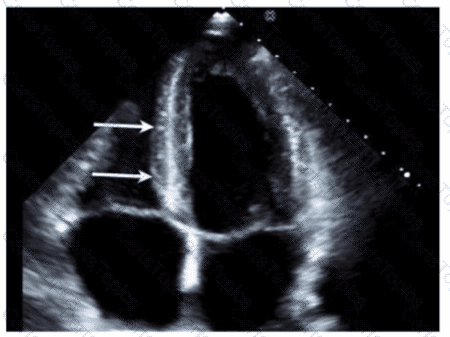
Options:

A.

Anteroseptum

B.

Inferoseptum

C.

Anterolateral

D.

Inferior

Question 7

Based on this video, what is the estimated right atrial pressure in millimeters of mercury (mmHg)?
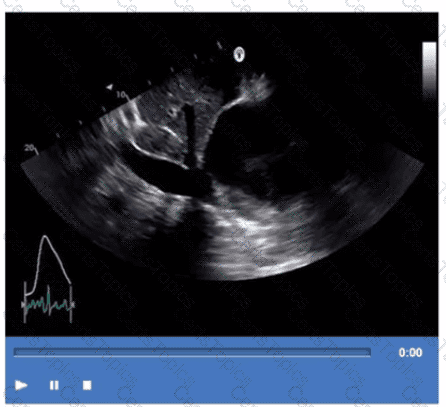
Options:

A.

3

B.

8

C.

10

D.

15

Question 8

Which Doppler signal is most consistent with significant aortic valve regurgitation?

Options:

A.

Pulsed wave Doppler forward flow in abdominal aorta

B.

Color Doppler vena contracta / Left ventricular outflow tract diameter ratio less than 25%

C.

Continuous wave Doppler pressure half-time less than 250 ms

D.

Continuous wave Doppler peak velocity equal to or greater than 4.5 m/s

Question 9

Which method of measuring left atrial size is most recommended and most accurate?

Options:

A.

3D imaging and volume calculations

B.

Linear dimension in the anteroposterior plane

C.

Area by planimetry, indexed to body surface area

D.

Biplane disk summation, indexed to body surface area

Question 10

Which adjustment is most likely to improve image quality from the suprasternal long axis window?

Options:

A.

Move probe just inferior to the sternum

B.

Ask patient to look slightly toward the left

C.

Place patient in left lateral decubitus position

D.

Rotate transducer indicator toward the patient's right shoulder

Question 11

Which finding is indicated by the arrow on this image?

Options:

A.

Pericardial effusion

B.

Hiatal hernia

C.

Left pleural effusion

D.

Ascites

Question 12

Which congenital heart anomaly is found in approximately 30% of normal adults?

Options:

A.

Cleft mitral valve

B.

Bicuspid aortic valve

C.

Patent foramen ovale

D.

Hypertrophic cardiomyopathy

Question 13

Which next step is appropriate after obtaining the Doppler signal in this image?
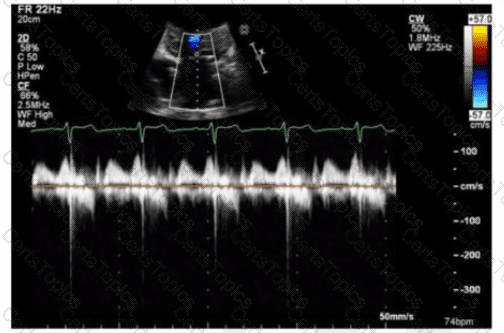
Options:

A.

Pulsed wave at various levels of the left ventricle to localize intracavitary gradient.

B.

Pulsed wave at the level of the mitral valve leaflet tips to assess for mitral stenosis

C.

Continuous wave through the left ventricle to localize intracavitary gradient

D.

Continuous wave through the mitral valve to assess for mitral stenosis

Question 14

The sonographer obtains this Doppler signal while using the non-imaging transducer in the apical position. What is the best way to differentiate between mitral regurgitation and aortic stenosis signals in the waveform shown in this image?
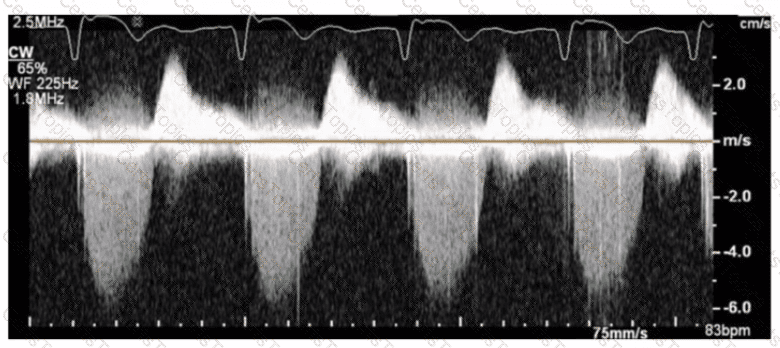
Options:

A.

Aortic stenosis velocities will always be higher

B.

Aortic stenosis waveforms will always be denser

C.

Mitral regurgitation only happens in diastole

D.

Mitral regurgitation signal will be longer

Question 15

Which finding is NOT associated with severe mitral valve regurgitation?

Options:

A.

Severely dilated left atrium

B.

Systolic flow reversal in the pulmonary vein

C.

Mitral regurgitant jet velocity less than 0.5 cm/sec

D.

Eccentrically directed mitral regurgitant jet

Question 16

What is a normal response to dobutamine stress testing?

Options:

A.

An increase in left ventricular cavity size and an increase in systolic blood pressure

B.

An increase in left ventricular cavity size and a decrease in systolic blood pressure

C.

A decrease in left ventricular cavity size and a decrease in systolic blood pressure

D.

A decrease in left ventricular cavity size and an increase in systolic blood pressure

Question 17

What is the incidental finding seen by color Doppler in this four-chamber view of a patient with left atrial enlargement?

Options:

A.

Muscular ventricular septal defect

B.

Coronary-cameral fistula

C.

Patent foramen ovale

D.

Sinus venosus defect

Question 18

What potential source of error is the greatest when calculating the aortic valve area by the continuity equation?

Options:

A.

Aortic valve planimetry in parasternal short axis

B.

Left ventricular outflow tract velocity recorded with pulsed Doppler

C.

Left ventricular outflow tract diameter

D.

Aortic jet velocity by continuous wave Doppler

Question 19

Which of the following is the most likely cause for the findings demonstrated in this video?
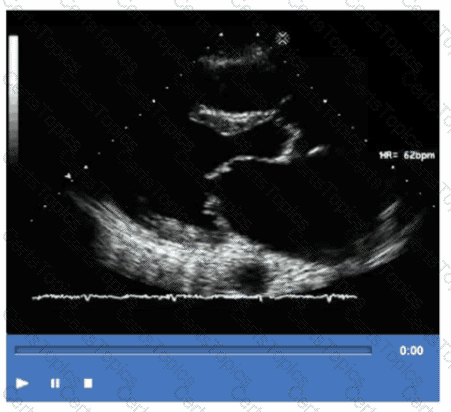
Options:

A.

Infective endocarditis

B.

Rheumatic fever

C.

Drug-induced valvulopathy

D.

Systemic lupus

Question 20

Which of the following conditions will increase in seventy with Valsalva maneuver?

Options:

A.

Aortic valve stenosis

B.

Aortic valve regurgitation

C.

Mitral valve regurgitation

D.

Hypertrophic obstructive cardiomyopathy

Question 21

Identify the right pulmonary artery.

Using your mouse, place the cursor on the appropriate region of the image and then left click the mouse button to indicate your selection.
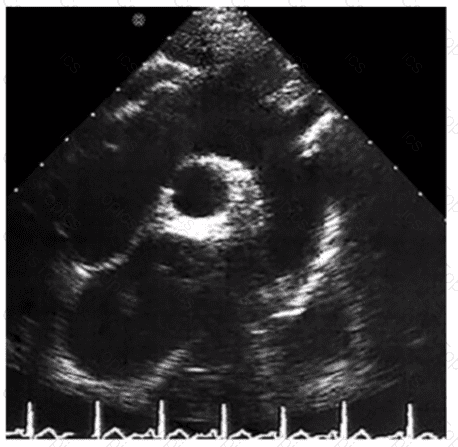
Which mitral regurgitation jet direction is most consistent with hypertrophic obstructive cardiomyopathy?

Options:

A.

Anterior

B.

Posterior

C.

Central

D.

Medial

Question 22

Which hepatic vein flow pattern signals severe tricuspid regurgitation?

Options:

A.

Flow reversal in systole

B.

Flow reversal in diastole

C.

Atrial flow reversal in systole

D.

Biphasic flow reversal in diastole

Question 23

Which view is most appropriate for measuring right ventricular dimensions?

Options:

A.

Subcostal four-chamber

B.

Parasternal short axis at the base

C.

Apical lateral right ventricular-focused

D.

Parasternal long axis

Question 24

Which syndrome is associated with pulmonic stenosis?

Options:

A.

Turner

B.

Eisenmenger

C.

Noonan

D.

Marfan

Question 25

The variables necessary to calculate mitral regurgitant (MR) effective orifice area by the proximal isovelocity surface area (PISA) equation include MR aliasing hemispheric radius, the aliasing velocity, and which other parameter?

Options:

A.

Mitral annular diameter

B.

Time velocity integral of pulsed wave at mitral annulus

C.

Maximum mitral regurgitant velocity

D.

Left ventricular outflow tract diameter

Question 26

What is the normal dP/dt value of left ventricular systolic function?

Options:

A.

400-799 mmHg/s

B.

800-1199 mmHg/s

C.

Less than 400 mmHg/s

D.

Greater than 1200 mmHg/s

Question 27

Which of the following is a feature of constrictive pericarditis?

Options:

A.

Mitral inflow pattern has a large E-wave and a small A-wave without respiratory changes

B.

Normal hepatic vein size

C.

Dilated inferior vena cava with inspiratory collapse during sniff test

D.

Interventricular septal bounce

Question 28

Which flow abnormality produces a continuous murmur?

Options:

A.

Aortic regurgitation

B.

Mitral stenosis

C.

Muscular ventricular septal defect

D.

Ruptured sinus of Valsalva aneurysm

Question 29

Which condition is most likely demonstrated by this M-mode image?

Options:

A.

Dilated cardiomyopathy

B.

Hypertrophic cardiomyopathy

C.

Mitral valve prolapse

D.

Mitral stenosis

Question 30

A patient with a ventricular septal defect, an atrial septal defect, and a cleft mitral valve is likely to have which abnormality?

Options:

A.

Atrioventricular canal defect

B.

Ebstein anomaly

C.

Marfan syndrome

D.

Shone syndrome

Question 31

Which color Doppler adjustment would optimize visualization of flow across the interatrial septum?

Options:

A.

Decreased color gain

B.

Decreased color scale

C.

Increased color sector size

D.

Increased wall filter

Question 32

Which view is best used to evaluate a bicuspid aortic valve?

Options:

A.

Right sternal border

B.

Apical five-chamber

C.

Apical long axis

D.

Parasternal short axis

Question 33

Which echocardiography assessment requires mitral inflow pulsed wave, pulmonary venous pulsed wave, and tissue Doppler of the mitral annulus?

Options:

A.

Left ventricular diastolic function

B.

Left ventricular systolic function

C.

Myocardial performance index

D.

Mitral regurgitation severity

Question 34

The 'P' wave of an electrocardiogram relates to which echocardiography event?

Options:

A.

Atrial contraction

B.

Ventricular contraction

C.

Atrial relaxation

D.

Ventricular diastole

Question 35

Which of the following can be calculated from the peak tricuspid regurgitant velocity?

Options:

A.

Right atrial pressure

B.

Pulmonary artery diastolic pressure

C.

Mean pulmonary artery pressure

D.

Right ventricular systolic pressure

Question 36

Which critical finding is most likely to require immediate surgical intervention?

Options:

A.

True aneurysm

B.

Pseudoaneurysm

C.

Severe aortic stenosis

D.

Severe mitral stenosis

Question 37

Which valvular pathology is illustrated in this left heart pressure tracing?
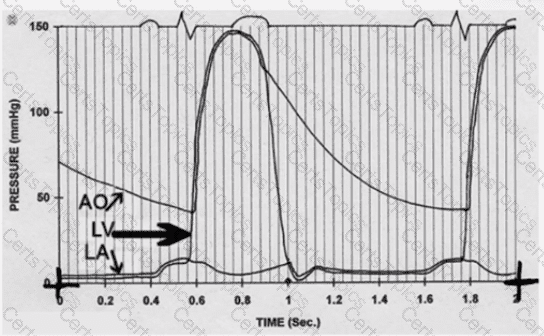
Options:

A.

Mitral stenosis

B.

Aortic stenosis

C.

Mitral regurgitation

D.

Aortic regurgitation

Question 38

An intravenous drug user presents with a fever of unknown origin, flu-like symptoms, dyspnea, and chest pain. Which ultrasound finding is mostly likely associated with this presentation?

Options:

A.

Aortic dissection

B.

Hypertrophic cardiomyopathy

C.

Mitral valve prolapse

D.

Endocarditis

Question 39

Which condition is commonly associated with cardiac tamponade?

Options:

A.

Decreased jugular venous pressure

B.

Bradycardia

C.

Hypertension

D.

Hypotension

Question 40

Which diagnosis is most consistent with the findings in these images?
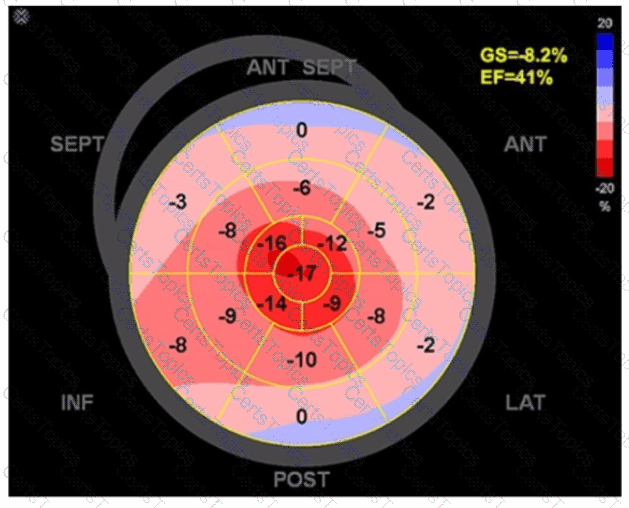
Options:

A.

Takotsubo cardiomyopathy

B.

Apical hypertrophic cardiomyopathy

C.

Hypertrophic obstructive cardiomyopathy

D.

Restrictive cardiomyopathy from amyloidosis

Question 41

Which condition is most plausible based on the finding indicated by the arrow on this image?
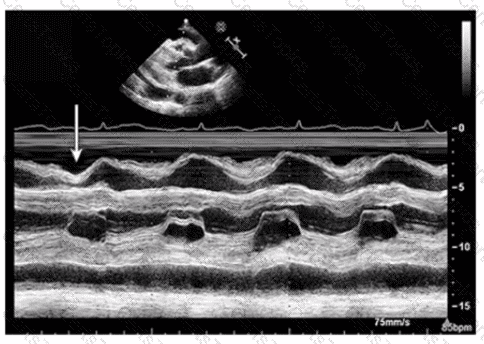
Options:

A.

Cardiac tamponade

B.

Constrictive pericarditis

C.

Pulmonary embolism

D.

Pulmonary hypertension